

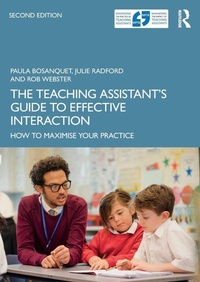
The Teaching Assistant's Guide to Effective Interaction
How to Maximise Your Practice
2nd Edition
Published on 31. May 2021
Book
Paperback/Softback
132 pages
978-0-367-89703-1 (ISBN)
Description
This second edition of The Teaching Assistant's Guide to Effective Interaction is the definitive guide to teaching assistant-pupil interaction, fully updated with examples from schools that have implemented techniques from the first edition. An invaluable professional development tool for classroom support staff and the teachers who work with them, this new edition answers the need for specific, practical guidance on the role of the teaching assistant.
This practical and accessible guide sets out a role for teaching assistants that focuses on developing pupils' independence and ownership of learning, with key learning points now summarised in each chapter. Based on a classroom-tested framework and covering the main contexts in which teaching assistants work, it includes a range of strategies and reflective activities to help improve the support provided to pupils in everyday settings. This book sets out successful strategies for:
Responding to additional needs
Understanding the principles behind effective classroom talk
Carefully scaffolding pupils' learning
Delivering intervention programmes
The Teaching Assistant's Guide to Effective Interaction is an essential read for all teaching assistants and will also be of interest to school leaders, SENCOs and teachers in both primary and secondary schools who wish to improve their deployment of teaching assistants and their own interactions with pupils.
Used in combination with Maximising the Impact of Teaching Assistants in Primary Schools, The Teaching Assistant's Guide to Effective Interaction is a comprehensive and unrivalled resource for supporting school workforce improvement.
This practical and accessible guide sets out a role for teaching assistants that focuses on developing pupils' independence and ownership of learning, with key learning points now summarised in each chapter. Based on a classroom-tested framework and covering the main contexts in which teaching assistants work, it includes a range of strategies and reflective activities to help improve the support provided to pupils in everyday settings. This book sets out successful strategies for:
Responding to additional needs
Understanding the principles behind effective classroom talk
Carefully scaffolding pupils' learning
Delivering intervention programmes
The Teaching Assistant's Guide to Effective Interaction is an essential read for all teaching assistants and will also be of interest to school leaders, SENCOs and teachers in both primary and secondary schools who wish to improve their deployment of teaching assistants and their own interactions with pupils.
Used in combination with Maximising the Impact of Teaching Assistants in Primary Schools, The Teaching Assistant's Guide to Effective Interaction is a comprehensive and unrivalled resource for supporting school workforce improvement.
Reviews / Votes
"An impressive and important book ... I urge colleagues to read and treasure this as a means of building a rich resource of pedagogical support within the classroom. If you have support staff on your team, this book is an essential read." - Professor Dame Alison Peacock, Chief Executive, Chartered College of Teaching"An essential read for all educators but especially Teaching Assistants. Packed with theory, practical strategies and reflective activities. This research informed guide should frame and guide professional development for supporting and educating all children, everywhere." - Aimee Durning, The University of Cambridge Primary School
"A really practical guide to help teaching assistants improve their practice ... a must read for headteachers, teachers and teaching assistants." - Sue Cowley, author and teacher trainer
"An awe inspiring must read if you play any role in a child's educational journey." - Tracy Alcon, Teaching Assistant, Baynards Primary School, Essex
"This accessible, interesting and well-informed book offers teaching assistants the opportunity to understand, review and plan their interactions with students, so they can offer them the best help with their learning." - Neil Mercer, Professor of Education, University of Cambridge
"This evidence-based book is a constant point of reference for TAs and teachers. The scaffolding framework is a game-changer; how TA-pupil interactions, often so intuitive, impact on independence and learning. Embedded in Lincolnshire schools, this practice is now simply 'what we do'." - Vanessa Hopkinson, Mobilise TA Project Lead, KYRA Teaching School, Lincolnshire
"This easy-to-read book combines practical everyday examples with clear explanations of current research. It has implications for how TAs can support children to become more independent." - Heather Lacey, Headteacher and Local Leader of Education, Shirley Manor Primary Academy, Bradford
More details
Edition
2nd edition
Language
English
Place of publication
London
United Kingdom
Publishing group
Taylor & Francis Ltd
Target group
College/higher education
Professional and scholarly
Academic, Further/Vocational Education, Professional, and Professional Practice & Development
Illustrations
8 s/w Zeichnungen, 14 s/w Tabellen, 8 s/w Abbildungen
14 Tables, black and white; 8 Line drawings, black and white; 8 Illustrations, black and white
Dimensions
Height: 246 mm
Width: 174 mm
Thickness: 8 mm
Weight
264 gr
ISBN-13
978-0-367-89703-1 (9780367897031)
Copyright in bibliographic data and cover images is held by Nielsen Book Services Limited or by the publishers or by their respective licensors: all rights reserved.
Schweitzer Classification
Other editions
New editions

Paula Bosanquet | Julie Radford | Rob Webster
The Teaching Assistant's Guide to Effective Interaction
How to Maximise Your Practice
Book
approx. 07/2026
3rd Edition
Routledge
€37.50
Not yet published
Additional editions
Paula Bosanquet | Julie Radford | Rob Webster
The Teaching Assistant's Guide to Effective Interaction
How to Maximise Your Practice
Book
05/2021
2nd Edition
Routledge
€205.70
Shipment within 15-20 days
Paula Bosanquet | Julie Radford | Rob Webster
The Teaching Assistant's Guide to Effective Interaction
How to Maximise Your Practice
E-Book
05/2021
2nd Edition
Routledge
€44.99
Available for download
Paula Bosanquet | Julie Radford | Rob Webster
The Teaching Assistant's Guide to Effective Interaction
How to Maximise Your Practice
E-Book
05/2021
2nd Edition
Routledge
€44.99
Available for download
Previous edition
Paula Bosanquet | Julie Radford | Rob Webster
The Teaching Assistant's Guide to Effective Interaction
How to maximise your practice
Book
09/2015
1st Edition
Routledge
€60.91
Withdrawn from sale
Persons
Paula Bosanquet is a Senior Teaching Fellow in Special Educational Needs at UCL Institute of Education, London. A former primary teacher, she has worked extensively as a trainer with teaching assistants, schools and local authorities.
Julie Radford is an Associate Professor at UCL Institute of Education, London. She researches classroom interactions involving children with special educational needs and disabilities. Julie has authored 30 academic publications and has supervised several doctoral students on this topic.
Rob Webster is an Associate Professor at UCL Institute of Education, London. He researches and writes about special educational needs and inclusion, and he developed the Maximising the Impact of Teaching Assistants programme.
Julie Radford is an Associate Professor at UCL Institute of Education, London. She researches classroom interactions involving children with special educational needs and disabilities. Julie has authored 30 academic publications and has supervised several doctoral students on this topic.
Rob Webster is an Associate Professor at UCL Institute of Education, London. He researches and writes about special educational needs and inclusion, and he developed the Maximising the Impact of Teaching Assistants programme.
Content
1. The teaching assistant as scaffolder 2. The value of planning the right task and pupils taking an active role in interactions 3. The principles of scaffolding 4. Scaffolding strategies 5. Assessment for learning: Providing feedback for teachers and pupils 6. Promoting effective group working 7. Delivering intervention programmes