

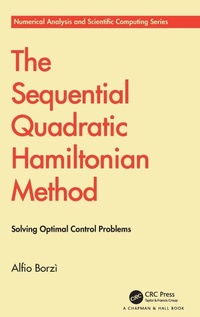
The Sequential Quadratic Hamiltonian Method
Solving Optimal Control Problems
1st Edition
Published on 26. May 2023
Book
Hardback
250 pages
978-0-367-71552-6 (ISBN)
Description
The sequential quadratic hamiltonian (SQH) method is a novel numerical optimization procedure for solving optimal control problems governed by differential models. It is based on the characterisation of optimal controls in the framework of the Pontryagin maximum principle (PMP).
The SQH method is a powerful computational methodology that is capable of development in many directions. The Sequential Quadratic Hamiltonian Method: Solving Optimal Control Problems discusses its analysis and use in solving nonsmooth ODE control problems, relaxed ODE control problems, stochastic control problems, mixed-integer control problems, PDE control problems, inverse PDE problems, differential Nash game problems, and problems related to residual neural networks.
This book may serve as a textbook for undergraduate and graduate students, and as an introduction for researchers in sciences and engineering who intend to further develop the SQH method or wish to use it as a numerical tool for solving challenging optimal control problems and for investigating the Pontryagin maximum principle on new optimisation problems.
Features
Provides insight into mathematical and computational issues concerning optimal control problems, while discussing many differential models of interest in different disciplines.
Suitable for undergraduate and graduate students and as an introduction for researchers in sciences and engineering.
Accompanied by codes which allow the reader to apply the SQH method to solve many different optimal control and optimisation problems.
The SQH method is a powerful computational methodology that is capable of development in many directions. The Sequential Quadratic Hamiltonian Method: Solving Optimal Control Problems discusses its analysis and use in solving nonsmooth ODE control problems, relaxed ODE control problems, stochastic control problems, mixed-integer control problems, PDE control problems, inverse PDE problems, differential Nash game problems, and problems related to residual neural networks.
This book may serve as a textbook for undergraduate and graduate students, and as an introduction for researchers in sciences and engineering who intend to further develop the SQH method or wish to use it as a numerical tool for solving challenging optimal control problems and for investigating the Pontryagin maximum principle on new optimisation problems.
Features
Provides insight into mathematical and computational issues concerning optimal control problems, while discussing many differential models of interest in different disciplines.
Suitable for undergraduate and graduate students and as an introduction for researchers in sciences and engineering.
Accompanied by codes which allow the reader to apply the SQH method to solve many different optimal control and optimisation problems.
More details
Series
Language
English
Place of publication
United Kingdom
Publishing group
Taylor & Francis Ltd
Target group
College/higher education
Postgraduate
Illustrations
61 s/w Abbildungen, 61 s/w Zeichnungen, 3 s/w Tabellen
3 Tables, black and white; 61 Line drawings, black and white; 61 Illustrations, black and white
Dimensions
Height: 240 mm
Width: 161 mm
Thickness: 19 mm
Weight
570 gr
ISBN-13
978-0-367-71552-6 (9780367715526)
Copyright in bibliographic data and cover images is held by Nielsen Book Services Limited or by the publishers or by their respective licensors: all rights reserved.
Schweitzer Classification
Other editions
Additional editions
E-Book
05/2023
1st Edition
Chapman & Hall/CRC
€231.99
Available for download
E-Book
05/2023
1st Edition
Chapman & Hall/CRC
€231.99
Available for download
Person
Alfio Borzi, born 1965 in Catania (Italy), is Professor and Chair of Scientific Computing at the Institute for Mathematics of the University of Wuerzburg, Germany. He studied Mathematics and Physics in Catania and Trieste where he received his PhD in Mathematics from Scuola Internazionale Superiore di Studi Avanzati (SISSA).
He served as Research Officer at the University of Oxford (UK) and as Assistant Professor at the University of Graz (Austria) where he completed his Habilitation and was appointed as Associate Professor. Since 2011 he has been Professor of Scientific Computing at the University of Wuerzburg.
Alfio Borzi is author of 4 mathematics books and numerous articles in scientific journals. The main topics of his research and teaching activities are modelling and numerical analysis, optimal control, optimisation, and scientific computing. He is member of the editorial board for SIAM Review.
He served as Research Officer at the University of Oxford (UK) and as Assistant Professor at the University of Graz (Austria) where he completed his Habilitation and was appointed as Associate Professor. Since 2011 he has been Professor of Scientific Computing at the University of Wuerzburg.
Alfio Borzi is author of 4 mathematics books and numerous articles in scientific journals. The main topics of his research and teaching activities are modelling and numerical analysis, optimal control, optimisation, and scientific computing. He is member of the editorial board for SIAM Review.
Content
1. Optimal control problems with ODEs. 1.1. Formulation of ODE optimal control problems. 1.2. The controlled ODE model. 1.3. Existence of optimal controls. 1.4. Optimality conditions. 1.5. The Pontryagin maximum principle. 1.6. The PMP and path constraints. 1.7. Sufficient conditions for optimality. 1.8. Analytical solutions via PMP. 2. The sequential quadratic hamiltonian method. 2.1. Successive approximations schemes. 2.2. The sequential quadratic hamiltonian method. 2.3. Mixed control and state constraints. 2.4. Time-optimal control problems. 2.5. Analysis of the SQH method. 3. Optimal relaxed controls. 3.1. Young measures and optimal relaxed controls. 3.2. The sequential quadratic hamiltonian method. 3.3. The SQH minimising property. 3.4. An application with two relaxed controls. 4. Differential Nash games. 4.1. Introduction. 4.2. PMP characterization of Nash games. 4.3. The SQH method for solving Nash games. 4.4. Numerical experiments. 5. Deep learning in residual neural networks. 5.1. Introduction. 5.2. Supervised learning and optimal control. 5.3. The discrete maximum principle. 5.4. The sequential quadratic hamiltonian method. 5.5. Wellposedness and convergence results. 5.6. Numerical experiments. 6. Control of stochastic models. 6.1. Introduction. 6.2. Formulation of ensemble optimal control problems. 6.3. The PMP characterisation of optimal controls. 6.4. The Hamilton-Jacobi-Bellman equation. 6.5. Two SQH methods. 6.6. Numerical experiments. 7. PDE optimal control problems 7.1 Introduction. 7.2. Elliptic optimal control problems. 7.3. The sequential quadratic hamiltonian method. 7.4. Linear elliptic optimal control problems. 7.5. A problem with discontinuous control costs. 7.6. Bilinear elliptic optimal control problems. 7.7. Nonlinear elliptic optimal control problems. 7.8. A problem with state constraints. 7.9. A non-smooth problem with L1 tracking term. 7.10. Parabolic optimal control problems. 7.11. Hyperbolic optimal control problems. 8. Identification of a diffusion coefficient. 8.1. Introduction. 8.2. An inverse diffusion coefficient problem. 8.3. The SQH method. 8.4. Finite element approximation. 8.5. Numerical experiments. A. Results of analysis.