

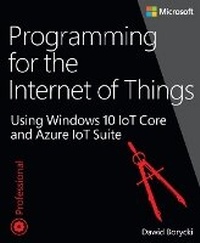
Programming for the Internet of Things
Using Windows 10 IoT Core and Azure IoT Suite
Published on 5. June 2017
Book
Paperback/Softback
624 pages
978-1-5093-0206-2 (ISBN)
Description
Rapidly implement Internet of Things solutions
Creating programs for the Internet of Things offers you an opportunity to build and program custom devices whose functionality is limited only by your imagination. This book teaches you to do exactly that, with solutions presented in a step-by-step format. When you read this book, you not only learn the fundamentals of device programming, you will also be ready to write code for revolutionizing devices and robots.
You don't need to be an expert in low-level programming to benefit from this book. It explains basic concepts and programming techniques before diving into the more complicated topics. Each of the book's chapters and appendices contains a suitable level of detail to help you quickly master device programming.
MCP Dawid Borycki shows you how to:
Build Universal Windows Platform (UWP) applications that target interconnected embedded devices
Design and implement background apps for seamless integration with hardware components
Use intrinsic UWP functionality to detect and track human faces
Build artificial auditory, visual, and learning systems
Process audio signals to blink LEDs to the rhythm of music
Use OpenCV to develop custom image-processing algorithms
Communicate with external devices by using serial, USB, Wi-Fi, and AllJoyn connectivity
Design and implement applications to control DC, stepper, and servo motors for robotics
Use Microsoft Cognitive Services to detect human emotions
Build predictive analysis and preventive maintenance systems by using the Azure IoT Suite
Creating programs for the Internet of Things offers you an opportunity to build and program custom devices whose functionality is limited only by your imagination. This book teaches you to do exactly that, with solutions presented in a step-by-step format. When you read this book, you not only learn the fundamentals of device programming, you will also be ready to write code for revolutionizing devices and robots.
You don't need to be an expert in low-level programming to benefit from this book. It explains basic concepts and programming techniques before diving into the more complicated topics. Each of the book's chapters and appendices contains a suitable level of detail to help you quickly master device programming.
MCP Dawid Borycki shows you how to:
Build Universal Windows Platform (UWP) applications that target interconnected embedded devices
Design and implement background apps for seamless integration with hardware components
Use intrinsic UWP functionality to detect and track human faces
Build artificial auditory, visual, and learning systems
Process audio signals to blink LEDs to the rhythm of music
Use OpenCV to develop custom image-processing algorithms
Communicate with external devices by using serial, USB, Wi-Fi, and AllJoyn connectivity
Design and implement applications to control DC, stepper, and servo motors for robotics
Use Microsoft Cognitive Services to detect human emotions
Build predictive analysis and preventive maintenance systems by using the Azure IoT Suite
More details
Other editions
Additional editions
E-Book
05/2017
1st Edition
Microsoft Press
€71.39
Available for download
E-Book
05/2017
1st Edition
Microsoft Press
€37.19
Available for download
Person
Dawid Borycki is a software engineer and biomedical researcher who is experienced in Microsoft technologies. He has completed a broad range of challenging projects involving the development of software for device prototypes (mostly medical equipment), embedded device interfacing, and desktop and mobile programming.
Content
PART I ESSENTIALS
Chapter 1 Embedded devices programming
Chapter 2 Universal Windows Platform on devices
Chapter 3 Windows IoT programming essentials
Chapter 4 User interface design for headed devices
PART II DEVICE PROGRAMMING
Chapter 5 Reading data from sensors
Chapter 6 Input and output
Chapter 7 Audio processing
Chapter 8 Image processing
Chapter 9 Connecting devices
Chapter 10 Motors
Chapter 11 Device learning
PART III AZURE IOT SUITE
Chapter 12 Remote device monitoring
Chapter 13 Predictive maintenance
Chapter 14 Custom solution
Appendix A Code examples for controlling LED using Visual Basic and JavaScript
Appendix B Raspberry Pi 2 HDMI modes
Appendix C Bits, bytes, and data types
Appendix D Class library for Sense HAT sensors
Appendix E Visual C++ component extensions
Appendix F Setting up Visual Studio 2017 for IoT development
Chapter 1 Embedded devices programming
Chapter 2 Universal Windows Platform on devices
Chapter 3 Windows IoT programming essentials
Chapter 4 User interface design for headed devices
PART II DEVICE PROGRAMMING
Chapter 5 Reading data from sensors
Chapter 6 Input and output
Chapter 7 Audio processing
Chapter 8 Image processing
Chapter 9 Connecting devices
Chapter 10 Motors
Chapter 11 Device learning
PART III AZURE IOT SUITE
Chapter 12 Remote device monitoring
Chapter 13 Predictive maintenance
Chapter 14 Custom solution
Appendix A Code examples for controlling LED using Visual Basic and JavaScript
Appendix B Raspberry Pi 2 HDMI modes
Appendix C Bits, bytes, and data types
Appendix D Class library for Sense HAT sensors
Appendix E Visual C++ component extensions
Appendix F Setting up Visual Studio 2017 for IoT development