

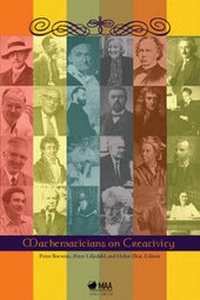
Mathematicians on Creativity
Published on 1. October 2015
Book
Paperback/Softback
215 pages
978-0-88385-574-4 (ISBN)
Description
In their own words, many of the world's foremost mathematicians discuss the art and practice of their work in this book, which shines a light on some of the issues of mathematical creativity. It is neither a philosophical treatise nor the presentation of experimental results, but a compilation of re?ections from top-calibre working mathematicians. This approach highlights the creative aspects of the ?eld, illustrates the dramatic variation by individual, and hopes to express the vibrancy of creative minds at work. Organised alphabetically, this book is meant for a general audience and is best read by browsing. It can be used as a supplementary text in mathematics history and mathematics education courses.
Reviews / Votes
This interesting work is an alphabetic compilation of quotes excerpted from the writings of numerous mathematicians on mathematical creativity (going back many centuries) plus the responses of many contemporary mathematicians to seven questions regarding the creative process. The genesis of this project was a survey done by Jacques Hadamard around 70 years ago. Borwein and Liljedahl (both, Simon Fraser Univ., Canada) and Zhai (bachelor's degree, Simon Fraser) asked five questions (or combinations of questions) from the original survey and two additional ones. Only the most prominent mathematicians were asked to participate. Many are winners of Fields Medals, Wolf Prizes, and other prestigious awards. While not all those surveyed responded to the questions asked, the responses were all relevant. This book is another treasure from the MAA Spectrum series and is sure to be a source of inspiration to student and teacher alike. Those who want to go to the source of motivation for this book might read Jacques Hadamard's The Mathematician's Mind: The Psychology of Invention in the Mathematical Field (1996)."" - R.L. Pour, CHOICE""This book is recommended for all those who wish to know the deeper thoughts of their colleagues."" - Ad Meskens, Mathematical Reviews Clippings
More details
Series
Language
English
Place of publication
Washington
United States
Product notice
Paperback (trade)
Dimensions
Height: 229 mm
Width: 151 mm
Thickness: 11 mm
Weight
300 gr
ISBN-13
978-0-88385-574-4 (9780883855744)
Copyright in bibliographic data and cover images is held by Nielsen Book Services Limited or by the publishers or by their respective licensors: all rights reserved.
Schweitzer Classification
Persons
Peter Borwein is the founding Project Leader and currently an Executive Co-Director of The IRMACS Centre. He is a Burnaby Mountain Chair at Simon Fraser University and has been a professor in the Mathematics Department since 1993 when he moved from Dalhousie University. He is also an Adjunct Professor in Computing Science. His research interests span various aspects of mathematics and computer science, health and criminology modelling and visualization. Peter Liljedahl is an Associate Professor of Mathematics Education in the Faculty of Education, an associate member in the Department of Mathematics, and co-director of the David Wheeler Institute for Research in Mathematics Education at Simon Fraser University in Vancouver, Canada. His research interests are creativity, insight, and discovery in mathematics teaching and learning; the role of the affective domain on the teaching and learning of mathematics; the professional growth of mathematics teachers; mathematical problem solving; and numeracy. Helen Zhai graduated with a BSc in Mathematics and BEd from Simon Fraser University. She has received undergraduate NSERC grants, one of which initiated her collaboration with Peter Borwein and Peter Liljedahl in their work on creativity in mathematics teaching and learning.
Content
Introduction; Chapter A; Chapter B; Chapter C; Chapter D; Chapter E; Chapter F; Chapter G; Chapter H, Chapter I; Chapter J; Chapter K; Chapter L; Chapter M; Chapter N; Chapter P; Chapter R; Chapter S; Chapter T; Chapter U; Chapter V; Chapter W; Appendix A. Hadamard's Survey; Appendix B. Biographies; Bibliography; Index.