

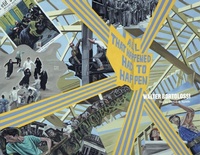
All That Happened Had to Happen
Will be published approx. on 30. March 2011
Book
Paperback/Softback
104 pages
978-0-8071-4236-3 (ISBN)
Description
In his first U.S. one-man exhibition, Italian painter Walter Bortolossi comes to one of our nations centers of European cultural influence for a show of his recent work and a series of lectures and workshops. Bortolossi, who has exhibited extensively and won numerous awards in Europe, combines a visionary seriousness of purpose with a lightness of touch that is fundamentally generous, pluralistic, inclusive, and relevant. Bortolossi is known for his kaleidoscopic compositions that critically and ironically dissect the sacred cows of post-industrial societies: mass media, information technology, scientific progress, addictive consumerism, omnipresent entertainment, and the struggles over economic power and globalization. In this catalog, Darius Spieth, Associate Professor of Art History at Louisiana State University and, in 2011, Mellon Visiting Associate Professor of History, California Institute of Technology, introduces Bortolossi's work to an English-speaking audience and conducts an interview with the artist. Spieth explores the coexistence of high and popular culture, as well the tension between the past and the present, that make themselves felt in every one of Bortolossi's canvases. Welcome to the world of Italo Post-Pop Art.
More details
Language
English
Place of publication
Baton Rouge
United States
Target group
Professional and scholarly
Product notice
Paperback (trade)
sewn/stitched
Dimensions
Height: 305 mm
Width: 236 mm
Thickness: 10 mm
Weight
703 gr
ISBN-13
978-0-8071-4236-3 (9780807142363)
Copyright in bibliographic data and cover images is held by Nielsen Book Services Limited or by the publishers or by their respective licensors: all rights reserved.
Schweitzer Classification
Persons
Darius A. Spieth is professor of art history at Louisiana State University. He translated and prefaced a bilingual edition of What Language to Say the Arts? French Rhetoric and German Aesthetics in the Eighteenth Century.