

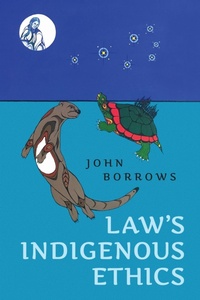
Law's Indigenous Ethics
Published on 9. April 2019
Book
Paperback/Softback
392 pages
978-1-4875-2355-8 (ISBN)
Description
Law's Indigenous Ethics examines the revitalization of Indigenous peoples' relationship to their own laws and, in so doing, attempts to enrich Canadian constitutional law more generally. Organized around the seven Anishinaabe grandmother and grandfather teachings of love, truth, bravery, humility, wisdom, honesty, and respect, this book explores ethics in relation to Aboriginal issues including title, treaties, legal education, and residential schools.
With characteristic depth and sensitivity, John Borrows brings insights drawn from philosophy, law, and political science to bear on some of the most pressing issues that arise in contemplating the interaction between Canadian state law and Indigenous legal traditions. In the course of a wide-ranging but accessible inquiry, he discusses such topics as Indigenous agency, self-determination, legal pluralism, and power. In its use of Anishinaabe stories and methodologies drawn from the emerging field of Indigenous studies, Law's Indigenous Ethics makes a significant contribution to scholarly debate and is an essential resource for readers seeking a deeper understanding of Indigenous rights, societies, and cultures.
With characteristic depth and sensitivity, John Borrows brings insights drawn from philosophy, law, and political science to bear on some of the most pressing issues that arise in contemplating the interaction between Canadian state law and Indigenous legal traditions. In the course of a wide-ranging but accessible inquiry, he discusses such topics as Indigenous agency, self-determination, legal pluralism, and power. In its use of Anishinaabe stories and methodologies drawn from the emerging field of Indigenous studies, Law's Indigenous Ethics makes a significant contribution to scholarly debate and is an essential resource for readers seeking a deeper understanding of Indigenous rights, societies, and cultures.
Reviews / Votes
"Many Canadians will agree that Indigenous law should be given more prominence within Canadian law. But the question remains: How do we implement this vision on the ground? The notion that Indigenous law should influence the development of non-Indigenous law is persuasive enough in theory, but what does it look like in practice? Law's Indigenous Ethics offers some answers."- Karen Drake (Canadian Journal of Native Studies) "Law's Indigenous Ethics follows the John Borrows' tradition of creative and insightful scholarship. It relies on Anishinaabe Grandmother and Grandfather teachings of love, truth, bravery, humility, wisdom, honesty, and respect as ethical relationships in Indigenous laws."
- Mary Hemmings, Thompson Rivers University (Canadian Law Library Review) "Borrows wants to deploy Indigenous law teachings to replace the political violence of state law with a network of trustworthy, consensual, reciprocal relations. He has assembled a remarkably wide set of materials to point the way." - Peter d'Errico, University of Massachusetts Amherst (American Indian Culture and Research Journal)
More details
Language
English
Place of publication
Toronto
Canada
Target group
College/higher education
Professional and scholarly
Product notice
Paperback (trade)
Dimensions
Height: 229 mm
Width: 152 mm
Thickness: 23 mm
Weight
544 gr
ISBN-13
978-1-4875-2355-8 (9781487523558)
Copyright in bibliographic data and cover images is held by Nielsen Book Services Limited or by the publishers or by their respective licensors: all rights reserved.
Schweitzer Classification
Person
John Borrows is a professor and the Loveland Chair in Indigenous Law in the Faculty of Law at the University of Toronto.
Content
Acknowledgements \
Introduction: Niizhwaaswi-Miigiwewinan (Seven Gifts): Nokomis' Constitution Nitam-Miigiwewin: Zaagidiwin (Gift 1: Love)
1. Love: Law & Land in Canada's Indigenous Constitution
Niizho-Miigiwewin: Debwewin (Gift 2: Truth)
2. Truth: Origin Stories, Metaphysics, and Law
Niso-Miigiwewin: Zoongide'iwin (Gift 3: Bravery)
3. Bravery: Challenging the Durability of Terra Nullius: Tsilhqot'in v. British Columbia
Niiyo-Miigiwewin: Dabaadendizowin (Gift 4: Humility)
4. Humility: Entanglement, Aboriginal Title and 'Private' Property
Naano-Miigiwewin: Nibwaakaawin (Gift 5: Wisdom)
5. Wisdom: Outsider Education and Indigenous Law
Ningodwaaso-Miigiwewin: Gwayakwaadiziwin (Gift 6: Honesty)
6. Honesty: Legal Education, and Heroes, Tricksters, Monsters and Caretakers
Niizhwaaso-Miigewewin: Manaaji'idiwin (Gift 7: Respect)
7. Respect: Residential Schools, Responsibilities for Past Harms
Conclusion
Nookomis' Re-Constitution
Endnotes
Introduction: Niizhwaaswi-Miigiwewinan (Seven Gifts): Nokomis' Constitution Nitam-Miigiwewin: Zaagidiwin (Gift 1: Love)
1. Love: Law & Land in Canada's Indigenous Constitution
Niizho-Miigiwewin: Debwewin (Gift 2: Truth)
2. Truth: Origin Stories, Metaphysics, and Law
Niso-Miigiwewin: Zoongide'iwin (Gift 3: Bravery)
3. Bravery: Challenging the Durability of Terra Nullius: Tsilhqot'in v. British Columbia
Niiyo-Miigiwewin: Dabaadendizowin (Gift 4: Humility)
4. Humility: Entanglement, Aboriginal Title and 'Private' Property
Naano-Miigiwewin: Nibwaakaawin (Gift 5: Wisdom)
5. Wisdom: Outsider Education and Indigenous Law
Ningodwaaso-Miigiwewin: Gwayakwaadiziwin (Gift 6: Honesty)
6. Honesty: Legal Education, and Heroes, Tricksters, Monsters and Caretakers
Niizhwaaso-Miigewewin: Manaaji'idiwin (Gift 7: Respect)
7. Respect: Residential Schools, Responsibilities for Past Harms
Conclusion
Nookomis' Re-Constitution
Endnotes