

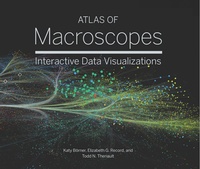
Atlas of Macroscopes
Interactive Data Visualizations
Published on 14. October 2025
Book
Hardback
184 pages
978-0-262-04992-4 (ISBN)
Description
A fascinating data adventure through the lens of macroscopes, which offer us illuminating and holistic views of our ever-changing world. In Atlas of Macroscopes, Katy Borner, Elizabeth Record, and Todd Theriault take you on an epic data adventure. You will explore data landscapes, designed as uniquely interactive spaces, and learn more about our world and your place in it. You will gain new perspectives on how to gather, understand, and communicate data, as well as how to best use it. You will discover what it means to 'touch' data that informs and inspires. Transcending the static nature of the maps featured in the initial trilogy, this fourth Atlas showcases 40 real-life macroscopes, or interactive data visualizations, that were displayed in the first decade (2015 2024) of the traveling exhibit Places & Spaces: Mapping Science. Encompassing vast amounts of data, macroscopes give us holistic views of complex systems or networks. They provide an entry point for scientists and laypeople alike, and empower us to engage directly with large datasets and to conduct our own lines of questioning. As interactive tools, macroscopes connect data creators and users. As portals to continuously evolving data, macroscopes can serve as windows to the dynamics of any terrain personal or professional, local or global and offer key insights into our surroundings and even our place in the universe. While big data is creating new ways to view and understand information, macroscopes help us see the big picture as we seek to better navigate our ever-changing world.
Reviews / Votes
"The book is a colorful, image-rich guide...A recommended purchase for all libraries, this book will be most appealing for users with a strong interest in data visualization."-Booklist
More details
Language
English
Place of publication
Cambridge (Massachusetts)
United States
Publishing group
MIT Press Ltd
Product notice
sewn/stitched
Cloth over boards
Illustrations
210 COLOR ILLUS.
Dimensions
Height: 332 mm
Width: 282 mm
Thickness: 29 mm
Weight
1824 gr
ISBN-13
978-0-262-04992-4 (9780262049924)
Copyright in bibliographic data and cover images is held by Nielsen Book Services Limited or by the publishers or by their respective licensors: all rights reserved.
Schweitzer Classification
Persons
Katy Borner is Victor H. Yngve Distinguished Professor of Engineering and Information Science in the Departments of Intelligent Systems Engineering and Information Science at the Luddy School of Informatics, Computing, and Engineering at Indiana University Bloomington, where she is also the founding director of the Cyberinfrastructure for Network Science Center. She is the author of Atlas of Science and Atlas of Knowledge (both MIT Press) and a co-curator of the Places & Spaces: Mapping Science (scimaps.org) exhibit. Elizabeth G. Record is Associate Director of the Cyberinfrastructure for Network Science Center at Indiana University Bloomington. She is a co-curator of the Places & Spaces: Mapping Science data visualization exhibit, which is an outreach activity of the Cyberinfrastructure for Network Science Center. Todd Theriault is a co-curator of the Places & Spaces: Mapping Science exhibit. He is deeply engaged in the outreach and pedagogical efforts of the exhibit s institutional home, the Cyberinfrastructure for Network Science Center in the Luddy School at Indiana University Bloomington.
Content
Part 1: The Power of Macroscopes
Who Needs What Insights?
What Datasets Exist Where?
What Visualization Tools Work?
How to Make a Macroscope?
How to Tell Stories with Data?
Part 2: Macroscopes in Action
Overview
11th Iteration (2015): Macroscopes for Interacting with Science
12th Iteration (2016): Macroscopes for Making Sense of Science
13th Iteration (2017): Macroscopes for Playing with Scale
14th Iteration (2018): Macroscopes for Ensuring Our Well-Being
15th Iteration (2019): Macroscopes for Tracking the Flow of Resources
16th Iteration (2020): Macroscopes for Harnessing the Power of Data
17th Iteration (2021): Macroscopes for Placing Data in Space
18th Iteration (2022): Macroscopes for Gaining a New Perspective
19th Iteration (2023): Macroscopes for Confronting Big Problems
20th Iteration (2024): Macroscopes for Seeing the Future
Part 3: Challenges and Opportunities
Increasing Global Data Visualization Literacy
Tangible Data
Inspiring Stories
Future Macroscopes
Who Needs What Insights?
What Datasets Exist Where?
What Visualization Tools Work?
How to Make a Macroscope?
How to Tell Stories with Data?
Part 2: Macroscopes in Action
Overview
11th Iteration (2015): Macroscopes for Interacting with Science
12th Iteration (2016): Macroscopes for Making Sense of Science
13th Iteration (2017): Macroscopes for Playing with Scale
14th Iteration (2018): Macroscopes for Ensuring Our Well-Being
15th Iteration (2019): Macroscopes for Tracking the Flow of Resources
16th Iteration (2020): Macroscopes for Harnessing the Power of Data
17th Iteration (2021): Macroscopes for Placing Data in Space
18th Iteration (2022): Macroscopes for Gaining a New Perspective
19th Iteration (2023): Macroscopes for Confronting Big Problems
20th Iteration (2024): Macroscopes for Seeing the Future
Part 3: Challenges and Opportunities
Increasing Global Data Visualization Literacy
Tangible Data
Inspiring Stories
Future Macroscopes