

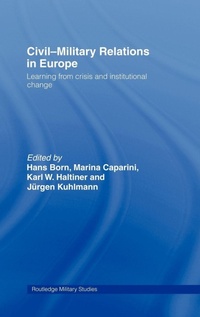
Civil-Military Relations in Europe
Learning from Crisis and Institutional Change
1st Edition
Published on 9. February 2006
Book
Hardback
300 pages
978-0-415-38540-4 (ISBN)
Description
This new book illustrates how democracy cannot develop or endure unless military and security forces are under the full control of democratic institutions, and all the necessary safeguards, checks and balances are in place.
The contributors show how contemporary European states manage the following issue: how does a society, primarily through its legitimate, democratically elected political leaders and their appointed officials, control the military, that same state institution that has been established for its protection and wields the monopoly of legitimate force?
Twenty-eight case studies are selected from key countries: the Czech Republic, Germany, Georgia, France, Hungary, Ireland, Israel, Macedonia, Poland, Romania, Slovenia, Serbia and Montenegro, Switzerland, and the Ukraine. The key subjects of these cases vary from corruption to military incompetence, disobedience towards civilian superiors, to unauthorized strikes and accidents. The focus is on the relationship between political, civilian and military actors while identifying problems and dangers that can emerge in those relations to the detriment of effective and legitimate democratic control.
This is essential reading for students of civil-military relations, democratization, European politics and security studies in general.
The contributors show how contemporary European states manage the following issue: how does a society, primarily through its legitimate, democratically elected political leaders and their appointed officials, control the military, that same state institution that has been established for its protection and wields the monopoly of legitimate force?
Twenty-eight case studies are selected from key countries: the Czech Republic, Germany, Georgia, France, Hungary, Ireland, Israel, Macedonia, Poland, Romania, Slovenia, Serbia and Montenegro, Switzerland, and the Ukraine. The key subjects of these cases vary from corruption to military incompetence, disobedience towards civilian superiors, to unauthorized strikes and accidents. The focus is on the relationship between political, civilian and military actors while identifying problems and dangers that can emerge in those relations to the detriment of effective and legitimate democratic control.
This is essential reading for students of civil-military relations, democratization, European politics and security studies in general.
Reviews / Votes
'This book stands out for the breadth of the countries studied and should be read by all students of security sector reform.'Thomas Jackson, Journal of Peace ResearchMore details
Series
Language
English
Place of publication
London
United Kingdom
Publishing group
Taylor & Francis Ltd
Target group
College/higher education
Illustrations
2 s/w Abbildungen, 6 s/w Tabellen
6 Tables, black and white; 2 Illustrations, black and white
Dimensions
Height: 240 mm
Width: 161 mm
Thickness: 21 mm
Weight
617 gr
ISBN-13
978-0-415-38540-4 (9780415385404)
Copyright in bibliographic data and cover images is held by Nielsen Book Services Limited or by the publishers or by their respective licensors: all rights reserved.
Schweitzer Classification
Other editions
Additional editions
Hans Born | Marina Caparini | Karl Haltiner
Civil-Military Relations in Europe
Learning from Crisis and Institutional Change
Book
01/2009
1st Edition
Routledge
€71.80
Shipment within 15-20 days
Hans Born | Marina Caparini | Karl Haltiner
Civil-Military Relations in Europe
Learning from Crisis and Institutional Change
E-Book
09/2006
Routledge
€64.49
Available for download
Hans Born | Marina Caparini | Karl Haltiner
Civil-Military Relations in Europe
Learning from Crisis and Institutional Change
E-Book
09/2006
Routledge
€64.49
Available for download
Persons
Hans Born, Marina Caparini, Karl Haltiner, Juergen Kuhlmann
Content
Part 1. Introduction 1. Civilians and the Military in Europe Part 2. Transition States 2. Stressed and Strained Civil-Military Relations in Romania, but Successfully Reforming 3. Differentia Specifica: Military Reform in Serbia and Montenegro 4. The Impact of Conflict and Corruption on Macedonia's Civil Military Relations 5. Political Irresponsibility and Lack of Transparency in Ukrainian Defence Reform 6. Striving for Effective Parliamentary Control over the Armed Forces in Georgia Part 3. Consolidating democracies 7. Problems Confronting Civilian Democratic Control in Poland 8. Civil-Military Relations in Hungary: From Competition to Cooperation 9. Executive Decisions and Divisions: Disputing Competences in Civil-Military Relations in Slovenia 10 Modernisation of the Czech Armed Forces: No Walk through a Rose Garden 11. The Eve of Statehood for Israel: a Battle for Civil Supremacy over the Military Part 4. Established democracies 12. The Military Voice in France: On the Streets and in the Newspapers 13. Democratic Control of the Swiss Militia in Times of War and Peace: Ideal and Reality 14. International Prestige and Domestic Democratic Values in Civil-Military Conflicts: Two Irish Case Studies 15. His Master's Voice? Freedom of Speech and the German Citizen in Uniform Part V. Conclusions Patterns of Democratic Governance of Civil-Military Relations