

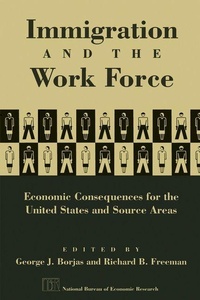
Immigration and the Work Force
Economic Consequences for the United States and Source Areas
Will be published approx. on 1. November 1992
Book
Hardback
291 pages
978-0-226-06633-2 (ISBN)
Description
Since the 1970s, the striking increase in immigration to the United States has been accompanied by a marked change in the composition of the immigrant community, with a much higher percentage of foreign-born workers coming from Latin America and Asia and a dramatically lower percentage from Europe.
This timely study is unique in presenting new data sets on the labor force, wage rates, and demographic conditions of both the U.S. and source-area economies through the 1980s. The contributors analyze the economic effects of immigration on the United States and selected source areas, with a focus on Puerto Rico and El Salvador. They examine the education and job performance of foreign-born workers; assimilation, fertility, and wage rates; and the impact of remittances by immigrants to family members on the overall gross domestic product of source areas.
A revealing and original examination of a topic of growing importance, this book will stand as a guide for further research on immigration and on the economies of developing countries.
This timely study is unique in presenting new data sets on the labor force, wage rates, and demographic conditions of both the U.S. and source-area economies through the 1980s. The contributors analyze the economic effects of immigration on the United States and selected source areas, with a focus on Puerto Rico and El Salvador. They examine the education and job performance of foreign-born workers; assimilation, fertility, and wage rates; and the impact of remittances by immigrants to family members on the overall gross domestic product of source areas.
A revealing and original examination of a topic of growing importance, this book will stand as a guide for further research on immigration and on the economies of developing countries.
More details
Series
Language
English
Place of publication
Chicago
United States
Publishing group
The University of Chicago Press
Target group
College/higher education
Professional and scholarly
Product notice
sewn/stitched
Cloth over boards
Dimensions
Height: 237 mm
Width: 160 mm
Thickness: 24 mm
Weight
590 gr
ISBN-13
978-0-226-06633-2 (9780226066332)
Copyright in bibliographic data and cover images is held by Nielsen Book Services Limited or by the publishers or by their respective licensors: all rights reserved.
Schweitzer Classification
Other editions
Additional editions
George J. Borjas | Richard B. Freeman
Immigration and the Work Force
Economic Consequences for the United States and Source Areas
E-Book
12/2007
1st Edition
University of Chicago Press
€117.29
Available for download
Persons
George J. Borjas is professor of economics at the University of California at San Diego. Richard B. Freeman is professor of economics at Harvard University and director of the Labor Studies Program at the National Bureau of Economic Research.
Content
Introduction and Summary, George J. Borjas and Richard B. Freeman 1 National Origin and the Skills of Immigrants in the Postwar Period George J. Borjas 2 Out-Migration and Return Migration of Puerto Ricans Fernando A. Ramos 3 The Assimilation of Immigrants in the U.S. Labor Market Robert J. LaLonde and Robert H. Topel 4 The Fertility of Immigrant Women: Evidence from High-Fertility Source Countries Francine D. Blau 5 Mass Emigration, Remittances, and Economic Adjustment: The Case of El Salvador in the Late 1980s Edward Funkhouser 6 When the Minimum Wage Really Bites: The Effect of the U.S.-Level Minimum on Puerto Rico Alida J. Castillo-Freeman and Richard B. Freeman 7 On the Labor Market Effects of Immigration and Trade George J. Borjas, Richard B. Freeman, and Lawrence F. Katz 8 The Effect of Immigrant Arrivals on Migratory Patterns of Native Workers Randall K. Filer