

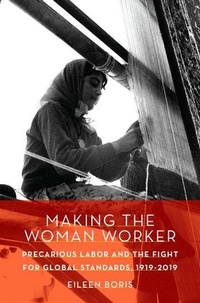
Making the Woman Worker
Precarious Labor and the Fight for Global Standards, 1919-2019
Published on 10. October 2019
Book
Hardback
352 pages
978-0-19-087462-9 (ISBN)
Description
Founded in 1919 along with the League of Nations, the International Labour Organization (ILO) establishes labor standards and produces knowledge about the world of work, serving as a forum for nations, unions, and employer associations. Before WWII, it focused on enhancing conditions for male industrial workers in Western, often imperial, economies, while restricting the circumstances of women's labors. Over time, the ILO embraced non-discrimination and equal treatment. It now promotes fair globalization, standardized employment and decent work for women in the developing world. In Making the Woman Worker, Eileen Boris illuminates the ILO's transformation in the context of the long fight for social justice.
Boris analyzes three ways in which the ILO has classified the division of labor: between women and men from 1919 to 1958; between women in the global south and the west from 1955 to 1996; and between the earning and care needs of all workers from 1990s to today. Before 1945, the ILO focused on distinguishing feminized labor from male workers, whom the organization prioritized. But when the world needed more women workers, the ILO (a UN agency after WWII) highlighted the global differences in women's work, began to combat sexism in the workplace, and declared care work essential to women's labor participation. Today, the ILO enters its second century with a mission to protect the interests of all workers in the face of increasingly globalized supply chains, the digitization of homework, and cross-border labor trafficking.
As Boris shows, the ILO's treatment of women is a window into the modern history of labor. The historic relegation of feminized labor to the part-time, short-term, and low-waged prefigures the future organization of work. The labor force is increasingly self-employed and working as long as possible--a steep price for flexibility--with minimal governmental oversight. How we treat workers in the next century will inevitably build upon evolving ideas of the woman worker, shaped significantly through the ILO.
Boris analyzes three ways in which the ILO has classified the division of labor: between women and men from 1919 to 1958; between women in the global south and the west from 1955 to 1996; and between the earning and care needs of all workers from 1990s to today. Before 1945, the ILO focused on distinguishing feminized labor from male workers, whom the organization prioritized. But when the world needed more women workers, the ILO (a UN agency after WWII) highlighted the global differences in women's work, began to combat sexism in the workplace, and declared care work essential to women's labor participation. Today, the ILO enters its second century with a mission to protect the interests of all workers in the face of increasingly globalized supply chains, the digitization of homework, and cross-border labor trafficking.
As Boris shows, the ILO's treatment of women is a window into the modern history of labor. The historic relegation of feminized labor to the part-time, short-term, and low-waged prefigures the future organization of work. The labor force is increasingly self-employed and working as long as possible--a steep price for flexibility--with minimal governmental oversight. How we treat workers in the next century will inevitably build upon evolving ideas of the woman worker, shaped significantly through the ILO.
Reviews / Votes
Eileen Boris's Making the Woman Worker offers a fundamentally important contribution to the thriving research on twentieth-century global feminisms, to histories of the changing conditions of (women's) work, and to understandings of supranational organisations and the UN system. * Maud Anne Bracke, Journal of Contemporary History * This book delivers a clear and detailed account of women in paid and unpaid work based on ILO's century-long history and its transformation, focusing mainly on women who have been more disadvantaged than others in terms of definition, recognition, equal treatment, and empowerment... this outstanding work promises to present a solid narrative of the challenges, failures, victories, and oppositions in the process as well as support, conflict, and tensions among actors involved in the "making of the woman worker" during ILO's 100 years, and the author keeps this promise. * Asli Ermis-Mert, Affilia: Journal of Women and Social Work * On the centennial of the International Labour Organization (ILO), the transnational body founded after World War I to create global labor standards covering a wide range of workers, Eileen Boris gives us a sweeping 100-year history. She charts the evolution of this crucial body from its almost entirely white, Euro-American, male-dominated origins through the post-World War II era when women from across the Global South began to demand representation and regulation, to the 21st century when women are the majority of activists in a resurgent global labor movement. With verve, keen analysis, and scrupulous attention to detail, Boris takes us inside complex, heated negotiations over the course of the long 20th century that shed light on the ways that, before corporate globalism, labor activists, governments and grass roots workers sought to make a more just world-and, in it, a place for all kinds of woman workers. * Annelise Orleck, author of We Are All Fast Food Workers * Boris has written a lively, interesting, and timely study of women's precarious informal work and intimate labors. Covering a century's worth of documents from the ILO archive, she situates her account within the broader historical forces of cold war, decolonization, and globalization. At the same time, she provides an analytic framework for understanding the successes and limits of the ILO's efforts to reform the world of work. The rapid expansion of precarious labor across all types of work and the assault on international institutions by right-wing populist forces makes this an even more compelling achievement. * Mary Margaret Fonow, Norton and Ramsey Professor of Social Transformation and Professor Women and Gender Studies, Arizona State University * In this ambitious, insightful, and provocative book, Boris uses the ILO to reveal how notions of who is a worker and what work deserves recognition and reward have changed over the last century. She shows how women shaped this discourse despite their marginalization from decision-making and she makes the case forhow notions of difference - across sex, region, race, and occupation - disadvantaged some and privileged others. Thoroughly grounded in primary sources, her analysis draws from astute readings of multiple scholarly literatures, including the newest research on gender, global labor, and women's history. * Dorothy Sue Cobble, Distinguished Professor of Labor Studies and History, Rutgers University *More details
Language
English
Place of publication
New York
United States
Product notice
sewn/stitched
Cloth over boards
Illustrations
18
Dimensions
Height: 246 mm
Width: 167 mm
Thickness: 37 mm
Weight
613 gr
ISBN-13
978-0-19-087462-9 (9780190874629)
Copyright in bibliographic data and cover images is held by Nielsen Book Services Limited or by the publishers or by their respective licensors: all rights reserved.
Schweitzer Classification
Other editions
Additional editions
E-Book
08/2019
OUP eBook
€18.99
Available for download
E-Book
08/2019
OUP eBook
€18.99
Available for download
Person
Eileen Boris is the Hull Professor and Distinguished Professor of Feminist Studies, University of California, Santa Barbara. She is the author, with Jennifer Klein, of Caring for America: Home Health Workers in the Shadow of the Welfare State (Oxford, 2012), which received the Sara A. Whaley Award from the National Women's Studies Association. She serves as President of the International Federation for Research in Women's History, 2015-2020 and received the 2017 Distinguished Service Award to the Field from the Labor and Working-Class History Association. She comments on women's labor in homes and other workplaces in activist and popular as well as scholarly venues.
Content
- Prologue
- Acknowledgments
- Abbreviations
- Note on Nomenclature
- List of Illustrations
- Introduction: Making Women, Defining Work
- I. Difference: The Problem of the Woman Worker, 1919-1958
- 1. Protection
- 2. Equality
- II. Difference's Other: Women in "Developing" Countries, 1944-1996
- 3. Development
- 4. Reproduction
- 5. Outwork
- III. Difference All: Centering Care, 1990s-2010s
- 6. Home
- 7. Women's Place (in the Future of Work)
- Appendix 1 List of Key Conventions and Recommendations
- Appendix 2 Publications of the Programme on Rural Women, 1978-1988