

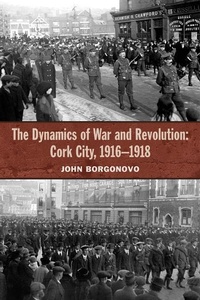
The Dynamics of War and Revolution
Cork City, 1916-1918
Published on 3. May 2013
Book
Hardback
344 pages
978-1-909005-82-2 (ISBN)
Description
At the beginning of the First World War, Irish separatists in the city of Cork were marginalised and without political power. By the war's end, they had supplanted the local elite and launched a bloody war for independence. Using Cork as a case study, this book considers how the First World War brought about political revolution in Ireland, examining: wartime failures of constitutional nationalism; anxieties over food shortages; explosions in trade unionism; the effects of government repression; rising expectations for self-determination; the creation of a mass independence movement; and strident opposition to military conscription. For the first time, the Irish Revolution is viewed through a First World War prism, yielding results that will surprise students of both subjects. The book offers ground-breaking scholarship within an accessible narrative, and will be released shortly before the centenaries of the Irish Revolution and First World War, which will attract unprecedented scholarly and public attention to both subjects.The book: Argues that the Irish Revolution was directly caused by the First World War; explains why Irish public opinion swung so quickly towards the independence movement following the 1916 Easter Rising; and examines the rich political and social tapestry of one city during the turmoil of the First World War.
The book offers the first local study of Ireland's wartime political transformation that preceded the violent revolution of 1919-1923. It begins immediately after the Republican defeat in the 1916 Easter Rising, and concludes with the triumph of Sinn Fein in the 1918 General Election. A number of new findings will influence the scholarship of this period, especially chapters regarding rising social unrest, collapsing popular deference, and war-related food and morality anxiety exploited by Irish Republicans. As such, this manuscript will significantly impact the charged debates surrounding the Irish Revolution and Ireland's First World War experience.
The book offers the first local study of Ireland's wartime political transformation that preceded the violent revolution of 1919-1923. It begins immediately after the Republican defeat in the 1916 Easter Rising, and concludes with the triumph of Sinn Fein in the 1918 General Election. A number of new findings will influence the scholarship of this period, especially chapters regarding rising social unrest, collapsing popular deference, and war-related food and morality anxiety exploited by Irish Republicans. As such, this manuscript will significantly impact the charged debates surrounding the Irish Revolution and Ireland's First World War experience.
More details
Language
English
Place of publication
Cork
Ireland
Target group
College/higher education
Product notice
sewn/stitched
Cloth over boards
With dust jacket
Dimensions
Height: 236 mm
Width: 157 mm
Thickness: 33 mm
Weight
658 gr
ISBN-13
978-1-909005-82-2 (9781909005822)
Copyright in bibliographic data and cover images is held by Nielsen Book Services Limited or by the publishers or by their respective licensors: all rights reserved.
Schweitzer Classification
Person
John Borgonovo is a lecturer in the School of History, University College Cork. He is the author of The Battle for Cork, July August 1922 (2011); (best known for) Spies, Informers, and the Anti-Sinn Fein Society: The Intelligence War in Cork City, 1920-1921 (2007); and Florence and Josephine O Donoghue s War of Independence, A Destiny that Shapes our Ends (2006).