

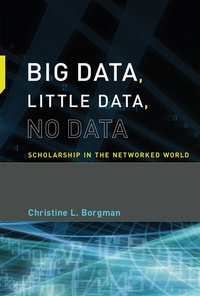
Big Data, Little Data, No Data
Scholarship in the Networked World
Published on 2. January 2015
Book
Hardback
416 pages
978-0-262-02856-1 (ISBN)
Description
An examination of the uses of data within a changing knowledge infrastructure, offering analysis and case studies from the sciences, social sciences, and humanities.
"Big Data" is on the covers of Science, Nature, the Economist, and Wired magazines, on the front pages of the Wall Street Journal and the New York Times. But despite the media hyperbole, as Christine Borgman points out in this examination of data and scholarly research, having the right data is usually better than having more data; little data can be just as valuable as big data. In many cases, there are no data-because relevant data don't exist, cannot be found, or are not available. Moreover, data sharing is difficult, incentives to do so are minimal, and data practices vary widely across disciplines.
Borgman, an often-cited authority on scholarly communication, argues that data have no value or meaning in isolation; they exist within a knowledge infrastructure-an ecology of people, practices, technologies, institutions, material objects, and relationships. After laying out the premises of her investigation-six "provocations" meant to inspire discussion about the uses of data in scholarship-Borgman offers case studies of data practices in the sciences, the social sciences, and the humanities, and then considers the implications of her findings for scholarly practice and research policy. To manage and exploit data over the long term, Borgman argues, requires massive investment in knowledge infrastructures; at stake is the future of scholarship.
"Big Data" is on the covers of Science, Nature, the Economist, and Wired magazines, on the front pages of the Wall Street Journal and the New York Times. But despite the media hyperbole, as Christine Borgman points out in this examination of data and scholarly research, having the right data is usually better than having more data; little data can be just as valuable as big data. In many cases, there are no data-because relevant data don't exist, cannot be found, or are not available. Moreover, data sharing is difficult, incentives to do so are minimal, and data practices vary widely across disciplines.
Borgman, an often-cited authority on scholarly communication, argues that data have no value or meaning in isolation; they exist within a knowledge infrastructure-an ecology of people, practices, technologies, institutions, material objects, and relationships. After laying out the premises of her investigation-six "provocations" meant to inspire discussion about the uses of data in scholarship-Borgman offers case studies of data practices in the sciences, the social sciences, and the humanities, and then considers the implications of her findings for scholarly practice and research policy. To manage and exploit data over the long term, Borgman argues, requires massive investment in knowledge infrastructures; at stake is the future of scholarship.
More details
Series
Language
English
Place of publication
Cambridge, Mass.
United States
Publishing group
MIT Press Ltd
Target group
College/higher education
Interest Age: From 18 years
Illustrations
7 Schaubilder
7 figures
Dimensions
Height: 229 mm
Width: 152 mm
Thickness: 17 mm
ISBN-13
978-0-262-02856-1 (9780262028561)
Copyright in bibliographic data and cover images is held by Nielsen Book Services Limited or by the publishers or by their respective licensors: all rights reserved.
Schweitzer Classification
Other editions
New editions
Book
02/2017
MIT Press
€36.50
Shipment within 10-20 days
Additional editions
Book
02/2017
MIT Press
€36.50
Shipment within 10-20 days
E-Book
01/2015
MIT Press
€29.49
Available for download
Person
Christine L. Borgman is Professor and Presidential Chair in Information Studies at the University of California, Los Angeles. She is the author of From Gutenberg to the Global Information Infrastructure and Scholarship in the Digital Age (both winners of the "Best Information Science Book" award from ASIS&T), published by the MIT Press.