

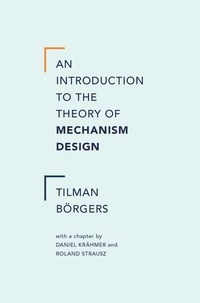
An Introduction to the Theory of Mechanism Design
Published on 25. June 2015
Book
Hardback
264 pages
978-0-19-973402-3 (ISBN)
Description
What is the best way of auctioning an asset? How should a group of people organize themselves to ensure the best provision of public goods? How should exchanges be organized? In An Introduction to the Theory of Mechanism Design, Tilman Boergers addresses these questions and more through an exploration of the economic theory of mechanism design, also known as reverse game theory. Game theory takes the rules of the game as a given and makes predictions about the behavior of strategic players, but the theory of mechanism design goes a step further to select the optimal rules of the game.
A relatively new economic theory, mechanism design studies the instrument itself rather than the results of the instrument. An Introduction to the Theory of Mechanism Design provides rigorous but accessible explanations of classic results in the theory of mechanism design, such as Myerson's theorem on expected revenue maximizing auctions, Myerson and Satterthwaite's theorem on the impossibility of ex post efficient bilateral trade with asymmetric information, and Gibbard and Satterthwaite's theorem on the non-existence of dominant strategy voting mechanisms. Boergers also provides an examination of the frontiers of current research in the area with an original and unified perspective that will appeal to advanced students of economics.
A relatively new economic theory, mechanism design studies the instrument itself rather than the results of the instrument. An Introduction to the Theory of Mechanism Design provides rigorous but accessible explanations of classic results in the theory of mechanism design, such as Myerson's theorem on expected revenue maximizing auctions, Myerson and Satterthwaite's theorem on the impossibility of ex post efficient bilateral trade with asymmetric information, and Gibbard and Satterthwaite's theorem on the non-existence of dominant strategy voting mechanisms. Boergers also provides an examination of the frontiers of current research in the area with an original and unified perspective that will appeal to advanced students of economics.
Reviews / Votes
Tilman Borgers offers the first book-length introduction into the theory of mechanism design. Written in a very personal and masterful style, he carefully covers the main developments in theory of mechanism design-the theory of how to choose the rules of the game-over the past decades. It will be an ideal textbook for advanced undergraduate and graduate courses for many years to come. * Dirk Bergemann, Douglass and Marion Campbell Professor of Economics and Chair, Yale University *More details
Language
English
Place of publication
New York
United States
Target group
College/higher education
Product notice
sewn/stitched
Cloth over boards
With dust jacket
Dimensions
Height: 239 mm
Width: 163 mm
Thickness: 23 mm
Weight
550 gr
ISBN-13
978-0-19-973402-3 (9780199734023)
Copyright in bibliographic data and cover images is held by Nielsen Book Services Limited or by the publishers or by their respective licensors: all rights reserved.
Schweitzer Classification
Other editions
Additional editions
Tilman Borgers
An Introduction to the Theory of Mechanism Design
E-Book
05/2015
1st Edition
OUP eBook
€73.99
Available for download
Tilman Borgers
An Introduction to the Theory of Mechanism Design
E-Book
05/2015
1st Edition
OUP eBook
€73.99
Available for download
Persons
Tilman Boergers is Samuel Zell Professor of the Economics of Risk at the University of Michigan. Before coming to Michigan in 2005, he was Professor of Economics at University College London. He holds a PhD in economics from the London School of Economics.; Daniel Kraehmer is Full Professor of Economics in the Department of Economics at Universitaet Bonn, Germany.; Roland Strausz is Full Professor and Chair of the Institute for Economic Theory at Humboldt-Universitaet Berlin, Germany.
Author
Samuel Zell Professor of the Economics of RiskSamuel Zell Professor of the Economics of Risk, University of Michigan
Full Professor of EconomicsFull Professor of Economics, Department of Economics, Universitdt Bonn, Germany
Full Professor, Chair of Institute for Economic TheoryFull Professor, Chair of Institute for Economic Theory, Humboldt-Universitdt Berlin, Germany
Content
1. Introduction ; 2. Screening ; 3. Bayesian Mechanism Design: Examples ; 4. Dominant Strategy Mechanisms: Examples ; 5. Incentive Compatibility ; 6. Bayesian Mechanism Design ; 7. Dominant Strategy Mechanisms ; 8. Non-Transferrable Utility ; 9. Informational Interdependence ; 10. Robust Mechanism Design ; 11. Dynamic Mechanism Design