

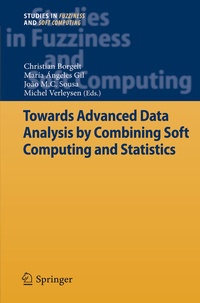
Towards Advanced Data Analysis by Combining Soft Computing and Statistics
Published on 20. September 2014
Book
Paperback/Softback
X, 378 pages
978-3-642-44374-9 (ISBN)
Description
Soft computing, as an engineering science, and statistics, as a classical branch of mathematics, emphasize different aspects of data analysis.
Soft computing focuses on obtaining working solutions quickly, accepting approximations and unconventional approaches. Its strength lies in its flexibility to create models that suit the needs arising in applications. In addition, it emphasizes the need for intuitive and interpretable models, which are tolerant to imprecision and uncertainty.
Statistics is more rigorous and focuses on establishing objective conclusions based on experimental data by analyzing the possible situations and their (relative) likelihood. It emphasizes the need for mathematical methods and tools to assess solutions and guarantee performance.
Combining the two fields enhances the robustness and generalizability of data analysis methods, while preserving the flexibility to solve real-world problems efficiently and intuitively.
Soft computing focuses on obtaining working solutions quickly, accepting approximations and unconventional approaches. Its strength lies in its flexibility to create models that suit the needs arising in applications. In addition, it emphasizes the need for intuitive and interpretable models, which are tolerant to imprecision and uncertainty.
Statistics is more rigorous and focuses on establishing objective conclusions based on experimental data by analyzing the possible situations and their (relative) likelihood. It emphasizes the need for mathematical methods and tools to assess solutions and guarantee performance.
Combining the two fields enhances the robustness and generalizability of data analysis methods, while preserving the flexibility to solve real-world problems efficiently and intuitively.
Reviews / Votes
From the reviews:
"This excellent volume will serve as an introduction to an important merging of viewpoints. The papers are generally very good and the text is clear and readable. The mathematical rigor is high and nearly all papers include real-world examples or experimental data. . This book is a valuable resource for those employed in statistical and soft computing, and a useful work for promoting better connections between these two fields." (Creed Jones, ACM Computing Reviews, December, 2012)
More details
Series
Edition
2013 ed.
Language
English
Place of publication
Berlin
Germany
Publishing group
Springer Berlin
Target group
Professional and scholarly
Research
Illustrations
X, 378 p.
Dimensions
Height: 235 mm
Width: 155 mm
Thickness: 21 mm
Weight
587 gr
ISBN-13
978-3-642-44374-9 (9783642443749)
DOI
10.1007/978-3-642-30278-7
Schweitzer Classification
Other editions
Additional editions
Christian Borgelt | María Ángeles Gil | João M.C. Sousa
Towards Advanced Data Analysis by Combining Soft Computing and Statistics
Book
08/2012
Springer
€160.49
Shipment within 7-9 days
Persons
Content
From the Contents: Arithmetic and Distance-Based Approach to the Statistical Analysis of Imprecisely Valued Data.- Linear Regression Analysis for Interval-valued Data Based on Set Arithmetic: A Bootstrap Confidence Intervals for the Parameters of a Linear Regression Model with Fuzzy Random Variables.- On the Estimation of the Regression Model M for Interval Data.- Hybrid Least-Squares Regression Modelling Using Confidence.- Testing the Variability of Interval Data: An Application to Tidal Fluctuation.-Comparing the Medians of a Random Interval Defined by Means of Two Different L1 Metrics.-Comparing the Representativeness of the 1-norm Median for Likert and Free-response Fuzzy Scales.-Fuzzy Probability Distributions in Reliability Analysis, Fuzzy HPD-regions, and Fuzzy Predictive Distributions.