

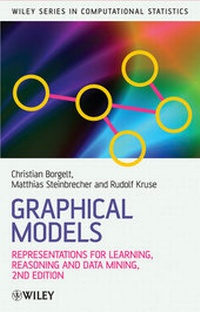
Graphical Models
Representations for Learning, Reasoning and Data Mining
2nd Edition
Published on 7. August 2009
Book
Hardback
404 pages
978-0-470-72210-7 (ISBN)
Description
Graphical models are of increasing importance in applied statistics, and in particular in data mining. Providing a self-contained introduction and overview to learning relational, probabilistic, and possibilistic networks from data, this second edition of Graphical Models is thoroughly updated to include the latest research in this burgeoning field, including a new chapter on visualization. The text provides graduate students, and researchers with all the necessary background material, including modelling under uncertainty, decomposition of distributions, graphical representation of distributions, and applications relating to graphical models and problems for further research.
Reviews / Votes
"The text provides graduate students, and researchers with all the necessary background material, including modelling under uncertainty, decomposition of distributions, graphical representation of distributions, and applications relating to graphical models and problems for further research." (Zentralblatt Math, 1 August 2013)"All of the necessary background is provided, with material on modeling under uncertainty and imprecision modeling, decomposition of distributions, graphical representation of distributions, applications relating to graphical models, and problems for further research." (Book News, December 2009)
More details
Product info
gebunden
Series
Edition
2. Auflage
Language
English
Place of publication
New York
United States
Target group
Professional and scholarly
Product notice
Unsewn / adhesive bound
Paper over boards
Dimensions
Height: 236 mm
Width: 160 mm
Thickness: 28 mm
Weight
722 gr
ISBN-13
978-0-470-72210-7 (9780470722107)
Schweitzer Classification
Other editions
Additional editions
Christian Borgelt | Matthias Steinbrecher | Rudolf R. Kruse
Graphical Models
Representations for Learning, Reasoning and Data Mining
E-Book
07/2009
2nd Edition
Wiley
€96.99
Available for download
Previous edition
Book
02/2002
Wiley
Unfortunately, price unknown
Article exhausted; check for reprint
Persons
Christian Borgelt, is the Principal researcher at the European Centre for Soft Computing at Otto-von-Guericke University of Magdeburg.
Rudolf Kruse, Professor for Computer Science at Otto-von-Guericke University of Magdeburg.
Matthias Steinbrecher, Department of Knowledge Processing and Language Engineering, School of Computer Science, Universitaetsplatz 2,?Magdeburg, Germany.
Rudolf Kruse, Professor for Computer Science at Otto-von-Guericke University of Magdeburg.
Matthias Steinbrecher, Department of Knowledge Processing and Language Engineering, School of Computer Science, Universitaetsplatz 2,?Magdeburg, Germany.
Content
Preface.
1 Introduction.
1.1 Data and Knowledge.
1.2 Knowledge Discovery and Data Mining.
1.3 Graphical Models.
1.4 Outline of this Book.
2 Imprecision and Uncertainty.
2.1 Modeling Inferences.
2.2 Imprecision and Relational Algebra.
2.3 Uncertainty and Probability Theory.
2.4 Possibility Theory and the Context Model.
3 Decomposition.
3.1 Decomposition and Reasoning.
3.2 Relational Decomposition.
3.3 Probabilistic Decomposition.
3.4 Possibilistic Decomposition.
3.5 Possibility versus Probability.
4 Graphical Representation.
4.1 Conditional Independence Graphs.
4.2 Evidence Propagation in Graphs.
5 Computing Projections.
5.1 Databases of Sample Cases.
5.2 Relational and Sum Projections.
5.3 Expectation Maximization.
5.4 Maximum Projections.
6 Naive Classifiers.
6.1 Naive Bayes Classifiers.
6.2 A Naive Possibilistic Classifier.
6.3 Classifier Simplification.
6.4 Experimental Evaluation.
7 Learning Global Structure.
7.1 Principles of Learning Global Structure.
7.2 Evaluation Measures.
7.3 Search Methods.
7.4 Experimental Evaluation.
8 Learning Local Structure.
8.1 Local Network Structure.
8.2 Learning Local Structure.
8.3 Experimental Evaluation.
9 Inductive Causation.
9.1 Correlation and Causation.
9.2 Causal and Probabilistic Structure.
9.3 Faithfulness and Latent Variables.
9.4 The Inductive Causation Algorithm.
9.5 Critique of the Underlying Assumptions.
9.6 Evaluation.
10 Visualization.
10.1 Potentials.
10.2 Association Rules.
11 Applications.
11.1 Diagnosis of Electrical Circuits.
11.2 Application in Telecommunications.
11.3 Application at Volkswagen.
11.4 Application at DaimlerChrysler.
A Proofs of Theorems.
A.1 Proof of Theorem 4.1.2.
A.2 Proof of Theorem 4.1.18.
A.3 Proof of Theorem 4.1.20.
A.4 Proof of Theorem 4.1.26.
A.5 Proof of Theorem 4.1.28.
A.6 Proof of Theorem 4.1.30.
A.7 Proof of Theorem 4.1.31.
A.8 Proof of Theorem 5.4.8.
A.9 Proof of Lemma.2.2.
A.10 Proof of Lemma.2.4.
A.11 Proof of Lemma.2.6.
A.12 Proof of Theorem 7.3.1.
A.13 Proof of Theorem 7.3.2.
A.14 Proof of Theorem 7.3.3.
A.15 Proof of Theorem 7.3.5.
A.16 Proof of Theorem 7.3.7.
B Software Tools.
Bibliography.
Index.