

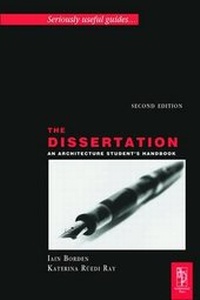
The Dissertation
2nd Edition
Published on 21. January 2016
Book
Hardback
342 pages
978-1-138-13866-7 (ISBN)
Description
The Dissertation is one of the most demanding yet potentially most stimulating components of an architectural course. Properly done, it can be a valuable contribution not only to the students own learning development but also to the field of architecture as a whole. This book provides a complete guide to what to do, how to do it, when to do it, and the major pitfalls involved.
This is a comprehensive guide to all that an architecture student might need to know about undertaking the dissertation, including new material on CD-ROM and online sources, web based research techniques, digital images, alternative imaging strategies, key architecture links, referencing and new dissertation extracts. It clearly navigates the student through the whole process of writing, preparing and submitting a dissertation, as well as suggesting what to do after the dissertation has been completed. Subjects covered include how to write a proposal, which research methodologies and techniques to adopt, which libraries and archives to utilize (including special architectural resources on the net), as well as how to structure, reference and illustrate the final submission.
The authors also take architecture students into new terrain, suggesting alternative methods of undertaking dissertations, whether as video, prose writing, multimedia or other forms of expression. Furthermore, this guide includes new examples of exemplary dissertations of all kinds, as completed by students in Europe and North America so that the reader can clearly see the kinds of work which they themselves might choose to pursue.
Also in the Seriously Useful Guides Series:
* The Crit
* The The Portfolio
* Practical Experience
This is a comprehensive guide to all that an architecture student might need to know about undertaking the dissertation, including new material on CD-ROM and online sources, web based research techniques, digital images, alternative imaging strategies, key architecture links, referencing and new dissertation extracts. It clearly navigates the student through the whole process of writing, preparing and submitting a dissertation, as well as suggesting what to do after the dissertation has been completed. Subjects covered include how to write a proposal, which research methodologies and techniques to adopt, which libraries and archives to utilize (including special architectural resources on the net), as well as how to structure, reference and illustrate the final submission.
The authors also take architecture students into new terrain, suggesting alternative methods of undertaking dissertations, whether as video, prose writing, multimedia or other forms of expression. Furthermore, this guide includes new examples of exemplary dissertations of all kinds, as completed by students in Europe and North America so that the reader can clearly see the kinds of work which they themselves might choose to pursue.
Also in the Seriously Useful Guides Series:
* The Crit
* The The Portfolio
* Practical Experience
More details
Edition
2nd New edition
Language
English
Place of publication
London
United Kingdom
Publishing group
Taylor & Francis Ltd
Target group
College/higher education
Edition type
New edition
Dimensions
Height: 198 mm
Width: 133 mm
Weight
454 gr
ISBN-13
978-1-138-13866-7 (9781138138667)
Copyright in bibliographic data and cover images is held by Nielsen Book Services Limited or by the publishers or by their respective licensors: all rights reserved.
Schweitzer Classification
Other editions
New editions
Book
11/2015
3rd Edition
Routledge
€187.10
Shipment within 10-20 days
Additional editions
Book
11/2005
2nd Edition
Architectural Press
€29.70
Article exhausted; check for reprint
Content
1 Introduction: Why Write a Dissertation?, The Handbook; 2 Starting, What is a Dissertation?, Selecting a Dissertation Subject, Assessing a Dissertation Subject, Choosing and Working with a Supervisor, Writing a Proposal; 3 Researching, What is Research?, Historical and Critical Methodology, Research Techniques, Libraries and Archives, The Internet; 4 Preparing, Structuring a Dissertation, Working Methods, Illustrations, Referencing, Bibliographies, Plagiarism, Submitting a Draft, Word-Processing, Alternative Dissertations; 5 Presenting, General Presentation, Illustrations, Computer Software, Assessment Criteria, Oral Examinations; 6 Afterwards, Further Research and Study, Publications, Troubleshooting; 7 Dissertation Excerpts Index.