

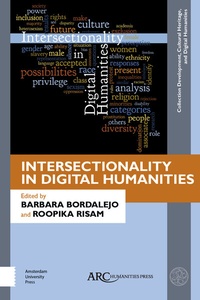
Intersectionality in Digital Humanities
Published on 30. November 2019
Book
Hardback
208 pages
978-1-64189-050-2 (ISBN)
Description
As digital humanities has expanded in scope
and content, questions of how to negotiate
the overlapping influences of race, class,
gender, sexuality, nation, and other
dimensions that shape data, archives, and
methodologies have come to the fore. Taking
up these concerns, the authors in this volume
explore their effects on the methodological,
political, and ethical practices of digital
humanities.
and content, questions of how to negotiate
the overlapping influences of race, class,
gender, sexuality, nation, and other
dimensions that shape data, archives, and
methodologies have come to the fore. Taking
up these concerns, the authors in this volume
explore their effects on the methodological,
political, and ethical practices of digital
humanities.
More details
Series
Edition
New edition
Language
English
Place of publication
Leeds
United States
Target group
Professional and scholarly
US School Grade: College Graduate Student
Edition type
New edition
Illustrations
11 s/w Abbildungen
11 Illustrations, black and white
Dimensions
Height: 234 mm
Width: 156 mm
ISBN-13
978-1-64189-050-2 (9781641890502)
Copyright in bibliographic data and cover images is held by Nielsen Book Services Limited or by the publishers or by their respective licensors: all rights reserved.
Schweitzer Classification
Other editions
Additional editions
Barbara Bordalejo | Roopika Risam
Intersectionality in Digital Humanities
E-Book
11/2019
Arc Humanities Press
€178.00
Available for download
Content
Barbara Bordalejo and Roopika Risam: Introduction
1. Moya Z. Bailey: All the Digital Humanists Are White, All the Nerds Are Men, but Some of Us Are Brave
2. Roopika Risam: Beyond the Margins: Intersectionality and Digital Humanities
3. Adam Vázquez: You Build the Lanes, We are the Intersections
4. Dorothy Kim: Digital Humanities, Intersectionality and the Ethics of Harm
5. Barbara Bordalejo: Walking Alone Online: Intersectional Violence on the Internet
6. Kyle Dase: Ready Player Two: Inclusion and Positivity as a Means of Furthering Equality in the Digital Humanities and Computer Science
7. Peter Robinson: Gender, Feminism, Textual Scholarship, and Digital Humanities.
8. Vera Fasshauer: Faulty, Clumsy, Negligible? Revaluating Early Modern Princesses' Letters as a Source for Cultural History and Corpus Linguistics
9. Amalia Levi: Intersectionality in Digital Archives: The Case Study of the Barbados Synagogue Restoration Project Collection
10. Kimberly Harsley: Accessioning Digital Content and the Unwitting Move towards Intersectionality in the Archive
11. Daniel O'Donnell: All along the Watchtower: Diversity as a core intellectual value in Digital Humanities
Selected Bibliography
1. Moya Z. Bailey: All the Digital Humanists Are White, All the Nerds Are Men, but Some of Us Are Brave
2. Roopika Risam: Beyond the Margins: Intersectionality and Digital Humanities
3. Adam Vázquez: You Build the Lanes, We are the Intersections
4. Dorothy Kim: Digital Humanities, Intersectionality and the Ethics of Harm
5. Barbara Bordalejo: Walking Alone Online: Intersectional Violence on the Internet
6. Kyle Dase: Ready Player Two: Inclusion and Positivity as a Means of Furthering Equality in the Digital Humanities and Computer Science
7. Peter Robinson: Gender, Feminism, Textual Scholarship, and Digital Humanities.
8. Vera Fasshauer: Faulty, Clumsy, Negligible? Revaluating Early Modern Princesses' Letters as a Source for Cultural History and Corpus Linguistics
9. Amalia Levi: Intersectionality in Digital Archives: The Case Study of the Barbados Synagogue Restoration Project Collection
10. Kimberly Harsley: Accessioning Digital Content and the Unwitting Move towards Intersectionality in the Archive
11. Daniel O'Donnell: All along the Watchtower: Diversity as a core intellectual value in Digital Humanities
Selected Bibliography