

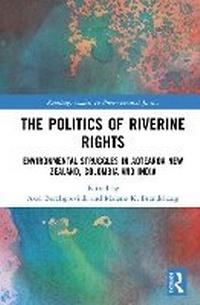
The Politics of Riverine Rights
Environmental Struggles in Aotearoa New Zealand, Colombia and India
1st Edition
Will be published approx. on 19. January 2026
Book
Hardback
248 pages
978-1-032-94678-8 (ISBN)
Description
This edited collection, based on comparative, multi-sited ethnographic research, explores the concept of riverine rights in relation to rivers in New Zealand, Columbia and India that have been declared legal persons or subjects of rights: the Whanganui, the Atrato, the Ganges and the Yamuna.
The cases drew significant attention from academia and the wider public, as examples of the Rights of Nature in practice. This book contributes with in-depth empirical research carried out by a highly interdisciplinary team of co-authors - from anthropology, law, history, political science, management studies and water science - many of whom are from the case study countries and the river basins. The first chapters carefully examine each case, discussing its history, the institutional context, the actors and interests, the issues to be addressed by the legal decisions, and their outcomes. Subsequent chapters provide detailed comparative analysis on the Rights of Nature, legal pluralism, the struggles of Indigenous and marginalized groups, and on different ontological understandings of the relations between people, rivers and nature. The book concludes with reflections on how these cases of riverine rights relate to global trends, and discusses the tensions and synergies between Human Rights and Nature's Rights, with a particular emphasis on how Indigenous Rights intersect with Rivers' Rights. Finally, it argues for a broad notion of Riverine Rights that includes those who live by the river, and beyond Riverine Rights, to the social, cultural and political dimensions of the legal innovations, and to the larger environmental crises they seek to address.
This interdisciplinary book will be essential reading for academics and researchers across social sciences and law with an interest in how social struggles, environmental justice and innovative legislation intersect for the wellbeing of rivers and their people.
The cases drew significant attention from academia and the wider public, as examples of the Rights of Nature in practice. This book contributes with in-depth empirical research carried out by a highly interdisciplinary team of co-authors - from anthropology, law, history, political science, management studies and water science - many of whom are from the case study countries and the river basins. The first chapters carefully examine each case, discussing its history, the institutional context, the actors and interests, the issues to be addressed by the legal decisions, and their outcomes. Subsequent chapters provide detailed comparative analysis on the Rights of Nature, legal pluralism, the struggles of Indigenous and marginalized groups, and on different ontological understandings of the relations between people, rivers and nature. The book concludes with reflections on how these cases of riverine rights relate to global trends, and discusses the tensions and synergies between Human Rights and Nature's Rights, with a particular emphasis on how Indigenous Rights intersect with Rivers' Rights. Finally, it argues for a broad notion of Riverine Rights that includes those who live by the river, and beyond Riverine Rights, to the social, cultural and political dimensions of the legal innovations, and to the larger environmental crises they seek to address.
This interdisciplinary book will be essential reading for academics and researchers across social sciences and law with an interest in how social struggles, environmental justice and innovative legislation intersect for the wellbeing of rivers and their people.
More details
Series
Language
English
Place of publication
London
United Kingdom
Publishing group
Taylor & Francis Ltd
Target group
College/higher education
Professional and scholarly
Academic and Postgraduate
Illustrations
3 s/w Tabellen, 15 s/w Photographien bzw. Rasterbilder, 15 s/w Abbildungen
3 Tables, black and white; 15 Halftones, black and white; 15 Illustrations, black and white
Dimensions
Height: 240 mm
Width: 161 mm
Thickness: 18 mm
Weight
534 gr
ISBN-13
978-1-032-94678-8 (9781032946788)
Copyright in bibliographic data and cover images is held by Nielsen Book Services Limited or by the publishers or by their respective licensors: all rights reserved.
Schweitzer Classification
Other editions
Additional editions
Axel Borchgrevink | Malene K. Brandshaug
The Politics of Riverine Rights
Environmental Struggles in Aotearoa New Zealand, Colombia and India
E-Book
01/2026
Routledge
€0.00
Available for download
Axel Borchgrevink | Malene K. Brandshaug
The Politics of Riverine Rights
Environmental Struggles in Aotearoa New Zealand, Colombia and India
E-Book
01/2026
Routledge
€0.00
Available for download
Persons
Axel Borchgrevink is Professor of Development Studies at Oslo Metropolitan University, Norway. He holds a PhD in social anthropology from the University of Oslo. He has done research in Latin America, the Horn of Africa, the Philippines and New Zealand, and worked with issues of rural development and resource politics, civil society and indigenous rights, and development aid. He is the author of Clean and Green: Knowledge and Morality in a Philippine Farming Community and has also co-edited the book Contested Powers: The Politics of Energy and Development in Latin America. He is the project leader of Riverine Rights: Exploring the Currents and Consequences of Legal Innovations on the Rights of Rivers.
Malene K. Brandshaug is a postdoctoral fellow at Department of International Studies, Oslo Metropolitan University, Norway, and holds a PhD in Social Anthropology from the School of Global Studies at University of Gothenburg (2020), Sweden. Her decade-long ethnographic specialisation in water and Peru, is amplified by her recent work on human-water relations and environmental activism in Norway, and on international currents regarding Rights of Rivers. She is currently working on her postdoctoral project Rights of Waters: An Ethnographic Study of Human-Environment Relations and Local Mobilisation in Norway, and is a member of the research project Riverine Rights: Exploring the Currents and Consequences of Legal Innovations on the Rights of Rivers.
Malene K. Brandshaug is a postdoctoral fellow at Department of International Studies, Oslo Metropolitan University, Norway, and holds a PhD in Social Anthropology from the School of Global Studies at University of Gothenburg (2020), Sweden. Her decade-long ethnographic specialisation in water and Peru, is amplified by her recent work on human-water relations and environmental activism in Norway, and on international currents regarding Rights of Rivers. She is currently working on her postdoctoral project Rights of Waters: An Ethnographic Study of Human-Environment Relations and Local Mobilisation in Norway, and is a member of the research project Riverine Rights: Exploring the Currents and Consequences of Legal Innovations on the Rights of Rivers.
Content
1. Exploring Riverine Rights 2. Te Awa Tupua and Rights for Whanganui River, Aotearoa New Zealand 3. The Biocultural Rights of Colombia's Atrato River 4. India's Ganga and Yamuna Rivers as Legal Persons 5. People-river Inseparability 6. Legal Innovations for Rivers 7. The Politics of Riverine Rights 8. Rights of Nature Redux