

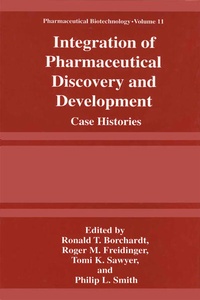
Integration of Pharmaceutical Discovery and Development
Case Histories
Published on 31. August 1998
Book
Hardback
XXIX, 610 pages
978-0-306-45743-2 (ISBN)
Description
In the late 1980s, it became painfully evident to the pharmaceutical industry that the old paradigm of drug discovery, which involved highly segmented drug - sign and development activities, would not produce an acceptable success rate in the future. Therefore, in the early 1990s a paradigm shift occurred in which drug design and development activities became more highly integrated. This new str- egy required medicinal chemists to design drug candidates with structural f- tures that optimized pharmacological (e. g. , high affinity and specificity for the target receptor), pharmaceutical (e. g. , solubility and chemical stability), bioph- maceutical (e. g. , cell membrane permeability), and metabolic/pharmacokinetic (e. g. , metabolic stability, clearance, and protein binding) properties. Successful implementation of this strategy requires a multidisciplinary team effort, incl- ing scientists from drug design (e. g. , medicinal chemists, cell biologists, en- mologists, pharmacologists) and drug development (e. g. , analytical chemists, pharmaceutical scientists, physiologists, and molecular biologists representing the disciplines of pharmaceutics, biopharmaceutics, and pharmacokinetics/drug metabolism). With this new, highly integrated approach to drug design now widely utilized by the pharmaceutical industry, the editors of this book have provided the sci- tific community with case histories to illustrate the nature of the interdisciplinary interactions necessary to successfully implement this new approach to drug d- covery. In the first chapter, Ralph Hirschmann provides a historical perspective of why this paradigm shift in drug discovery has occurred.
More details
Series
Edition
1998 ed.
Language
English
Place of publication
New York
United States
Publishing group
Springer Science+Business Media
Target group
Professional and scholarly
Research
Illustrations
1 farbige Abbildung, 30 s/w Abbildungen
XXIX, 610 p. 31 illus., 1 illus. in color.
Dimensions
Height: 241 mm
Width: 160 mm
Thickness: 40 mm
Weight
1127 gr
ISBN-13
978-0-306-45743-2 (9780306457432)
DOI
10.1007/b114429
Schweitzer Classification
Other editions
Additional editions
Ronald T. Borchardt | Roger M. Freidinger | Tomi K. Sawyer
Integration of Pharmaceutical Discovery and Development
Case Histories
Book
12/2010
Springer
€213.99
Shipment within 15-20 days
Ronald T. Borchardt | Roger M. Freidinger | Tomi K. Sawyer
Integration of Pharmaceutical Discovery and Development
Case Histories
E-Book
01/2006
1st Edition
Kluwer Academic / Plenum Publishers
€213.99
Available for download
Content
Renin Inhibitors.- The Discovery and Development of Angiotensin II Antagonists.- Development of an Orally Active Tripeptide Arginal Thrombin Inhibitor.- Discovery and Development of an Endothelin a Receptor-Selective Antagonist PD 156707.- Endothelin Receptor Antagonists.- LHRH Antagonists.- LHRH Agonists.- Discovery and Development of Somatostatin Agonists.- Factors Impacting the Delivery of Therapeutic Levels of Pyrone-Based HIV Protease Inhibitors.- The Integration of Medicinal Chemistry, Drug Metabolism, and Pharmaceutical Research and Development in Drug Discovery and Development.- De Novo Design and Discovery of Cyclic HIV Protease Inhibitors Capable of Displacing the Active-Site Structural Water Molecule.- Discovery and Development of the BHAP Nonnucleoside Reverse Transcriptase Inhibitor Delavirdine Mesylate.- Famciclovir.- The Use of Esters as Prodrugs for Oral Delivery of ?-Lactam Antibiotics.- Hematoregulators.- Discovery and Development of GG745, a Potent Inhibitor of Both Isozymes of of 5?-Reductase.- Discovery of a Potent and Selective ?1A Antagonist.- Discovery of Bioavailable Inhibitors of Secretory Phospholipase A2.- The Anxieties of Drug Discovery and Development.- CI-1015.- Orally Active Nonpeptide CCK-A Agonists.- Orally Active Growth Hormone Secretagogues.- Dorzolamide, a 40-Year Wait.- Discovery and Development of Novel Melanogenic Drugs.