

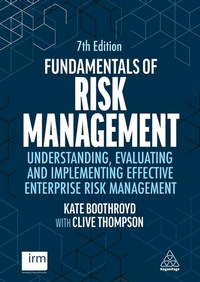
Fundamentals of Risk Management
Understanding, Evaluating and Implementing Effective Enterprise Risk Management
7th Edition
Published on 3. December 2024
Book
Hardback
472 pages
978-1-3986-1868-8 (ISBN)
Description
Fundamentals of Risk Management provides a comprehensive introduction to enterprise risk for students and risk professionals, with tools and tips, expert insights and coverage of key developments in an ever-evolving field.
Effective enterprise risk management allows organizations to maximize opportunities and minimize uncertainty. Aligned with ISO 31000, the COSO ERM Framework and the UK's Orange Book, this guide covers the key principles of risk management and how to deal with the different types of risk that organizations face. The frameworks of business continuity planning, enterprise risk management and project risk management are covered alongside an overview of international risk management standards and frameworks, strategy and policy. The text provides a clear introduction to a variety of risk management approaches used in sectors such as insurance, banking, law, health and safety and supply chain management.
Now in its seventh edition,
Fundamentals of Risk Management
guides readers through the steps of risk identification, risk analysis, risk description and risk estimation. It includes new chapters covering emerging trends in risk management such as on resilience, sustainability and strategic risk. It offers increased international coverage around corporate governance and real-world examples, allowing students to connect theory to practice. Supporting online resources include lecture slides with figures, tables and key points from the book.
Reviews / Votes
"The imperative for organizations to take risks to create value never goes away. Understanding the rules of the game is an essential first step, equipping both people new to risk management, and those who are willing to learn, with the knowledge they need and ideas of what they can do differently. This seventh edition provides a one-stop shop for all the requisite knowledge." * Dr Ruth Murray-Webster, Director, Potentiality Consultancy Services *More details
Language
English
Place of publication
London
United Kingdom
Target group
College/higher education
Professional and scholarly
Edition type
Revised edition
Product notice
Cloth over boards
Dimensions
Height: 250 mm
Width: 175 mm
Thickness: 30 mm
Weight
987 gr
ISBN-13
978-1-3986-1868-8 (9781398618688)
Schweitzer Classification
Other editions
Additional editions
Kate Boothroyd | Clive Thompson
Fundamentals of Risk Management
Understanding, Evaluating and Implementing Effective Enterprise Risk Management
Book
12/2024
7th Edition
Kogan Page Ltd
€62.50
Available immediately
Previous edition

Book
04/2025
8th Edition
Kogan Page Ltd
€75.20
Shipment within 10-20 days
Persons
Author
Kate Boothroyd is the Director of KB Risk Consulting Limited, a risk management consultancy working with clients across a variety of countries and industries. She joined the Institute of Risk Management in 1992 and is an accredited IRM trainer. She previously served as Director. She was lead developer on the IRM's updated Enterprise Risk Management Certificate. She is also the Lead Examiner on the Chartered Governance Institute UK & Ireland's Qualifying Programme Risk Management Module. She is based in Huddersfield, UK.
Clive Thompson has over 40 years of global experience in Insurance and Risk Management. He was founding Chair of the Professional Standards and the Interest Group Committees of the Institute of Risk Management (IRM) where he was Deputy Chair until 2020. As Deputy Chair, he initiated the first seminar to focus on Climate Change at the IRM and instigated the IRM's Special Interest Group on Climate Change. He is a Certified Fellow of the IRM and of the Chartered Insurance Institute. He is co- author of the 6th version of Fundamentals of Risk Management, also published by Kogan Page and is based in Littlehampton, UK.
Content
- Section - ONE: Introduction to risk management;
-
- Chapter - 01: What is risk and why is it important?;
- Chapter - 02: Risk as an opportunity as well as a threat;
- Chapter - 03: Risk management standards;
- Chapter - 04: The four steps of risk management;
- Section - TWO: Enterprise risk management;
-
- Chapter - 05: Risk management in context;
- Chapter - 06: Enterprise risk management;
- Chapter - 07: The background, aims and principles of risk management;
- Chapter - 08: Risk architecture and strategy;
- Chapter - 09: Roles, responsibilities, and documentation;
- Chapter - 10: Implementing enterprise risk management;
- Chapter - 11: Processes for risk management;
- Section - THREE: Defining context and objectives and assessing risk;
-
- Chapter - 12: The context for ERM;
- Chapter - 13: Setting objectives for ERM;
- Chapter - 14: Assessing risks: Risk identification, considerations, causes, and consequences;
- Chapter - 15: Classifying risks;
- Chapter - 16: Assessing risks: Risk analysis;
- Chapter - 17: Different lenses for considering risk;
- Chapter - 18: Assessing risks: Risk evaluation;
- Section - FOUR: Risk response: monitor, review, and report;
-
- Chapter - 19: Managing and responding to risk;
- Chapter - 20: Controlling downside risk;
- Chapter - 21: Risk treatment controls for threats;
- Chapter - 22: Controlling upside risk;
- Chapter - 23: Ongoing monitoring and review;
- Chapter - 24: Reporting on risk management;
- Section - FIVE: Decision making: Risk culture, appetite and tolerance;
-
- Chapter - 25: Culture and behaviours;
- Chapter - 26: Risk appetite and tolerance;
- Section - SIX: Corporate governance and assurance;
-
- Chapter - 27: Introducing corporate governance;
- Chapter - 28: Stakeholders, ethics, and corporate social responsibility;
- Chapter - 29: Different approaches to risk management;
- Chapter - 30: The control environment;
- Chapter - 31: Internal audit activities;
- Chapter - 32: Risk assurance techniques;
- Section - SEVEN: Organisational environment: Resilience and sustainability;
-
- Chapter - 33: Strategy and the risk environment;
- Chapter - 34: The organization's business model, visions and values;
- Chapter - 35: Resilience;
- Chapter - 36: Surviving shocks and disruption: ERM, BCP and resilience;
- Chapter - 37: Sustainability;
- Section - EIGHT: Different approaches;
-
- Chapter - 38: Insurance;
- Chapter - 39: Banking, legal, supply chain, and IT approaches to risk management;
- Chapter - 40: New approaches to the four steps of risk management;
- Section - NINE: Adding value;
-
- Chapter - 41: How risk management adds value;
- Chapter - 42: Maturity and continual improvement;
- Chapter - 43: Risk practitioner competencies;
- Chapter - 44: How risk practitioners add value