

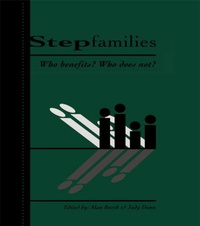
Stepfamilies
Who Benefits? Who Does Not?
Published on 1. November 1994
Book
Hardback
244 pages
978-0-8058-1544-3 (ISBN)
Description
Stepfamilies represent an increasing number of American households and shape the upbringing of countless stepchildren. Despite their prominence in society, our knowledge about these families is very limited. To address this deficit, the editors have drawn together the work of 16 nationally known scholars to deal with four questions:
* Marriages that create stepfamilies: Why do they occur? Fail? Succeed?
* How do stepfamilies function as child rearing environments?
* How do stepfamilies function as sources of support in later life?
* Building research and policy agendas: What is needed?
In seeking answers to these questions, the book bridges the disciplines of psychology, sociology, social psychology, child development, demography, law and policy. Readers will gain an understanding of the current knowledge about stepfamilies, obtain an appreciation of the diverse views on a variety of stepfamily issues, learn about existing and anticipated laws and policies that affect stepfamilies, and acquire ideas on needed research and policy agendas. Chapter authors are leading figures in psychology, sociology, demography, human development, and family law; their contributions are valuable to researchers, teachers, and students as well as policymakers and legislatures.
* Marriages that create stepfamilies: Why do they occur? Fail? Succeed?
* How do stepfamilies function as child rearing environments?
* How do stepfamilies function as sources of support in later life?
* Building research and policy agendas: What is needed?
In seeking answers to these questions, the book bridges the disciplines of psychology, sociology, social psychology, child development, demography, law and policy. Readers will gain an understanding of the current knowledge about stepfamilies, obtain an appreciation of the diverse views on a variety of stepfamily issues, learn about existing and anticipated laws and policies that affect stepfamilies, and acquire ideas on needed research and policy agendas. Chapter authors are leading figures in psychology, sociology, demography, human development, and family law; their contributions are valuable to researchers, teachers, and students as well as policymakers and legislatures.
Reviews / Votes
"...an important contribution to the stepfamily literature ...replete with suggestions for further research with stepfamilies."-Journal of Marriage and the Family
"...the reader benefits not only from a thorough review or presentation of original research but also from several other researchers' thoughtful discussion, elaboration, and sometimes dissent from the perspective of the lead scientist....This book is tailor-made for those wishing to come up to speed rapidly in a growing area of research. The individual research chapters will reward the time spent digesting them; the discussion chapters are sufficient to acquaint the newcomer with at least some of the major issues or research controversies in the area; and the chapter bibliographies are a good next step for further grounding."
-Contemporary Psychology
More details
Series
Language
English
Place of publication
New York
United States
Publishing group
Taylor & Francis Inc
Target group
College/higher education
Professional and scholarly
Dimensions
Height: 229 mm
Width: 152 mm
Weight
610 gr
ISBN-13
978-0-8058-1544-3 (9780805815443)
Copyright in bibliographic data and cover images is held by Nielsen Book Services Limited or by the publishers or by their respective licensors: all rights reserved.
Schweitzer Classification
Other editions
Additional editions
E-Book
04/2014
1st Edition
Routledge
€51.49
Available for download
E-Book
04/2014
1st Edition
Routledge
€51.49
Available for download
Persons
Booth, Alan; Dunn, Judy; Dunn, Judith F.
Content
Contents: Preface. Part I: Marriages That Create Stepfamilies--Why Do They Occur? Fail? Succeed?D. Popenoe, The Evolution of Marriage and the Problem of Stepfamilies: A Biosocial Perspective. M. Coleman, Stepfamilies in the United States: Challenging Biased Assumptions. L.A. Kurdek, Remarriages and Stepfamilies Are Not Inherently Problematic. N.D. Glenn, Biology, Evolutionary Theory, and Family Social Science. Part II: How Do Stepfamilies Function as Childrearing Organizations?E.M. Hetherington, K.M. Jodl, Stepfamilies as Settings for Child Development. P.R. Amato, The Implications of Research Findings on Children in Stepfamilies. E. Thomson, "Settings" and "Development" From a Demographic Point of View. N. Zill, Understanding Why Children in Stepfamilies Have More Learning and Behavior Problems Than Children in Nuclear Families. Part III: How Do Stepfamilies Function as Sources of Support?L. White, Stepfamilies Over the Life Course: Social Support. T.M. Cooney, Conceptual and Methodological Issues in the Study of Stepfamilies Over the Life Course. D.P. Hogan, Stepfamilies: Selectivity of High-Risk Persons or Risk State? J.A. Seltzer, Intergenerational Ties in Adulthood and Childhood Experience. Part IV: Building Research and Policy Agendas--What Is Needed?J. Brooks-Gunn, Research on Stepparenting Families: Integrating Disciplinary Approaches and Informing Policy. M.M. Mahoney, Reformulating the Legal Definition of the Stepparent-Child Relationship. M.A. Fine, Social Policy Pertaining to Stepfamilies: Should Stepparents and Stepchildren Have the Option of Establishing a Legal Relationship? P.L. Chase-Lansdale, Policies for Stepfamilies: Crosswalking Private and Public Domains. J. Dunn, A. Booth, Stepfamilies: An Overview.