

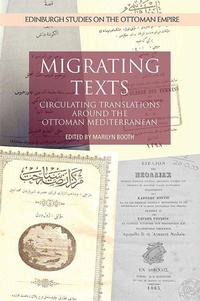
Migrating Texts
Circulating Translations around the Ottoman Mediterranean
Published on 16. February 2021
Book
Paperback/Softback
368 pages
978-1-4744-3900-8 (ISBN)
Description
Fenelon, Offenbach and the Iliad in Arabic, Robinson Crusoe in Turkish, the Bible in Greek-alphabet Turkish, excoriated French novels circulating through the Ottoman Empire in Greek, Arabic and Turkish - literary translation at the eastern end of the Mediterranean offered worldly vistas and new, hybrid genres to emerging literate audiences in the nineteenth and early twentieth centuries.
Whether to propagate 'national' language reform, circulate the Bible, help audiences understand European opera, argue for girls' education, institute pan-Islamic conversations, introduce political concepts, share the Persian Gulistan with Anglophone readers in Bengal, or provide racy fiction to schooled adolescents in Cairo and Istanbul, translation was an essential tool. But as these essays show, translators were inventors. And their efforts might yield surprising results.
Whether to propagate 'national' language reform, circulate the Bible, help audiences understand European opera, argue for girls' education, institute pan-Islamic conversations, introduce political concepts, share the Persian Gulistan with Anglophone readers in Bengal, or provide racy fiction to schooled adolescents in Cairo and Istanbul, translation was an essential tool. But as these essays show, translators were inventors. And their efforts might yield surprising results.
More details
Series
Language
English
Place of publication
Edinburgh
United Kingdom
Target group
Professional and scholarly
Illustrations
18 black and white illustrations
Dimensions
Height: 152 mm
Width: 230 mm
Thickness: 26 mm
Weight
544 gr
ISBN-13
978-1-4744-3900-8 (9781474439008)
Copyright in bibliographic data and cover images is held by Nielsen Book Services Limited or by the publishers or by their respective licensors: all rights reserved.
Schweitzer Classification
Other editions
Additional editions
E-Book
04/2022
1st Edition
De Gruyter
€0.00
Available for download
E-Book
05/2019
1st Edition
Edinburgh University Press
€3.49
Available for download
Person
Marilyn Booth is Khalid bin Abdallah Al Saud Professor for the Study of the Contemporary Arab World, University of Oxford. Her most recent monograph, The Career and Communities of Zaynab Fawwaz: Feminist Thinking in Fin-de-siecle Egypt (2021), is amongst numerous publications on early feminism, translation, and Arabophone women's writing in Egypt and Ottoman Syria. Initiator of the Ottoman Translation Studies Group, she edited Migrating Texts: Circulating Translations around the Ottoman Mediterranean (Edinburgh University Press, 2019). Translator of eighteen published works of fiction and memoir from the Arabic, she was co-winner of the 2019 Man Booker International Prize for her translation of Jokha Alharthi's Celestial Bodies.
Content
List of charts and mapsNote on Translation and TransliterationAcknowledgmentsIntroduction: Translation as Lateral Cosmopolitanism in the Ottoman Universe, Marilyn Booth
I. Translation, Territory, Community1. What was (really) translated in the Ottoman Empire? Sleuthing Nineteenth-Century Ottoman Translated Literature, Johann Strauss2. Translation and the Globalisation of the Novel: Relevance and Limits of a Diffusionist Model, Peter Hill; 3. On Eastern Cultures: Trans-Regionalism and Multilingualism in Iraq, 1910-38, Orit Bashkin
II. Translation and/as Fiction4. Gender and Diaspora in Late Ottoman Egypt: The Case of Greek Women Translators, Titika Dimitroulia and Alexander Kazamias5. Haunting Ottoman Middle-Class Sensibility: Ahmet Midhat Efendi's Gothic, A. Holly Shissler
III. 'Classical' interventions, 'European' inflections: Translation as/and Adaptation5. Lords or Idols? Translating the Greek Gods into Arabic in Nineteenth-Century Egypt, Raphael Cormack6. Translating World Literature into Arabic and Arabic Into World Literature: Sulayman al-Bustani's al-Ilyadha and Ruhi al-Khalidi's Arabic Rendition of Victor Hugo, Yaseen Noorani7. Girlhood Translated? Fenelon's Traite de l'education des filles (1687) as a Text of Egyptian Modernity (1901, 1909), Marilyn Booth8. Gulistan: Sublimity and the Colonial Credo of Translatability, Kamran Rastegar
BibliographyContributorsIndex
I. Translation, Territory, Community1. What was (really) translated in the Ottoman Empire? Sleuthing Nineteenth-Century Ottoman Translated Literature, Johann Strauss2. Translation and the Globalisation of the Novel: Relevance and Limits of a Diffusionist Model, Peter Hill; 3. On Eastern Cultures: Trans-Regionalism and Multilingualism in Iraq, 1910-38, Orit Bashkin
II. Translation and/as Fiction4. Gender and Diaspora in Late Ottoman Egypt: The Case of Greek Women Translators, Titika Dimitroulia and Alexander Kazamias5. Haunting Ottoman Middle-Class Sensibility: Ahmet Midhat Efendi's Gothic, A. Holly Shissler
III. 'Classical' interventions, 'European' inflections: Translation as/and Adaptation5. Lords or Idols? Translating the Greek Gods into Arabic in Nineteenth-Century Egypt, Raphael Cormack6. Translating World Literature into Arabic and Arabic Into World Literature: Sulayman al-Bustani's al-Ilyadha and Ruhi al-Khalidi's Arabic Rendition of Victor Hugo, Yaseen Noorani7. Girlhood Translated? Fenelon's Traite de l'education des filles (1687) as a Text of Egyptian Modernity (1901, 1909), Marilyn Booth8. Gulistan: Sublimity and the Colonial Credo of Translatability, Kamran Rastegar
BibliographyContributorsIndex