

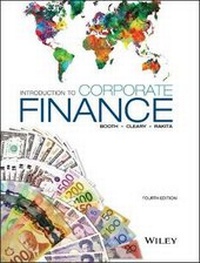
Introduction to Corporate Finance
Managing Canadian Firms in A Global Environment
4th Edition
Published on 18. May 2018
Book
Hardback
904 pages
978-1-119-17128-7 (ISBN)
Description
In the fourth edition of Introduction to Corporate Finance, authors Laurence Booth and Sean Cleary welcome new author Ian Rakita. The addition of a new author further enhances this already great ground up Canadian text. The fourth edition has been revised to be even more user friendly and engaging. Content has been restructured with additional sub headings in some chapters and the merger of some sections in others-all with the goal of aiding comprehension and retention. The text continues to provide undergraduate students with the most thorough, accessible, accurate, and current coverage of the theory and application of corporate finance within a uniquely Canadian context. This text will provide students with the skills they need to succeed not only in the undergraduate course, but in their future careers.
More details
Edition
4th edition
Language
English
Place of publication
New York
United States
Target group
College/higher education
Dimensions
Height: 277 mm
Width: 216 mm
Thickness: 36 mm
Weight
2087 gr
ISBN-13
978-1-119-17128-7 (9781119171287)
Copyright in bibliographic data and cover images is held by Nielsen Book Services Limited or by the publishers or by their respective licensors: all rights reserved.
Schweitzer Classification
Other editions
Previous edition
Laurence Booth | W. Sean Cleary
Introduction to Corporate Finance
Book
12/2012
3rd Edition
Wiley
€148.56
Article exhausted; check for reprint
Persons
Laurence Booth, DBA, MBA, MA (Indiana University); BS (London School of Economics), is Professor of Finance and holds the CIT chair in structured finance at the Rotman School of Management, University of Toronto. His major research interests are in corporate finance and the behaviour of regulated industries. He has published over 70 articles in numerous journals including Journal of Finance and Journal of Financial and Quantitative Analysis, has co-authored a textbook on international business and two on corporate finance, and is on the editorial board of several academic journals.
Sean Cleary, CFA, is the BMO Professor of Finance at the Smith School of Business, Queen 's University. Dr. Cleary holds a PhD in finance from the University of Toronto, an MBA, is a Chartered Financial Analyst (CFA) charterholder, and is a former board member of both the Atlantic Canada and Toronto CFA societies. He has also completed the Professional Financial Planning Course (PFPC), the Canadian Securities Course (CSC), and the Investment Funds Institute of Canada (IFIC) Mutual Fund Course.
Ian Rakita, CFA, started teaching in the Department of Finance at Concordia University 's John Molson School of Business in 1993 after extensive industry experience. He received his Bachelor of Science degree from McGill University, where he majored in mathematics, and his MBA from Concordia University. He earned his PhD from Concordia in 2000. During 1997-1998 he taught at Wilfrid Laurier University in Waterloo, Ontario, where he received a commendation for teaching excellence. Dr. Rakita teaches courses at the undergraduate and graduate level in corporate finance, fixed income securities, and derivatives. He has also taught courses in operations research and business statistics. His research interests are in the microstructure of new and secondary equity offerings as well as the efficiency of Canadian capital markets.
Sean Cleary, CFA, is the BMO Professor of Finance at the Smith School of Business, Queen 's University. Dr. Cleary holds a PhD in finance from the University of Toronto, an MBA, is a Chartered Financial Analyst (CFA) charterholder, and is a former board member of both the Atlantic Canada and Toronto CFA societies. He has also completed the Professional Financial Planning Course (PFPC), the Canadian Securities Course (CSC), and the Investment Funds Institute of Canada (IFIC) Mutual Fund Course.
Ian Rakita, CFA, started teaching in the Department of Finance at Concordia University 's John Molson School of Business in 1993 after extensive industry experience. He received his Bachelor of Science degree from McGill University, where he majored in mathematics, and his MBA from Concordia University. He earned his PhD from Concordia in 2000. During 1997-1998 he taught at Wilfrid Laurier University in Waterloo, Ontario, where he received a commendation for teaching excellence. Dr. Rakita teaches courses at the undergraduate and graduate level in corporate finance, fixed income securities, and derivatives. He has also taught courses in operations research and business statistics. His research interests are in the microstructure of new and secondary equity offerings as well as the efficiency of Canadian capital markets.
Content
PART 1: THE FINANCIAL ENVIRONMENT 1 Chapter 1: An Introduction to Finance 3
Chapter 2: Business (Corporate) Finance 29
PART 2: FINANCIAL ANALYSIS TOOLS 55
Chapter 3: Financial Statements 57
Chapter 4: Financial Statement Analysis and Forecasting 97
PART 3: VALUATION BASICS 141
Chapter 5: Time Value of Money 143
Chapter 6: Bond Valuation and Interest Rates 185
Chapter 7: Equity Valuation 225
PART 4: PORTFOLIO AND CAPITAL MARKET THEORY 263
Chapter 8: Risk, Return, and Portfolio Theory 265
Chapter 9: The Capital Asset Pricing Model (CAPM) 307
Chapter 10: Market Efficiency 339
PART 5: DERIVATIVE SECURITIES 371
Chapter 11: Forwards, Futures, and Swaps 373
Chapter 12: Options 415
PART 6: LONG-TERM INVESTMENT DECISIONS 455
Chapter 13: Capital Budgeting, Risk Considerations, and Other Special Issues 457
Chapter 14: Cash Flow Estimation and Capital Budgeting Decisions 493
Chapter 15: Mergers and Acquisitions 529
Chapter 16: Leasing 571
PART 7: LONG-TERM FINANCING 599
Chapter 17: Investment Banking and Securities Law 601
Chapter 18: Debt Instruments 631
Chapter 19: Equity and Hybrid Instruments 659
Chapter 20: Cost of Capital 693
PART 8: FINANCIAL POLICIES 739
Chapter 21: Capital Structure Decisions 741
Chapter 22: Dividend Policy 785
PART 9: WORKING CAPITAL MANAGEMENT 817
Chapter 23: Working Capital Management: General Issues 819
Chapter 24: Working Capital Management: Current Assets and Current Liabilities 843
Appendix 1 869
Index 871
Chapter 2: Business (Corporate) Finance 29
PART 2: FINANCIAL ANALYSIS TOOLS 55
Chapter 3: Financial Statements 57
Chapter 4: Financial Statement Analysis and Forecasting 97
PART 3: VALUATION BASICS 141
Chapter 5: Time Value of Money 143
Chapter 6: Bond Valuation and Interest Rates 185
Chapter 7: Equity Valuation 225
PART 4: PORTFOLIO AND CAPITAL MARKET THEORY 263
Chapter 8: Risk, Return, and Portfolio Theory 265
Chapter 9: The Capital Asset Pricing Model (CAPM) 307
Chapter 10: Market Efficiency 339
PART 5: DERIVATIVE SECURITIES 371
Chapter 11: Forwards, Futures, and Swaps 373
Chapter 12: Options 415
PART 6: LONG-TERM INVESTMENT DECISIONS 455
Chapter 13: Capital Budgeting, Risk Considerations, and Other Special Issues 457
Chapter 14: Cash Flow Estimation and Capital Budgeting Decisions 493
Chapter 15: Mergers and Acquisitions 529
Chapter 16: Leasing 571
PART 7: LONG-TERM FINANCING 599
Chapter 17: Investment Banking and Securities Law 601
Chapter 18: Debt Instruments 631
Chapter 19: Equity and Hybrid Instruments 659
Chapter 20: Cost of Capital 693
PART 8: FINANCIAL POLICIES 739
Chapter 21: Capital Structure Decisions 741
Chapter 22: Dividend Policy 785
PART 9: WORKING CAPITAL MANAGEMENT 817
Chapter 23: Working Capital Management: General Issues 819
Chapter 24: Working Capital Management: Current Assets and Current Liabilities 843
Appendix 1 869
Index 871