

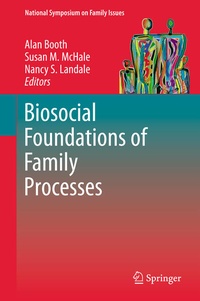
Biosocial Foundations of Family Processes
1st Edition
Published on 10. December 2010
Book
Hardback
XVI, 272 pages
978-1-4419-7360-3 (ISBN)
Description
Biosocial Research Contributions to Family Processes and Problems, based on the 17th annual National Symposium on Family Issues, examines biosocial models and processes in the context of the family. Research on both biological and social/environmental influences on behavior, health, and development is represented, including behavioral endocrinology, behavior genetics, neuroscience, evolutionary psychology, sociology, demography, anthropology, economics, and psychology. The authors consider physiological and social environmental influences on parenting and early childhood development, followed by adolescent adjustment, and family formation. Also, factors that influence how families adapt to social inequalities are examined.
More details
Series
Edition
1st Edition.
Language
English
Place of publication
New York
United States
Target group
Professional and scholarly
Research
Product notice
Unsewn / adhesive bound
Paper over boards
Illustrations
XVI, 272 p.
Dimensions
Height: 242 mm
Width: 165 mm
Thickness: 28 mm
Weight
569 gr
ISBN-13
978-1-4419-7360-3 (9781441973603)
DOI
10.1007/978-1-4419-7361-0
Schweitzer Classification
Other editions
Additional editions
Alan Booth | Susan M. McHale | Nancy S. Landale
Biosocial Foundations of Family Processes
Book
01/2013
Springer
€106.99
Shipment within 15-20 days
Alan Booth | Susan M. McHale | Nancy S. Landale
Biosocial Foundations of Family Processes
E-Book
12/2010
1st Edition
Springer
€96.29
Available for download
Content
I. Parenting and Early Childhood Behavior and Development.- How Mothers Are Born: A Psychobiological Analysis Of Mothering.- How Fathers Evolve: A Functional Analysis Of Fathering Behavior.- Caregiving As Co-Regulation: Psychobiological Processes And Child Functioning.- The Determinants of Parenting in GXE Perspective: A Case of Differential Susceptibility.- II. Development and Adjustment in Adolescence.- Gene-Environment Interplay Helps To Explain Influences Of Family Relationships On Adolescent Adjustment And Development.- The Importance of the Phenotype in Explorations of Gene-Environment Interplay.- The Importance of Puberty in Adolescent Development.- Genes, Hormones, and Family Behavior: What Makes Adolescence Unique.- III. Mate Selection, Family Formation, and Fertility.- Human Adaptations for Mating: Frameworks for Understanding Patterns of Family Formation and Fertility.- The Need for Family Research Using Multiple Approaches and Methods.- Psychological Adaptation and Human Fertility Patterns: Some Evidence of Human Mating Strategies as Evoked Sexual Culture.- Comments on Consilience Efforts.- IV. Family Adaptations to Resource Disparities.- Family Influences on Children's Well-Being: Potential Roles of Molecular Genetics and Epigenetics.- Social Inequalities, Family Relationships, and Child Health.- Family Resources, Genes, and Human Development.- In Search of GE: Why We Haven't Documented a Gene-Social Environment Interaction Yet.- A Promising Approach to Future Biosocial Research on the Family: Considering The Role of Temporal Context.