

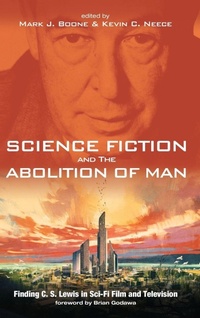
Science Fiction and the Abolition of Man
Finding C. S. Lewis in Sci-Fi Film and Television
Published on 13. December 2016
Book
Hardback
356 pages
978-1-4982-3236-4 (ISBN)
Description
The Abolition of Man, C. S. Lewis's masterpiece in ethics and the philosophy of science, warns of the danger of combining modern moral skepticism with the technological pursuit of human desires. The end result is the final destruction of human nature. From Brave New World to Star Trek, from steampunk to starships, science fiction film has considered from nearly every conceivable angle the same nexus of morality, technology, and humanity of which C. S. Lewis wrote. As a result, science fiction film has unintentionally given us stunning depictions of Lewis's terrifying vision of the future. In Science Fiction Film and the Abolition of Man, scholars of religion, philosophy, literature, and film explore the connections between sci-fi film and the three parts of Lewis's book: how sci-fi portrays ""Men without Chests"" incapable of responding properly to moral good, how it teaches the Tao or ""The Way,"" and how it portrays ""The Abolition of Man.""
""Though The Abolition of Man is one of Lewis's shortest books, it is also one of the most important and influential. This interesting collection of essays shows how the perceptive critiques and prescient warnings found in Abolition resound tellingly in many science fiction films and TV shows. A valuable and thought-provoking volume.""
--Michael Ward, Fellow of Blackfriars Hall, University of Oxford
""Students of C. S. Lewis and fans of science fiction alike will find their understanding of today's and tomorrow's world enriched, and likely chastened, by this thought-provoking collection of essays.""
--Charles T. Rubin, author of Eclipse of Man
""Here we have an engaging, accessible, and highly relevant collection of essays on how science fiction at its best portrays our possible subhuman future.""
--Peter Lawler, Dana Professor of Political Science, Berry College
""Science fiction is often a kind of sociological exploration. Science Fiction and the Abolition of Man demonstrates this clearly. The diverse interpretations demonstrate why sociological explorations of sci-fi are always journeys worth taking.""
--John Tenuto, Professor of Sociology, College of Lake Count
""Science fiction films have warned for decades: the purveyors of scientific technologies may promise a better and happier world, but in a culture bereft of orientation to goodness beyond ourselves, they can only provide different worlds--crafted at their whim, and often morally dangerous and profoundly unhappy. These delightful essays, by clarifying that warning through the lens of classic moral psychology, send us back to those great films with new eyes and, more importantly, refreshed hearts for goodness.""
--Robert B. Kruschwitz, Professor of Philosophy, Baylor University
Mark J. Boone is Assistant Professor of Philosophy at Forman Christian College. He is the author of The Conversion and Therapy of Desire: Augustine's Theology of Desire in the Cassiciacum Dialogues (Pickwick, 2016).
Kevin C. Neece is a speaker on media, the arts, and pop culture from a Christian worldview perspective. He is the author of The Gospel according to Star Trek (Cascade, 2016).
More details
Language
English
Place of publication
Eugene
United States
Product notice
sewn/stitched
Cloth over boards
With dust jacket
Dimensions
Height: 235 mm
Width: 157 mm
Thickness: 24 mm
Weight
669 gr
ISBN-13
978-1-4982-3236-4 (9781498232364)
Copyright in bibliographic data and cover images is held by Nielsen Book Services Limited or by the publishers or by their respective licensors: all rights reserved.
Schweitzer Classification
Other editions
Additional editions
Mark J. Boone | Kevin C. Neece
Science Fiction and The Abolition of Man
Finding C. S. Lewis in Sci-Fi Film and Television
E-Book
12/2016
Wipf and Stock Publishers
€43.99
Available for download
Persons
Mark J. Boone is Assistant Professor of Philosophy at Forman Christian College. He is the author of The Conversion and Therapy of Desire: Augustine's Theology of Desire in the Cassiciacum Dialogues (Pickwick, 2016). Kevin C. Neece is a speaker on media, the arts, and pop culture from a Christian worldview perspective. He is the author of The Gospel according to Star Trek (Cascade, 2016).