

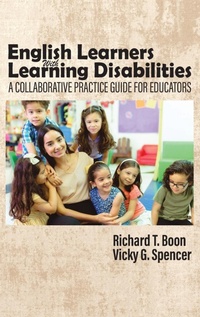
English Learners with Learning Disabilities
A Collaborative Practice Guide for Educators
Published on 10. April 2023
Book
Hardback
162 pages
979-8-88730-199-0 (ISBN)
Description
This edited book is intended to offer a practical guide for general, special, and bilingual/English as a second language educators working with English learners (ELs) with learning disabilities (LD) in the K-12 inclusive classroom. Authored by leading scholars with expertise in the fields of special and bilingual education, the book provides educators with a solid foundation of the growing demographics of ELs in our schools, an understanding of second language acquisition, and further knowledge of the referral, assessment, and identification process.
A detailed discussion addresses cultural competence and the development of the individualized education program (IEP) and provides an overview of legal and instructional foundations for developing culturally and linguistically responsive (CLR) IEPs for diverse learners, with a specific focus on students with LD who are acquiring English as an additional language. Federal legislative mandates, required IEP components, and the significant role that families assume in quality IEP development is presented along with practical examples that demonstrate a strengths-based perspective for engaging colleagues and families in the development of CLR IEPs for ELs.
The remaining chapters of the book provide content on the use of a multi-tiered systems of support (MTSS) framework, effective instructional practices, and research-based language and literacy interventions. To assist with the implementation of these interventions, a variety of co-teaching models are provided. Finally, the authors suggest ways to better communicate with parents and/or families to enhance collaboration between home and school.
A detailed discussion addresses cultural competence and the development of the individualized education program (IEP) and provides an overview of legal and instructional foundations for developing culturally and linguistically responsive (CLR) IEPs for diverse learners, with a specific focus on students with LD who are acquiring English as an additional language. Federal legislative mandates, required IEP components, and the significant role that families assume in quality IEP development is presented along with practical examples that demonstrate a strengths-based perspective for engaging colleagues and families in the development of CLR IEPs for ELs.
The remaining chapters of the book provide content on the use of a multi-tiered systems of support (MTSS) framework, effective instructional practices, and research-based language and literacy interventions. To assist with the implementation of these interventions, a variety of co-teaching models are provided. Finally, the authors suggest ways to better communicate with parents and/or families to enhance collaboration between home and school.
More details
Language
English
Place of publication
Charlotte
United States
Publishing group
Emerald Publishing Inc
Target group
Professional and scholarly
Dimensions
Height: 240 mm
Width: 161 mm
Thickness: 14 mm
Weight
414 gr
ISBN-13
979-8-88730-199-0 (9798887301990)
Copyright in bibliographic data and cover images is held by Nielsen Book Services Limited or by the publishers or by their respective licensors: all rights reserved.
Schweitzer Classification
Content
Chapter 1. English Learners With Learning Disabilities: Demographic Imperatives; Alba A. Ortiz.
Chapter 1. Second Language Acquisition; Sylvia Linan-Thompson.
Chapter 2. Referral, Assessment, and Identification; Catherine Richards-Tutor and Maria Virginia Cornejo Guevara.
Chapter 3. The Individualized Education Program; John J. Hoover and Lydia Sollenberger.
Chapter 4. Legislation, Pedagogy, and Multi-Tiered Systems of Support; Kristi L. Santi.
Chapter 5. Effective Instruction; Tim T. Andress and Colleen K. Reutebuch.
Chapter 6. Co-Teaching Models; Wendy W. Murawski and Samantha G. Toews.
Chapter 7. Communication and Collaboration With Families; Terese C. Aceves and Lauren Black.
Biographies.
Chapter 1. Second Language Acquisition; Sylvia Linan-Thompson.
Chapter 2. Referral, Assessment, and Identification; Catherine Richards-Tutor and Maria Virginia Cornejo Guevara.
Chapter 3. The Individualized Education Program; John J. Hoover and Lydia Sollenberger.
Chapter 4. Legislation, Pedagogy, and Multi-Tiered Systems of Support; Kristi L. Santi.
Chapter 5. Effective Instruction; Tim T. Andress and Colleen K. Reutebuch.
Chapter 6. Co-Teaching Models; Wendy W. Murawski and Samantha G. Toews.
Chapter 7. Communication and Collaboration With Families; Terese C. Aceves and Lauren Black.
Biographies.