

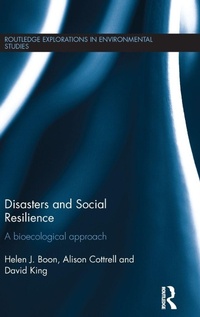
Disasters and Social Resilience
A bioecological approach
1st Edition
Published on 12. May 2016
Book
Hardback
220 pages
978-1-138-93312-5 (ISBN)
Description
The interconnectedness of communities, organisations, governing bodies, policy and individuals in the field of disaster studies has never been accurately examined or comprehensively modelled. This kind of study is vital for planning policy and emergency responses and assessing individual and community vulnerability, resilience and sustainability as well as mitigation and adaptation to climate change impacts; it therefore deserves attention.
Disasters and Social Resilience fills this gap by introducing to the field of disaster studies a fresh methodology and a model for examining and measuring impacts and responses to disasters. Urie Bronfenbrenner's bioecological systems theory, which is used to look at communities holistically, is outlined and illustrated through a series of chapters, guiding the reader from the theory's underpinnings through research illustrations and applications focused on each level of Bronfenbrenner's ecosystems, culminating in an integration chapter. The final chapter provides policy recommendations for local and national government bodies and emergency providers to help individuals and communities prepare and withstand the effects of a range of disasters.
This book will be of great interest to scholars and students of disaster and emergency management, disaster readiness and risk reduction (DRR), and to scholars and students of more general climate change and sustainability studies.
Disasters and Social Resilience fills this gap by introducing to the field of disaster studies a fresh methodology and a model for examining and measuring impacts and responses to disasters. Urie Bronfenbrenner's bioecological systems theory, which is used to look at communities holistically, is outlined and illustrated through a series of chapters, guiding the reader from the theory's underpinnings through research illustrations and applications focused on each level of Bronfenbrenner's ecosystems, culminating in an integration chapter. The final chapter provides policy recommendations for local and national government bodies and emergency providers to help individuals and communities prepare and withstand the effects of a range of disasters.
This book will be of great interest to scholars and students of disaster and emergency management, disaster readiness and risk reduction (DRR), and to scholars and students of more general climate change and sustainability studies.
Reviews / Votes
"The book makes a useful contribution to disaster management by highlighting the complexities of the concept of social resilience in the context of disasters. It provides an opportunity for the reader to reflect on social resilience and disasters."Michael Tarrent, Adjunct Associate Professor at Queensland University of Technology in Disasters and Social Resilience: a bioecological approach
More details
Series
Language
English
Place of publication
London
United Kingdom
Publishing group
Taylor & Francis Ltd
Target group
College/higher education
Illustrations
7 s/w Tabellen, 34 s/w Abbildungen, 12 s/w Photographien bzw. Rasterbilder, 15 s/w Zeichnungen
7 Tables, black and white; 15 Line drawings, black and white; 12 Halftones, black and white; 34 Illustrations, black and white
Dimensions
Height: 240 mm
Width: 161 mm
Thickness: 17 mm
Weight
502 gr
ISBN-13
978-1-138-93312-5 (9781138933125)
Copyright in bibliographic data and cover images is held by Nielsen Book Services Limited or by the publishers or by their respective licensors: all rights reserved.
Schweitzer Classification
Other editions
Additional editions
Book
01/2018
1st Edition
Routledge
€79.51
Shipment within 15-20 days
E-Book
05/2016
Routledge
€67.49
Available for download
E-Book
05/2016
Routledge
€67.49
Available for download
Persons
Helen J. Boon is a Senior Lecturer at the College of Arts, Society and Education, Division of Tropical Environments and Societies at James Cook University, Australia.
Alison Cottrell is an Associate Professor with the Centre for Disaster Studies and Associate Dean Research Education within the College of Marine and Environmental Sciences at James Cook University, Australia.
David King is an Associate Professor in the College of Marine and Environmental Sciences at James Cook University, Australia, and is Director of the Centre for Disaster Studies, and the Centre for Tropical Urban and Regional Planning.
Alison Cottrell is an Associate Professor with the Centre for Disaster Studies and Associate Dean Research Education within the College of Marine and Environmental Sciences at James Cook University, Australia.
David King is an Associate Professor in the College of Marine and Environmental Sciences at James Cook University, Australia, and is Director of the Centre for Disaster Studies, and the Centre for Tropical Urban and Regional Planning.
Content
1. Introduction 2. Rationale for the use of Bronfenbrenner's bioecological systems theory to examine resilience 3. Methodology: An application of Bronfenbrenner's bioecological systems theory 4. Individuals' disaster resilience 5. The microsystem in disaster resilience 6. The mesosystem in disaster resilience 7. The Exosystem and the Community 8. The Macrosystem 9. The Chronosystem Conclusion