

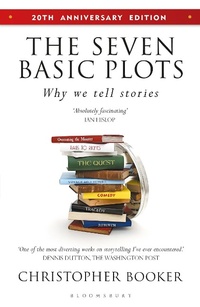
The Seven Basic Plots
Description
But this is only the prelude to an investigation into how and why we are 'programmed' to imagine stories in these ways, and how they relate to the inmost patterns of human psychology. Drawing on a vast array of examples, from Proust to detective stories, from the Marquis de Sade to E.T., Christopher Booker then leads us through the extraordinary changes in the nature of storytelling over the past 200 years, and why so many stories have 'lost the plot' by losing touch with their underlying archetypal purpose.
Booker analyses why evolution has given us the need to tell stories and illustrates how storytelling has provided a uniquely revealing mirror to mankind's psychological development over the past 5000 years.
This seminal book opens up in an entirely new way our understanding of the real purpose storytelling plays in our lives, and will be a talking point for years to come.
Reviews / Votes
Number 5 in Foyles bookshop Top Ten Number 5 in Foyles bookshop Top Ten Number 5 in Foyles bookshop Top Ten "....remarkable parallels between the structure of the modern film Jaws and that of the Old English Beowulf." Writing Magazine "If you have any interest in fiction and the way it works, you will enjoy this exploration of the seven basic plots and how they have been adapted and developed across the centuries." Writing Magazine Mentioned in article about author in The Lady, 17/07/07 -- The Lady "This magisterial volume really does offer readers a genuinely fresh and exciting perspective on virtually every tale ever told." --Bookmark, July 2005 -- Bookmark "Fantastically entertaining" The Times mention in Evangelical Times, 1 May 2009 Excerpts included in Gotham Writer's Workshop monthly e-newsletter for screenwriters. http://www.writingclasses.com/mailing.php?id=2419 'This book...has mind-expanding properties. Not only for anyone interested in literature, but also for those fascinated by wider questions of how human beings organise their societies and explain the outside world to their inmost selves, it is fascinating.' Katherine Sale, FT * Blurb from reviewer * 'Christopher Booker's mammoth account of plot types, archetypes, their role in literary history and where Western culture has gone horribly wrong.' Times Literary Supplement * Blurb from reviewer * 'His prose is a model of clarity, and his lively enthusiamsm for fictions of every description is infectious...The Seven Basic Plots is...one of the most diverting works on storytelling I've ever encountered.' Dennis Dutton, The Washington Post * Blurb from reviewer * 'This is the most extraordinary, exhilarating book. It always seemed to me that 'the story' was God's way of giving meaning to crude creation. Booker now interprets the mind of God, and analyses not just the novel - which will never to me be quite the same again - but puts the narrative of contemporary human affairs into a new perspective. If it took its author a lifetime to write, one can only feel gratitude that he did it.' Fay Weldon, novelist * Blurb from reviewer * 'An enormous piece of work...nothing less than the story of all stories. And an extraordinary tale it is ... Booker ranges over vast tracts of literature, drawing together the plots of everything from Beowulf to Bond, from Sophocles to soap opera, from Homer to Homer Simpson, to show the underlying parallels in stories from what appear to be the most disparate sources. If stories are about "what happens next", this book sets out to show that the answer is always "the same things", then to explain why. I found it absolutely fascinating.' Ian Hislop, editor of Private Eye * Blurb from reviewer * 'This is literally an incomparable book, because there is nothing to compare it with. It goes to the heart of man's cultural evolution through the stories we have told since storytelling began. It illuminates our nature, our beliefs and our collective emotions by shining a bright light on them from a completely new angle. Original, profound, fascinating - and on top of it all, a really good read.' Sir Antony Jay, co-author of Yes, Minister * Blurb from reviewer * 'I have been quite bowled over by Christopher Booker's new book. It is so well planned with an excellent beginning and the contrasts and comparisons throughout are highly entertaining as well as informative and most original - and always extremely readable.' John Bayley * Blurb from reviewer * 'Booker's knowledge and understanding of imaginative literature is unrivalled, his essays on the great authors both illuminating and stimulating. This is a truly important book, an accolade often bestowed and rarely deserved in our modern age.' Dame Beryl Bainbridge * Blurb from reviewer * Title mention in article -- Neil Philip * Books for Keep * 'some splendid links between story and reality...enjoyably provocative' -- Gordon Parsons * Morning Star, The * 'It's hard not to admire the commitment of any writer whose book has taken 34 years to evolve. And there can be no doubting that Christopher Booker's 700-page, exhaustive examination of "Why we tell stories" - the book's subtitle - is a labour of love.' -- Gordon Parsons * Morning Star, The * "one of the most brilliant books of recent years" -- Bel Mooney * Times *More details
Other editions
Additional editions
Persons
Content
Introduction and historical notes
PART ONE: THE SEVEN GATEWAYS TO THE UNDERWORLD
1 Overcoming the Monster
2 The Monster (II) and the Thrilling Escape from Death
3 Rages to Riches
4 The Quest
5 Voyage and Return
6 Comedy
7 Comedy (II): The Plot Disguised
8 Tragedy (I): The Five Stages
9 Tragedy (II): The Divided Self
10 Tragedy (III): The Hero as Monster
11 Rebirth
12 The Dark Power: From Shadow into Light
Epilogue to Part One: The Rule of Three (the role played in stories by numbers)
PART TWO: THE COMPLETE HAPPY ENDING
Prologue to Part Two
13 The Dark Figures
14 Seeing Whole: The Feminine and Masculine Values
15 The Perfect Balance
16 The Unrealised Value
17 The Archetypal Family Drama (Continued)
18 The Light Figures
19 Reaching the Goal
20 The Fatal Flaw
PART THREE: MISSING THE MARK
21 The Ego Takes Over (I): Enter the Dark Inversion
22 The Ego Takes Over (II): The Dark and Sentimental Versions
23 The Ego Takes Over (III): Quest, Voyage and Return, Comedy
24 The Ego Takes Over (IV): Tragedy and Rebirth
25 Losing the Plot: Thomas Hardy - A Case History
26 Going Nowhere: The Passive Ego. The Twentieth-Century Dead End - From Chekhov to Close Encounters
27 Why Sex and Violence? The Active Ego. The Twentieth-Century Obsession: From de Sade to The Terminator
28 Rebellion Against 'The One': From Job to Nineteen Eighty-Four
29 The Mystery
30 The Riddle of the Sphinx: Oedipus and Hamlet
PART FOUR: WHY WE TELL STORIES
31 Telling Us Who We Are: Ego versus Instinct
32 Into the Real World: The Ruling Consciousness
33 Of Gods and Men: Reconnecting with 'The One'
34 The Age of Loki: The Dismantling of the Self
Epilogue: The Light and the Shadows on the Wall
Author's Personal Note
Glossary of Terms
Bibliography
Index of Stories Cited
General Index