

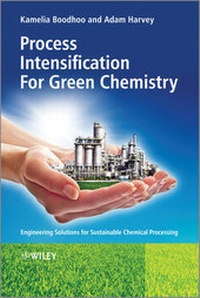
Process Intensification Technologies for Green Chemistry
Engineering Solutions for Sustainable Chemical Processing
Published on 1. February 2013
Book
Hardback
430 pages
978-0-470-97267-0 (ISBN)
Description
The successful implementation of greener chemical processes relies not only on the development of more efficient catalysts for synthetic chemistry but also, and as importantly, on the development of reactor and separation technologies which can deliver enhanced processing performance in a safe, cost-effective and energy efficient manner. Process intensification has emerged as a promising field which can effectively tackle the challenges of significant process enhancement, whilst also offering the potential to diminish the environmental impact presented by the chemical industry.
Following an introduction to process intensification and the principles of green chemistry, this book presents a number of intensified technologies which have been researched and developed, including case studies to illustrate their application to green chemical processes.
Topics covered include:
* Intensified reactor technologies: spinning disc reactors, microreactors, monolith reactors, oscillatory flow reactors, cavitational reactors
* Combined reactor/separator systems: membrane reactors, reactive distillation, reactive extraction, reactive absorption
* Membrane separations for green chemistry
* Industry relevance of process intensification, including economics and environmental impact, opportunities for energy saving, and practical considerations for industrial implementation.
Process Intensification for Green Chemistry is a valuable resource for practising engineers and chemists alike who are interested in applying intensified reactor and/or separator systems in a range of industries to achieve green chemistry principles.
More details
Edition
1. Auflage
Language
English
Place of publication
New York
United States
Target group
Professional and scholarly
Product notice
sewn/stitched
Paper over boards
Dimensions
Height: 250 mm
Width: 175 mm
Thickness: 28 mm
Weight
919 gr
ISBN-13
978-0-470-97267-0 (9780470972670)
Schweitzer Classification
Other editions
Additional editions
Kamelia Boodhoo | Adam Harvey
Process Intensification Technologies for Green Chemistry
Engineering Solutions for Sustainable Chemical Processing
E-Book
01/2013
Wiley
€112.99
Available for download
Kamelia Boodhoo | Adam Harvey
Process Intensification Technologies for Green Chemistry
Engineering Solutions for Sustainable Chemical Processing
E-Book
12/2012
Wiley
€112.99
Available for download
Persons
Dr Kamelia Boodhoo, Newcastle University, UK.
Dr Boodhoo's research in the area of Process Intensification focuses on the development of centrifugal field reactors with particular emphasis on Spinning Disc Reactors. She also has a keen interest in intensification applications involving green chemistry and engineering and renewable resources such as the use of biomass for biopolymers. Dr Boodhoo has been involved in designing and delivering a specialist module on Process Intensification targeted at final year MEng students and MSc students at Newcastle University. For the last two years, she has also been a guest lecturer on the MSc in Green Chemistry and Sustainable Industrial Technology programme at the University of York, teaching "Improved Reactor Designs through Process intensification".
Dr Adam Harvey, Newcastle University, UK.
Dr Harvey is an active member of the Process Intensification Group at Newcastle. He is a member of the steering committee of the international research network "Process Intensification Network" and co-author of "Process Intensification", published in 2008. He currently lectures on Oscillatory Flow Reactors as part of the Process Intensification module delivered to final year MEng and MSc students.
Dr Boodhoo's research in the area of Process Intensification focuses on the development of centrifugal field reactors with particular emphasis on Spinning Disc Reactors. She also has a keen interest in intensification applications involving green chemistry and engineering and renewable resources such as the use of biomass for biopolymers. Dr Boodhoo has been involved in designing and delivering a specialist module on Process Intensification targeted at final year MEng students and MSc students at Newcastle University. For the last two years, she has also been a guest lecturer on the MSc in Green Chemistry and Sustainable Industrial Technology programme at the University of York, teaching "Improved Reactor Designs through Process intensification".
Dr Adam Harvey, Newcastle University, UK.
Dr Harvey is an active member of the Process Intensification Group at Newcastle. He is a member of the steering committee of the international research network "Process Intensification Network" and co-author of "Process Intensification", published in 2008. He currently lectures on Oscillatory Flow Reactors as part of the Process Intensification module delivered to final year MEng and MSc students.
Content
List of Contributors xiii
Preface xv
1 Process Intensification: An Overview of Principles and Practice 1
Kamelia Boodhoo and Adam Harvey
1.1 Introduction 1
1.2 Process Intensification: Definition and Concept 2
1.3 Fundamentals of Chemical Engineering Operations 3
1.4 Intensification Techniques 11
1.5 Merits of PI Technologies 21
1.6 Challenges to Implementation of PI 24
1.7 Conclusion 25
Nomenclature 26
Greek Letters 26
References 27
2 Green Chemistry Principles 33
James Clark, Duncan Macquarrie, Mark Gronnow and Vitaly Budarin
2.1 Introduction 33
2.2 The Twelve Principles of Green Chemistry 35
2.3 Metrics for Chemistry 37
2.4 Catalysis and Green Chemistry 41
2.5 Renewable Feedstocks and Biocatalysis 46
2.6 An Overview of Green Chemical Processing Technologies 50
2.7 Conclusion 55
References 55
3 Spinning Disc Reactor: Continuous Thin-film Flow Processing for Green Chemistry Applications 59
Kamelia Boodhoo
3.1 Introduction 59
3.2 Design and Operating Features of SDRs 60
3.3 Characteristics of SDRs 66
3.4 Case Studies: SDR Application for Green Chemical Processing and Synthesis 76
3.5 Hurdles to Industry Implementation 84
3.6 Conclusion 86
Nomenclature 87
Greek Letters 87
Subscripts 87
References 87
4 Micro Process Technology and Novel Process Windows - Three Intensification Fields 91
Svetlana Borukhova and Volker Hessel
4.1 Introduction 91
4.2 Transport Intensification 93
4.3 Chemical Intensification 108
4.4 Process Design Intensification 128
4.5 Industrial Microreactor Process Development 137
4.6 Conclusion 140
Acknowledgement 141
References 141
5 Green Chemistry in Oscillatory Baffled Reactors 157
Adam Harvey
5.1 Introduction 157
5.2 Case Studies: OBR Green Chemistry 164
5.3 Conclusion 170
References 172
6 Monolith Reactors for Intensified Processing in Green Chemistry 175
Joseph Wood
6.1 Introduction 175
6.2 Design of Monolith Reactors 176
6.3 Hydrodynamics of Monolith Reactors 179
6.4 Advantages of Monolith Reactors 182
6.5 Applications in Green Chemistry 185
6.6 Conclusion 192
Acknowledgement 193
Nomenclature 193
Greek Letters 193
Subscripts and Superscripts 193
References 193
7 Process Intensification and Green Processing Using Cavitational Reactors 199
Vijayanand Moholkar, Parag Gogate and Aniruddha Pandit
7.1 Introduction 199
7.2 Mechanism of Cavitation-based PI of Chemical Processing 200
7.3 Reactor Configurations 201
7.4 Mathematical Modelling 207
7.5 Optimization of Operating Parameters in Cavitational Reactors 209
7.6 Intensification of Cavitational Activity 211
7.7 Case Studies: Intensification of Chemical Synthesis using Cavitation 214
7.8 Overview of Intensification and Green Processing Using Cavitational Reactors 218
7.9 The Future 221
7.10 Conclusion 222
References 222
8 Membrane Bioreactors for Green Processing in a Sustainable Production System 227
Rosalinda Mazzei, Emma Piacentini, Enrico Drioli and Lidietta Giorno
8.1 Introduction 227
8.2 Membrane Bioreactors 228
8.3 Biocatalytic Membrane Reactors 230
8.4 Case Studies: Membrane Bioreactors 232
8.5 Green Processing Impact of Membrane Bioreactors 245
8.6 Conclusion 247
References 247
9 Reactive Distillation 251
Anton Kiss
9.1 Introduction 251
9.2 Principles of RD 252
9.3 Design, Control and Applications 253
9.4 Modelling RD 256
9.5 Economical and Technical Evaluation 257
9.6 Case Studies: RD 261
9.7 Green Processing Impact of RD 270
9.8 Conclusion 271
References 271
10 Reactive Extraction Technology 275
Keat T. Lee and Steven Lim
10.1 Introduction 275
10.2 Case Studies: Reactive Extraction Technology 277
10.3 Impact on Green Processing and Process Intensification 284
10.4 Conclusion 286
References 286
11 Reactive Absorption 289
Anton A. Kiss
11.1 Introduction 289
11.2 Theory and Models 290
11.3 Equipment, Operation and Control 291
11.4 Applications in Gas Purification 293
11.5 Green Processing Impact of RA 307
11.6 Challenges and Future Prospects 307
References 307
12 Membrane Separations for Green Chemistry 311
Rosalinda Mazzei, Emma Piacentini, Enrico Drioli and Lidietta Giorno
12.1 Introduction 311
12.2 Membranes and Membrane Processes 312
12.3 Case Studies: Membrane Operations in Green Processes 318
12.4 Integrated Membrane Processes 342
12.5 Green Processing Impact of Membrane Processes 344
12.6 Conclusion 347
References 347
13 Process Intensification in a Business Context: General Considerations 355
Dag Eimer and Nils Eldrup
13.1 Introduction 355
13.2 The Industrial Setting 356
13.3 Process Case Study 358
13.4 Business Risk and Ideas 366
13.5 Conclusion 367
References 367
14 Process Economics and Environmental Impacts of Process Intensification in the Petrochemicals, Fine Chemicals and Pharmaceuticals Industries 369
Jan Harmsen
14.1 Introduction 369
14.2 Petrochemicals Industry 370
14.3 Fine Chemicals and Pharmaceuticals Industries 376
References 377
15 Opportunities for Energy Saving from Intensified Process Technologies in the Chemical and Processing Industries 379
Dena Ghiasy and Kamelia Boodhoo
15.1 Introduction 379
15.2 Energy-Intensive Processes in UK Chemical and Processing Industries 380
15.3 Case Study: Assessment of the Energy Saving Potential of SDR Technology 383
15.4 Conclusion 389
Nomenclature 390
Greek Letters 390
Subscripts 390
Appendix: Physical Properties of Styrene, Toluene and Cooling/Heating Fluids 391
References 391
16 Implementation of Process Intensification in Industry 393
Jan Harmsen
16.1 Introduction 393
16.2 Practical Considerations for Commercial Implementation 393
16.3 Scope for Implementation in Various Process Industries 397
16.4 Future Prospects 399
References 399
Index 401