

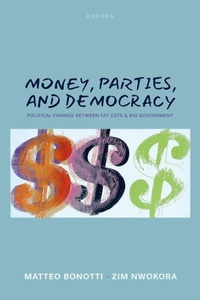
Money, Parties, and Democracy
Political Finance Between Fat Cats and Big Government
Published on 1. May 2025
Book
Hardback
192 pages
978-0-19-285759-0 (ISBN)
Description
Democratic politics is expensive. In United States (US) presidential elections, for instance, total spending, including funding by the candidate-supporting political action committees, now exceeds $6.5 billion. Who should bear these costs? Should the state fund political parties and their campaigns, or should most of the funding come from private citizens?
In the US, election campaigns are largely funded by private donations from individuals and corporate entities, whereas in Germany, the state is the main funder of electoral politics through subventions to parties. In some other countries, parties have been able to raise most of what they need internally by charging membership dues or, more exceptionally, by relying on a wealthy patron. Across these countries, and in many more, however, there have been numerous scandals and controversies involving political finance, which pose a serious challenge to fundamental democratic principles.
Matteo Bonotti and Zim Nwokora analyse the nature of these democratic risks and how they differ across various models of political finance. They argue that political finance rules ought to counterbalance the weaknesses of the party system they are being used alongside. To do so, political finance rules and party systems should be assessed together, in terms of three distinctive normative dimensions-collegiality, systemic voice and systemic accountability-which capture what parties, at their best, can contribute to democratic politics. Money, Parties, and Democracy sets out a framework for evaluating political finance systems so that they can be designed or reformed to better support good governance.
In the US, election campaigns are largely funded by private donations from individuals and corporate entities, whereas in Germany, the state is the main funder of electoral politics through subventions to parties. In some other countries, parties have been able to raise most of what they need internally by charging membership dues or, more exceptionally, by relying on a wealthy patron. Across these countries, and in many more, however, there have been numerous scandals and controversies involving political finance, which pose a serious challenge to fundamental democratic principles.
Matteo Bonotti and Zim Nwokora analyse the nature of these democratic risks and how they differ across various models of political finance. They argue that political finance rules ought to counterbalance the weaknesses of the party system they are being used alongside. To do so, political finance rules and party systems should be assessed together, in terms of three distinctive normative dimensions-collegiality, systemic voice and systemic accountability-which capture what parties, at their best, can contribute to democratic politics. Money, Parties, and Democracy sets out a framework for evaluating political finance systems so that they can be designed or reformed to better support good governance.
More details
Language
English
Place of publication
Oxford
United Kingdom
Target group
College/higher education
Product notice
sewn/stitched
Cloth over boards
Dimensions
Height: 236 mm
Width: 165 mm
Thickness: 30 mm
Weight
454 gr
ISBN-13
978-0-19-285759-0 (9780192857590)
Copyright in bibliographic data and cover images is held by Nielsen Book Services Limited or by the publishers or by their respective licensors: all rights reserved.
Schweitzer Classification
Persons
Matteo Bonotti is an Associate Professor of Politics and International Relations at Monash University in Melbourne. His research interests include democratic theory, political liberalism and public reason, linguistic justice, free speech and civility, and food justice. His work has appeared in journals such as the American Political Science Review, the Journal of Politics, the British Journal of Political Science, and Political Studies. He is the author of Partisanship and Political Liberalism in Diverse Societies (OUP, 2017) and the co-author of Healthy Eating Policy and Political Philosophy: A Public Reason Approach (OUP, 2022).
Zim Nwokora is an Associate Professor of Politics and Policy Studies at Deakin University in Melbourne. He is a comparative political scientist whose research examines theoretical and empirical questions about political party systems, constitutional structures, democracy, and political finance. His work has appeared in journals such as the Australian Journal of Political Science, the Australian Journal of Politics and History, the British Journal of Political Science, Governance, the International Journal of Constitutional Law, Party Politics, Political Research Quarterly, and Political Studies. His research has been discussed in media outlets such as ABC Radio, BBC World Service, and The Conversation.
Zim Nwokora is an Associate Professor of Politics and Policy Studies at Deakin University in Melbourne. He is a comparative political scientist whose research examines theoretical and empirical questions about political party systems, constitutional structures, democracy, and political finance. His work has appeared in journals such as the Australian Journal of Political Science, the Australian Journal of Politics and History, the British Journal of Political Science, Governance, the International Journal of Constitutional Law, Party Politics, Political Research Quarterly, and Political Studies. His research has been discussed in media outlets such as ABC Radio, BBC World Service, and The Conversation.
Content
List of Figure
List of Tables
Introduction
1: The Normative Theory of Partisanship
2: Concentrated Party Systems and the Normative Theory of Partisanship
3: Multiparty Systems and the Normative Theory of Partisanship
4: Political Finance Models and the Normative Theory of Partisanship: Towards a Civic Model
5: Contextualizing the Civic Model of Political Finance
6: Applying the Framework in Practice
References
Index
List of Tables
Introduction
1: The Normative Theory of Partisanship
2: Concentrated Party Systems and the Normative Theory of Partisanship
3: Multiparty Systems and the Normative Theory of Partisanship
4: Political Finance Models and the Normative Theory of Partisanship: Towards a Civic Model
5: Contextualizing the Civic Model of Political Finance
6: Applying the Framework in Practice
References
Index