

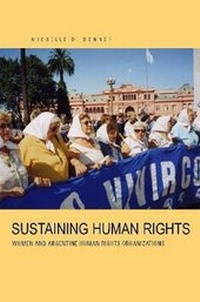
Sustaining Human Rights
Women and Argentine Human Rights Organizations
Published on 25. June 2007
Book
Hardback
216 pages
978-0-271-03264-1 (ISBN)
Description
The "disappearance" and torture of many people during the worst days of the authoritarian regimes that ruled many Latin American countries in the 1970s have been well documented and widely condemned as abuses of human rights. Less well known is what has become of the movements for human rights once democratic governments were restored in these countries. In this book, Michelle Bonner reveals how the defense of human rights continues today, taking Argentina as her primary example (with comparison to Chile in the final chapter).
Bonner shows that the role of women-viewed as protectors of the family-is key to understanding how human rights movements have evolved. Moreover, the continuity of the "historical frames" used to legitimate their activity is an essential element in the success of their efforts, even while the claimed abuse has changed from the political repression undertaken by the dictators' minions to the economic hardships created by market inequities resulting from neoliberal policies.
Based on extensive field research and providing a long historical view extending from colonial times to the present, this study compares the activities of the ten most prominent human rights organizations in Argentina and assesses the responses of both state and society.
Bonner shows that the role of women-viewed as protectors of the family-is key to understanding how human rights movements have evolved. Moreover, the continuity of the "historical frames" used to legitimate their activity is an essential element in the success of their efforts, even while the claimed abuse has changed from the political repression undertaken by the dictators' minions to the economic hardships created by market inequities resulting from neoliberal policies.
Based on extensive field research and providing a long historical view extending from colonial times to the present, this study compares the activities of the ten most prominent human rights organizations in Argentina and assesses the responses of both state and society.
Reviews / Votes
"This thoughtful, original study shows how women's human rights movements in Argentina adopted and extended gendered historical frames to forge a new political vocabulary for the promotion of human rights. Its comprehensive coverage of Argentina's path-breaking experience and its theoretical contribution, deepening our understanding of framing and the struggle for political legitimacy, should be of wide interest in Latin American studies, women's studies, political science, history, and sociology."-Alison Brysk, University of California, Irvine
More details
Language
English
Place of publication
Pennsylvania
United States
Target group
College/higher education
Product notice
sewn/stitched
Illustrations
1 Charts
Dimensions
Height: 229 mm
Width: 152 mm
Thickness: 22 mm
Weight
481 gr
ISBN-13
978-0-271-03264-1 (9780271032641)
Copyright in bibliographic data and cover images is held by Nielsen Book Services Limited or by the publishers or by their respective licensors: all rights reserved.
Schweitzer Classification
Person
Michelle D. Bonner is Assistant Professor of Political Science at the University of Victoria.
Content
Contents
List of Diagrams and Tables
Acknowledgments
Acronyms and Abbreviations
1. Sustaining Human Rights
2. Historical Frames: Colonialism to the 1976 Coup
3. Historical Frames: The Dirty War and Democratization, 1976-2002
4. Human Rights Organizations: Historical Frames as Collective Action Frames
5. The State and Human Rights Organizations: National and International Courts
6. Human Rights Organizations and Society: Demonstrations and the Media
7. Sustaining Human Rights: A Brief Comparison with Chile
Appendixes
Bibliography
Index
List of Diagrams and Tables
Acknowledgments
Acronyms and Abbreviations
1. Sustaining Human Rights
2. Historical Frames: Colonialism to the 1976 Coup
3. Historical Frames: The Dirty War and Democratization, 1976-2002
4. Human Rights Organizations: Historical Frames as Collective Action Frames
5. The State and Human Rights Organizations: National and International Courts
6. Human Rights Organizations and Society: Demonstrations and the Media
7. Sustaining Human Rights: A Brief Comparison with Chile
Appendixes
Bibliography
Index