

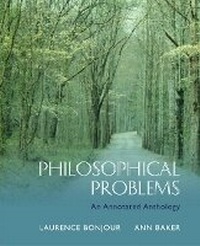
Philosophical Problems
An Annotated Anthology
Published on 15. February 2005
Book
Paperback/Softback
896 pages
978-0-321-23659-3 (ISBN)
Description
This anthology of classic and contemporary philosophical selections provides a &147;roadmap&148; for thinking philosophically, reinforced throughout the introductory essay, reading annotations, discussion questions, argument analysis, and appendix.
More details
Language
English
Place of publication
United States
Publishing group
Pearson Education (US)
Target group
Professional and scholarly
Dimensions
Height: 235 mm
Width: 191 mm
Weight
1334 gr
ISBN-13
978-0-321-23659-3 (9780321236593)
Copyright in bibliographic data and cover images is held by Nielsen Book Services Limited or by the publishers or by their respective licensors: all rights reserved.
Schweitzer Classification
Other editions
New editions
Book
08/2007
2nd Edition
Pearson
€73.22
Article exhausted; check for reprint
Content
Preface.
1. What is Philosophy?
Ann Baker: Philosophical Thinking.
Plato: Euthyphro.
Plato: Apology. Bertrand Russell: The Value of Philosophy.
2. God and Faith.
Does God Exist?
The Cosmological Argument.
St. Thomas Aquinas: The Five Ways, from Summa Theologica.
Samuel Clarke: The Cosmological Argument, from A Demonstration of the Being and Attributes of God.
David Hume: Problems with the Cosmological Argument, from Dialogues Concerning Natural Religion.
The Argument from Design.
William Paley : The Argument from Design, from Natural Theology.
Stephen Jay Gould: The Panda's Thumb.
David Hume: Problems with the Argument from Design, from Dialogues Concerning Natural Religion.
Antony Flew :Critique of the Global Argument from Design, from God: A Critical Inquiry.
The Ontological Argument.
Rene Descartes : The Ontological Argument.
Immanuel Kant: The Impossibility of an Ontological Proof and the Existence of God.
Why Is There Evil?
Fyodor Dostoevsky: Rebellion, from The Brothers Karamozov.
David Hume: The Problem of Evil, from Dialogues Concerning Natural Religion.
J. L. Mackie: Evil and Omnipotence.
John Hick: The Problem of Evil, from Philosophy of Religion.
Must We Have Reasons to Believe?
Walter Kaufmann: Pascal's Wager, from Critique of Religion and Philosophy.
W. K. Clifford: The Ethics of Belief.
William James: The Will to Believe.
3. Knowledge and Skepticism. Do we have knowledge of the external world? Rene Descartes: Meditations on First Philosophy. John Locke: An Essay Concerning Human Understanding. George Berkeley: Three Dialogues Between Hylas and Philonous. Thomas Reid: Of the Existence of a Material World. Laurence BonJour: Knowledge of the External World, from Epistemology: Classic Problems and Contemporary Responses. Are All Reasons Based on Experience? Immanuel Kant: Is All Knowledge Based on Experience or Is Some Knowledge A Priori?, from The Critique of Pure Reaso A. J. Ayer: The A Priori, from Language, Truth and Logic. A. C. Ewing: The "A Priori" and the Empirical, from The Fundamental Questions of Philosophy. Is Induction Justified? David Hume: An Enquiry Concerning Human Understanding, from An Understandng Enquiry Concerning Human Understanding. Wesley Salmon: The Problem of Induction, from The Foundations of Scientific Inference. 4. Minds and Bodies.
Are Minds and Mental States Distinct from Bodies and Material States?
Keith Campbell: How the Mind-Body Problem Arises.
John Foster: A Defense of Dualism. J. J. C. Smart: Sensations and Brain Processes. Jerry Fodor: The Mind-Body Problem.
Are Mental States Analogous to the States of a Computer? A. M. Turing: Computing Machinery and Intelligence. John R. Searle: Is the Brain's Mind a Computer Program? Jerry Fodor: Searle on What Only Brains Can Do. John R. Searle: Author's Response. Can Materialism Account for Qualitative Consciousness? Thomas Nagel: What Is It Like to Be a Bat? Frank Jackson: What Mary Didn't Know. Laurence BonJour: What Is It Like to Be a Human (Instead of a Bat)? David Lewis: Knowing What It's Like. David J. Chalmers: The Puzzle of Conscious Experience. What Is Required for Personal Identity? John Locke : Personal Identity, from An Essay Concerning Human Understanding. Thomas Reid : Of Mr. Locke's Account of Personal Identity. Bernard Williams: The Self and the Future. Derek Parfit: Personal Identity.
5. Free Will and Moral Responsibility.
Are Human Actions Genuinely Free? Miles Corwin: The Case of Robert Harris. Robert Blatchford : A Defense of Hard Determinism, from Not Guilty: A Defense of the Bottom Dog. David Hume : Of Liberty and Necessity. W. T. Stace : A Compatibalist Account of Free Will, from Religion and the Modern Mind. Paul Edwards : Hard and Soft Determinism. John Hospers : What Means This Freedom? Roderick M. Chisholm : Responsibility and Avoidability. C. A. Campbell : In Defense of Free Will. Robert Nozick : Choice and Indeterminism, from Philosophical Explanations. Is Freedom Required for Moral Responsibility? Galen Strawson: Free Will. Susan Wolf : Sanity and the Metaphysics of Responsiblility.
6. Morality. Is Morality Relative? Are We Motivated Only by Self-Interest? James Rachels: The Challenge of Cultural Relativism. James Rachels: Subjectivism in Ethics.
Plato: Are We Better Off Behaving Morally or Immorally? from The Republic.
Joel Feinberg: Psychological Egoism.
What Is the Best Theory of Morality?
Utilitarianism: Morality Depends on Consequences.
Jeremy Bentham: From An Introduction to Principles of Morals and Legislation.
John Stuart Mill : From Utilitarianism.
J. J. C. Smart: Extreme and Restricted Utilitarianism.
Bernard Williams: A Critique of Utilitarianism.
Deontological Views: Morality Depends on Duties and Rights.
Immanuel Kant : From Foundations of the Metaphysics of Morals.
Onora O'Neill : The Moral Perplexities of Famine Relief.
David T. Ozar: Rights: What They Are and Where They Come From.
Virtue Ethics: Morality Depends on Character Traits.
Aristotle: From The Nichomachean Ethics.
Rosalind Hursthouse: Normative Virtue Ethics.
What Are Some Views of Contemporary Moral Problems?
Judith Jarvis Thomson: A Defense of Abortion.
Philippa Foot: Euthanasia.
Thomas Nagel: War and Massacre.
Tom Regan : The Case for Animal Rights.
7. PHILOSOPHY AND THE GOOD LIFE. What Is the Justification for Government? Thomas Hobbes: The Social Contract, from Leviathan. John Locke : The Social Contract, from Second Treatise of Government. David Hume : Of the Original Contract. What Is Social Justice? Robert Nozick: The Entitlement Theory of Justice, from Anarchy, State, and Utopia. John Rawls : Justice as Fairness, from A Theory of Justice. Robert Nozick : A Critique of Rawls, from Anarchy, State, and Utopia.
Thomas M. Scanlon : Nozick on Rights, Liberty, and Property. 8. Philosophy and the Good Life. Leo Tolstoy : The Death of Ivan Illych. Robert Nozick : The Experience Machine. Epictetus : From the Manual.
Thomas Nagel : The Absurd.
Susan Wolf : Happiness and Meaning: Two Aspects of the Good Life.
Appendix.
Glossary.
1. What is Philosophy?
Ann Baker: Philosophical Thinking.
Plato: Euthyphro.
Plato: Apology. Bertrand Russell: The Value of Philosophy.
2. God and Faith.
Does God Exist?
The Cosmological Argument.
St. Thomas Aquinas: The Five Ways, from Summa Theologica.
Samuel Clarke: The Cosmological Argument, from A Demonstration of the Being and Attributes of God.
David Hume: Problems with the Cosmological Argument, from Dialogues Concerning Natural Religion.
The Argument from Design.
William Paley : The Argument from Design, from Natural Theology.
Stephen Jay Gould: The Panda's Thumb.
David Hume: Problems with the Argument from Design, from Dialogues Concerning Natural Religion.
Antony Flew :Critique of the Global Argument from Design, from God: A Critical Inquiry.
The Ontological Argument.
Rene Descartes : The Ontological Argument.
Immanuel Kant: The Impossibility of an Ontological Proof and the Existence of God.
Why Is There Evil?
Fyodor Dostoevsky: Rebellion, from The Brothers Karamozov.
David Hume: The Problem of Evil, from Dialogues Concerning Natural Religion.
J. L. Mackie: Evil and Omnipotence.
John Hick: The Problem of Evil, from Philosophy of Religion.
Must We Have Reasons to Believe?
Walter Kaufmann: Pascal's Wager, from Critique of Religion and Philosophy.
W. K. Clifford: The Ethics of Belief.
William James: The Will to Believe.
3. Knowledge and Skepticism. Do we have knowledge of the external world? Rene Descartes: Meditations on First Philosophy. John Locke: An Essay Concerning Human Understanding. George Berkeley: Three Dialogues Between Hylas and Philonous. Thomas Reid: Of the Existence of a Material World. Laurence BonJour: Knowledge of the External World, from Epistemology: Classic Problems and Contemporary Responses. Are All Reasons Based on Experience? Immanuel Kant: Is All Knowledge Based on Experience or Is Some Knowledge A Priori?, from The Critique of Pure Reaso A. J. Ayer: The A Priori, from Language, Truth and Logic. A. C. Ewing: The "A Priori" and the Empirical, from The Fundamental Questions of Philosophy. Is Induction Justified? David Hume: An Enquiry Concerning Human Understanding, from An Understandng Enquiry Concerning Human Understanding. Wesley Salmon: The Problem of Induction, from The Foundations of Scientific Inference. 4. Minds and Bodies.
Are Minds and Mental States Distinct from Bodies and Material States?
Keith Campbell: How the Mind-Body Problem Arises.
John Foster: A Defense of Dualism. J. J. C. Smart: Sensations and Brain Processes. Jerry Fodor: The Mind-Body Problem.
Are Mental States Analogous to the States of a Computer? A. M. Turing: Computing Machinery and Intelligence. John R. Searle: Is the Brain's Mind a Computer Program? Jerry Fodor: Searle on What Only Brains Can Do. John R. Searle: Author's Response. Can Materialism Account for Qualitative Consciousness? Thomas Nagel: What Is It Like to Be a Bat? Frank Jackson: What Mary Didn't Know. Laurence BonJour: What Is It Like to Be a Human (Instead of a Bat)? David Lewis: Knowing What It's Like. David J. Chalmers: The Puzzle of Conscious Experience. What Is Required for Personal Identity? John Locke : Personal Identity, from An Essay Concerning Human Understanding. Thomas Reid : Of Mr. Locke's Account of Personal Identity. Bernard Williams: The Self and the Future. Derek Parfit: Personal Identity.
5. Free Will and Moral Responsibility.
Are Human Actions Genuinely Free? Miles Corwin: The Case of Robert Harris. Robert Blatchford : A Defense of Hard Determinism, from Not Guilty: A Defense of the Bottom Dog. David Hume : Of Liberty and Necessity. W. T. Stace : A Compatibalist Account of Free Will, from Religion and the Modern Mind. Paul Edwards : Hard and Soft Determinism. John Hospers : What Means This Freedom? Roderick M. Chisholm : Responsibility and Avoidability. C. A. Campbell : In Defense of Free Will. Robert Nozick : Choice and Indeterminism, from Philosophical Explanations. Is Freedom Required for Moral Responsibility? Galen Strawson: Free Will. Susan Wolf : Sanity and the Metaphysics of Responsiblility.
6. Morality. Is Morality Relative? Are We Motivated Only by Self-Interest? James Rachels: The Challenge of Cultural Relativism. James Rachels: Subjectivism in Ethics.
Plato: Are We Better Off Behaving Morally or Immorally? from The Republic.
Joel Feinberg: Psychological Egoism.
What Is the Best Theory of Morality?
Utilitarianism: Morality Depends on Consequences.
Jeremy Bentham: From An Introduction to Principles of Morals and Legislation.
John Stuart Mill : From Utilitarianism.
J. J. C. Smart: Extreme and Restricted Utilitarianism.
Bernard Williams: A Critique of Utilitarianism.
Deontological Views: Morality Depends on Duties and Rights.
Immanuel Kant : From Foundations of the Metaphysics of Morals.
Onora O'Neill : The Moral Perplexities of Famine Relief.
David T. Ozar: Rights: What They Are and Where They Come From.
Virtue Ethics: Morality Depends on Character Traits.
Aristotle: From The Nichomachean Ethics.
Rosalind Hursthouse: Normative Virtue Ethics.
What Are Some Views of Contemporary Moral Problems?
Judith Jarvis Thomson: A Defense of Abortion.
Philippa Foot: Euthanasia.
Thomas Nagel: War and Massacre.
Tom Regan : The Case for Animal Rights.
7. PHILOSOPHY AND THE GOOD LIFE. What Is the Justification for Government? Thomas Hobbes: The Social Contract, from Leviathan. John Locke : The Social Contract, from Second Treatise of Government. David Hume : Of the Original Contract. What Is Social Justice? Robert Nozick: The Entitlement Theory of Justice, from Anarchy, State, and Utopia. John Rawls : Justice as Fairness, from A Theory of Justice. Robert Nozick : A Critique of Rawls, from Anarchy, State, and Utopia.
Thomas M. Scanlon : Nozick on Rights, Liberty, and Property. 8. Philosophy and the Good Life. Leo Tolstoy : The Death of Ivan Illych. Robert Nozick : The Experience Machine. Epictetus : From the Manual.
Thomas Nagel : The Absurd.
Susan Wolf : Happiness and Meaning: Two Aspects of the Good Life.
Appendix.
Glossary.