

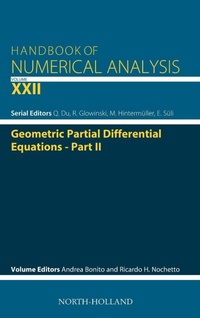
Geometric Partial Differential Equations - Part 2: Volume 22
Published on 29. January 2021
Book
Hardback
570 pages
978-0-444-64305-6 (ISBN)
Description
Besides their intrinsic mathematical interest, geometric partial differential equations (PDEs) are ubiquitous in many scientific, engineering and industrial applications. They represent an intellectual challenge and have received a great deal of attention recently. The purpose of this volume is to provide a missing reference consisting of self-contained and comprehensive presentations. It includes basic ideas, analysis and applications of state-of-the-art fundamental algorithms for the approximation of geometric PDEs together with their impacts in a variety of fields within mathematics, science, and engineering.
More details
Series
Language
English
Place of publication
United States
Publishing group
Elsevier Science & Technology
Target group
Professional and scholarly
The targeted audience is mathematically trained research scientists and engineers with basic knowledge in partial differential equations and their numerical approximations.
Product notice
Laminated cover
Dimensions
Height: 229 mm
Width: 152 mm
Thickness: 32 mm
Weight
928 gr
ISBN-13
978-0-444-64305-6 (9780444643056)
Copyright in bibliographic data and cover images is held by Nielsen Book Services Limited or by the publishers or by their respective licensors: all rights reserved.
Schweitzer Classification
Other editions
Additional editions
Andrea Bonito | Ricardo Horacio Nochetto
Geometric Partial Differential Equations - Part 2
E-Book
01/2021
Elsevier
€165.00
Available for download
Persons
Andrea Bonito is professor in the Department of Mathematics at Texas A&M University.
Together with Ricardo H. Nochetto they have more than forty years of experience in the variational formulation and approximation of a wide range of geometric partial differential equations (PDEs). Their work encompass fundamental studies of numerical PDEs: the design, analysis and implementation of efficient numerical algorithms for the approximation of PDEs; and their applications in modern engineering, science, and bio-medical problems. Ricardo H. Nochetto is professor in the Department of Mathematics and the Institute for Physical Science and Technology at the University of Maryland, College Park.
Together with Andrea Bonito they have more than forty years of experience in the variational formulation and approximation of a wide range of geometric partial differential equations (PDEs). Their work encompass fundamental studies of numerical PDEs: the design, analysis and implementation of efficient numerical algorithms for the approximation of PDEs; and their applications in modern engineering, science, and bio-medical problems.
Together with Ricardo H. Nochetto they have more than forty years of experience in the variational formulation and approximation of a wide range of geometric partial differential equations (PDEs). Their work encompass fundamental studies of numerical PDEs: the design, analysis and implementation of efficient numerical algorithms for the approximation of PDEs; and their applications in modern engineering, science, and bio-medical problems. Ricardo H. Nochetto is professor in the Department of Mathematics and the Institute for Physical Science and Technology at the University of Maryland, College Park.
Together with Andrea Bonito they have more than forty years of experience in the variational formulation and approximation of a wide range of geometric partial differential equations (PDEs). Their work encompass fundamental studies of numerical PDEs: the design, analysis and implementation of efficient numerical algorithms for the approximation of PDEs; and their applications in modern engineering, science, and bio-medical problems.
Content
1. Shape and topology optimization
Gregoire Allaire, Charles Dapogny, and Francois Jouve
2. Optimal transport: discretization and algorithms
Quentin Merigot and Boris Thibert
3. Optimal control of geometric partial differential equations
Michael Hintermueller and Tobias Keil
4. Lagrangian schemes for Wasserstein gradient flows
Jose A. Carrillo, Daniel Matthes, and Marie-Therese Wolfram
5. The Q-tensor model with uniaxial constraint
Juan Pablo Borthagaray and Shawn W. Walker
6. Approximating the total variation with finite differences or finite elements
Antonin Chambolle and Thomas Pock
7. Numerical simulation and benchmarking of drops and bubbles
Stefan Turek and Otto Mierka
8. Smooth multi-patch discretizations in isogeometric analysis
Thomas J.R. Hughes, Giancarlo Sangalli, Thomas Takacs, and Deepesh Toshniwal
Gregoire Allaire, Charles Dapogny, and Francois Jouve
2. Optimal transport: discretization and algorithms
Quentin Merigot and Boris Thibert
3. Optimal control of geometric partial differential equations
Michael Hintermueller and Tobias Keil
4. Lagrangian schemes for Wasserstein gradient flows
Jose A. Carrillo, Daniel Matthes, and Marie-Therese Wolfram
5. The Q-tensor model with uniaxial constraint
Juan Pablo Borthagaray and Shawn W. Walker
6. Approximating the total variation with finite differences or finite elements
Antonin Chambolle and Thomas Pock
7. Numerical simulation and benchmarking of drops and bubbles
Stefan Turek and Otto Mierka
8. Smooth multi-patch discretizations in isogeometric analysis
Thomas J.R. Hughes, Giancarlo Sangalli, Thomas Takacs, and Deepesh Toshniwal