

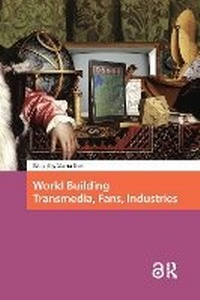
World Building
Transmedia, Fans, Industries
1st Edition
Will be published approx. on 1. December 2025
Book
Paperback/Softback
396 pages
978-1-041-19089-9 (ISBN)
Description
Thanks to modern technology, we are now living in an age of multiplatform fictional worlds, as television, film, the Internet, graphic novels, toys and more facilitate the creation of diverse yet compact imaginary universes, which are often recognisable as brands and exhibit well-defined identities. This volume, situated at the cutting edge of media theory, explores this phenomenon from both theoretical and practical perspectives, uncovering how the construction of these worlds influences our own determination of values and meaning in contemporary society.
More details
Series
Language
English
Place of publication
London
United Kingdom
Publishing group
Taylor & Francis Ltd
Target group
Professional and scholarly
Academic
Dimensions
Height: 234 mm
Width: 156 mm
Weight
730 gr
ISBN-13
978-1-041-19089-9 (9781041190899)
Copyright in bibliographic data and cover images is held by Nielsen Book Services Limited or by the publishers or by their respective licensors: all rights reserved.
Schweitzer Classification
Other editions
Additional editions
E-Book
10/2025
Routledge
€0.00
Available for download
E-Book
10/2025
Routledge
€0.00
Available for download
Book
09/2017
Pallas Publications
€166.50
Shipment within 10-20 days
Person
Marta Boni is assistant professor of Film and Television Studies at the University of Montreal. She has published Romanzo Criminale. Transmedia and Beyond (Ca' Foscari University Press, 2013), co-edited Networking Images. Approches interdisciplinaires des images en reseau (Presses de la Sorbonne Nouvelle, 2013), various essays in international scientific journals such as Mise au point, MEI, SERIES, Cinergie, and chapters in edited collections on television seriality, fandom, media paratexts, and transmedia.
Content
Introduction: Worlds, Today, Section 1: Theories of World Building, 1. The Aesthetics of Proliferation, 2. Building Science Fiction Worlds, 3. 'He Doesn't Look Like Sherlock Holmes': The Truth Value and Existential Status of Fictional Worlds and their Characters, 4. 'Visible World': The Atlas as a Visual Form of Knowledge and Narrative Paradigm in Contemporary Art, Section 2: Economies of World Building, 5. A World of Disney: Building a Transmedia Storyworld for Mickey and his Friends, 6. World Building Logics and Copyright: the Dark Knight and the Great Detective, 7. Battleworlds: The Management of Multiplicity in the Media Industries, 8. Platform Producer Meets Game Master: On the Conditions for the Media Mix, 9. Narrative Ecosystems: a Multidisciplinary Approach to Media Worlds, Section 3: Immersion, 10. The Building and Blurring of Worlds: Sound, Space, and Complex Narrative Cinema, 11. Beyond Immersion: Absorption, Saturation, and Overflow in the Building of Imaginary Worlds, 12. Zombie Escape and Survival Plans: Mapping the Transmedial World of the Dead, 13. MMORPG as Locally Realized Worlds of Action, Section 4: Media as World Building Devices, 14. The Worries of the World(s): Cartoons and Cinema, 15. Linguistic Terrain and World Time: Chinese Media Theories and Their World Imaginations, 16. The Worlds Align: Media Convergence and Complementary Storyworlds in Marvel's Thor: The Dark World, 17. World Building and Metafiction in Contemporary Comic Books: Metalepsis and Figurative Process of Graphic Fiction, Section 5: Appropriations and Fan Practices, 18. The Monster at the End of This Book: Metalepsis, Fandom and Worldmaking in Contemporary TV Series, 19. Traversing the 'Whoniverse': Doctor Who's Hyperdiegesis and Transmedia Discontinuity/Diachrony, 20. Transmediaphilia, World Building, and the Pleasures of the Personal Digital Archive, 21. The Politics of World-building: Heteroglossia in Janelle Monae's Afrofuturist WondaLand