

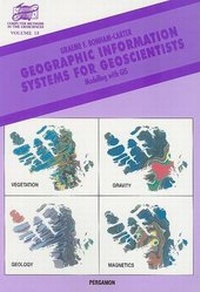
Geographic Information Systems for Geoscientists
Modelling with GIS
Published on 25. January 1995
Book
Paperback/Softback
416 pages
978-0-08-042420-0 (ISBN)
Description
This valuable reference book is unique in its coverage of examples from the geological sciences, many centred on applications to mineral exploration. The underlying principles of GIS are stressed and emphasis placed on the analysis and modelling of spatial data with applications to site selection and potential mapping. The book commences with a definition of GIS and describes a case study of mapping mineral potential. The ways in which spatial data are organized with models (raster, vector, relational) are discussed and data structures, such as quadtrees and topological structures are introduced. Data input including digitizing, geographic projections and conversions is covered together with output (visualization, representation of colour and spatial query). Spatial data transformations are dealt with thoroughly and attention is paid to map analysis and modelling as related to single maps, map pairs and multiple maps respectively. Methods of quantifying the associations between pairs of maps are also emphasized.
Finally, examples of landfill site selection and mineral potential mapping illustrate the application of map algebra for combining maps and tables with models, employing Boolean logic, index weighting, fuzzy logic and probability methods such as weights of evidence. There is an extensive glossary of terms, and references that accompany each chapter. It also contains 40 pages of colour illustrations.
Finally, examples of landfill site selection and mineral potential mapping illustrate the application of map algebra for combining maps and tables with models, employing Boolean logic, index weighting, fuzzy logic and probability methods such as weights of evidence. There is an extensive glossary of terms, and references that accompany each chapter. It also contains 40 pages of colour illustrations.
Reviews / Votes
W.C. Peters, University of Arizona Highly recommended for college libraries serving students in earth science, civil engineering, and geography. Upper-division undergraduate through professional. Choice S.J.D. Cox ...first text book on GIS directed specifically at geoscientists...an effective...introduction to GIS...will...bring explorationists up to speed on quantitative methods for mineral potential evaluation and the assistance they might get from the powerful new technology of GIS. Economic Geology ...should serve well as a textbook for GIS courses and as a reference volume for practising geoscience professionals. AMF Reviews C. Peter Keller This book is a 'must have' on the bookshelf of any geoscientist interested in digital spatial data analysis. Computers & Geosciences T.V. Loudon The book is a worthy addition to the valuable series...can be seen as required reading for many mineral explorationists, a comprehensive review of GIS concepts, a text for GIS courses, and a useful reference source in any geoscience library. Episodes R.S. Shiel For those who have never used GIS before, this text provides a readable account in a related field. It is not overly mathematical, and will appeal to those who do not wish to read the more technical texts in soil science. European Journal of Soil ScienceMore details
Series
Language
English
Place of publication
Amsterdam
Netherlands
Publishing group
Elsevier Science & Technology
Target group
Professional and scholarly
Illustrations
40 illustrations, references, appendices, index
Dimensions
Height: 241 mm
Width: 165 mm
Weight
771 gr
ISBN-13
978-0-08-042420-0 (9780080424200)
Copyright in bibliographic data and cover images is held by Nielsen Book Services Limited or by the publishers or by their respective licensors: all rights reserved.
Schweitzer Classification
Other editions
Additional editions
G. F. Bonham-Carter | Daniel F. Merriam
Geographic Information Systems for Geoscientists: Modelling with GIS
Modelling with GIS
E-Book
01/2013
Elsevier
€54.95
Available for download
Content
Chapter headings. Introduction to GIS. Spatial data models. Spatial data structures. Spatial data input. Visualization and query of spatial data. Spatial data transformations. Tools for map analysis: single maps. Tools for map analysis: map pairs. Tools for map analysis: multiple maps.