

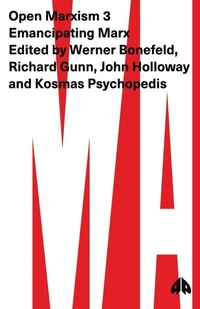
Open Marxism 3
Emancipating Marx
Published on 20. June 1995
Book
Paperback/Softback
226 pages
978-0-7453-0864-7 (ISBN)
Description
Publication of the first two volumes of Open Marxism has renewed interest in a theoretical tradition which, during the 1980s seemed to have lost momentum. The series aims to 'open' the theoretical categories of Marxism to actuality, to renew old debates and to project new ones. Within the framework of 'openness', the authors of this long-awaited third volume address a wide range of topics which have become classic in Marxist debate, including dialectics, epistemology, social emancipation, value theory, historical materialism and the relationship between feminism and Marxism. provides a forum for open debate on the key theoretical questions of the decade.
The contributors argue that sociological heritage which grew up under the banner of scientific Marxism has had a detrimental effect on the movement of socialist thinking. The 'emancipation of Marx' implies both freeing Marx from the understanding of the 20th Century and the freeing of the human spirit from the control of capital. The contributors have been selected from an international base and none have previously contributed to the series. The issues covered are of contemporary relevance and, along with the first two volumes, this third examination of 'open Marxism' provides the basis for a radical rethink on restructuring the world in which we live.
The contributors argue that sociological heritage which grew up under the banner of scientific Marxism has had a detrimental effect on the movement of socialist thinking. The 'emancipation of Marx' implies both freeing Marx from the understanding of the 20th Century and the freeing of the human spirit from the control of capital. The contributors have been selected from an international base and none have previously contributed to the series. The issues covered are of contemporary relevance and, along with the first two volumes, this third examination of 'open Marxism' provides the basis for a radical rethink on restructuring the world in which we live.
More details
Series
Language
English
Place of publication
London
United Kingdom
Target group
College/higher education
Professional and scholarly
Product notice
Paperback (UK-trade)
Dimensions
Height: 216 mm
Width: 140 mm
Thickness: 14 mm
Weight
328 gr
ISBN-13
978-0-7453-0864-7 (9780745308647)
Copyright in bibliographic data and cover images is held by Nielsen Book Services Limited or by the publishers or by their respective licensors: all rights reserved.
Schweitzer Classification
Persons
Werner Bonefeld lectures in Politics at the University of York. Research interests include political economy, Marxist social theory, and European Integration. He has been on the editorial board of Capital & Class and is on the editorial board of Common Sense. He is also on the Advisory Board of Historical Materialism. He has published in a number of journals, including Capital & Class, Common Sense, and Review of Radical Political Economy. His work has been translated into many languages, including German, Greek, Spanish, Italian and French.
Richard Gunn lectures in political theory at Edinburgh University, co-edits Common Sense and is a former member of the editorial board of Capital and Class.
John Holloway has published widely on Marxist theory, on the Zapatista movement and on the new forms of anti-capitalist struggle. His book Change the World without Taking Power has been translated into eleven languages and has stirred an international debate, and Crack Capitalism is a renowned classic. He is currently Professor of Sociology in the Instituto de Ciencias Sociales y Humanidades of the Benemerita Universidad Autonoma de Puebla in Mexico.
Kosmas Psychopedis teaches at the University of Athens
Richard Gunn lectures in political theory at Edinburgh University, co-edits Common Sense and is a former member of the editorial board of Capital and Class.
John Holloway has published widely on Marxist theory, on the Zapatista movement and on the new forms of anti-capitalist struggle. His book Change the World without Taking Power has been translated into eleven languages and has stirred an international debate, and Crack Capitalism is a renowned classic. He is currently Professor of Sociology in the Instituto de Ciencias Sociales y Humanidades of the Benemerita Universidad Autonoma de Puebla in Mexico.
Kosmas Psychopedis teaches at the University of Athens
Content
1. Introduction: Emancipating Marx by Werner Bonefeld, Richard Gunn, John Holloway and Kosmas Psychopedis
2. Capitalism and Reproduction by Mariarosa Dalla Costa Professor
3. Emancipating Explanation by Kosmas Psychopedis
4. Why did Marx Conceal his Dialectical Method? by Helmut Reichelt (University of Bremen)
5. Hegel's Philosophy of Right and Marx's Critique: A Reassessment by Robert Fine (University of Warwick)
6. The Dialectics of Rights: Transitions and Emancipatory Claims in the Marxian Tradition by Manolis Angelidis
7. The Complicity of Posthistory by Adrian Wilding (University of Warwick)
8. From Scream of Refusal to Scream of Power: The Centrality of Work by John Holloway
9. Capital as Subject and the Existence of Labour by Werner Bonefeld
Index
2. Capitalism and Reproduction by Mariarosa Dalla Costa Professor
3. Emancipating Explanation by Kosmas Psychopedis
4. Why did Marx Conceal his Dialectical Method? by Helmut Reichelt (University of Bremen)
5. Hegel's Philosophy of Right and Marx's Critique: A Reassessment by Robert Fine (University of Warwick)
6. The Dialectics of Rights: Transitions and Emancipatory Claims in the Marxian Tradition by Manolis Angelidis
7. The Complicity of Posthistory by Adrian Wilding (University of Warwick)
8. From Scream of Refusal to Scream of Power: The Centrality of Work by John Holloway
9. Capital as Subject and the Existence of Labour by Werner Bonefeld
Index