

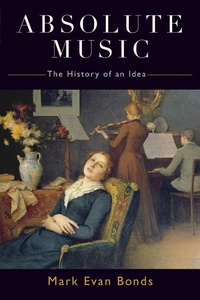
Absolute Music
The History of an Idea
Published on 28. December 2017
Book
Paperback/Softback
394 pages
978-0-19-085117-0 (ISBN)
Description
What is music, and why does it move us? From Pythagoras to the present, writers have struggled to isolate the essence of "pure" or "absolute" music in ways that also account for its profound effect. In Absolute Music: The History of an Idea, Mark Evan Bonds traces the history of these efforts across more than two millennia, paying special attention to the relationship between music's essence and its qualities of form, expression, beauty, autonomy, as well as its perceived capacity to disclose philosophical truths.
The core of this book focuses on the period between 1850 and 1945. Although the idea of pure music is as old as antiquity, the term "absolute music" is itself relatively recent. It was Richard Wagner who coined the term, in 1846, and he used it as a pejorative in his efforts to expose the limitations of purely instrumental music. For Wagner, music that was "absolute" was isolated, detached from the world, sterile. His contemporary, the Viennese critic Eduard Hanslick, embraced this quality of isolation as a guarantor of purity. Only pure, absolute music, he argued, could realize the highest potential of the art.
Bonds reveals how and why perceptions of absolute music changed so radically between the 1850s and 1920s. When it first appeared, "absolute music" was a new term applied to old music, but by the early decades of the twentieth century, it had become-paradoxically--an old term associated with the new music of modernists like Schoenberg and Stravinsky. Bonds argues that the key developments in this shift lay not in discourse about music but rather the visual arts. The growing prestige of abstraction and form in painting at the turn of the twentieth century-line and color, as opposed to object-helped move the idea of purely abstract, absolute music to the cutting edge of musical modernism.
By carefully tracing the evolution of absolute music from Ancient Greece through the Middle Ages to the twentieth-century, Bonds not only provides the first comprehensive history of this pivotal concept but also provokes new thoughts on the essence of music and how essence has been used to explain music's effect. A long awaited book from one of the most respected senior scholars in the field, Absolute Music will be essential reading for anyone interested in the history, theory, and aesthetics of music.
The core of this book focuses on the period between 1850 and 1945. Although the idea of pure music is as old as antiquity, the term "absolute music" is itself relatively recent. It was Richard Wagner who coined the term, in 1846, and he used it as a pejorative in his efforts to expose the limitations of purely instrumental music. For Wagner, music that was "absolute" was isolated, detached from the world, sterile. His contemporary, the Viennese critic Eduard Hanslick, embraced this quality of isolation as a guarantor of purity. Only pure, absolute music, he argued, could realize the highest potential of the art.
Bonds reveals how and why perceptions of absolute music changed so radically between the 1850s and 1920s. When it first appeared, "absolute music" was a new term applied to old music, but by the early decades of the twentieth century, it had become-paradoxically--an old term associated with the new music of modernists like Schoenberg and Stravinsky. Bonds argues that the key developments in this shift lay not in discourse about music but rather the visual arts. The growing prestige of abstraction and form in painting at the turn of the twentieth century-line and color, as opposed to object-helped move the idea of purely abstract, absolute music to the cutting edge of musical modernism.
By carefully tracing the evolution of absolute music from Ancient Greece through the Middle Ages to the twentieth-century, Bonds not only provides the first comprehensive history of this pivotal concept but also provokes new thoughts on the essence of music and how essence has been used to explain music's effect. A long awaited book from one of the most respected senior scholars in the field, Absolute Music will be essential reading for anyone interested in the history, theory, and aesthetics of music.
Reviews / Votes
You should derive considerable enlightenment from Bonds' trenchant and pertinent perspectives. * Arnold Whittall, The Musical Times* ...the idea...turns out to be a big one, and Bonds rises brilliantly to his own challenge, writing an epic narrative with a masterly command of 2,500 years of music history from the mysteries of Pythagoras to the mysteries of the CIA...Bonds's concept is immaculately conceived, wonderfully lucid, beautifully organized, and elegantly written. * Music Theory Online * This is an immensely informed, thoroughly documented, and detailed book, offering much to chew on during a delicious and intellectually nourishing journey through millennia of theoretical discussions about the nature of music. Readers with an interest in these matters should find Bonds' account profoundly satisfying, and his book should also provide the basis for graduate seminars on musical aesthetics. Highly recommended. * Classical.Net *
More details
Language
English
Place of publication
New York
United States
Target group
College/higher education
Professional and scholarly
Illustrations
3 BW line, 9 BW halftones
Dimensions
Height: 234 mm
Width: 156 mm
Thickness: 24 mm
Weight
665 gr
ISBN-13
978-0-19-085117-0 (9780190851170)
Copyright in bibliographic data and cover images is held by Nielsen Book Services Limited or by the publishers or by their respective licensors: all rights reserved.
Schweitzer Classification
Other editions
Additional editions
Book
06/2014
Oxford University Press Inc
€81.10
Shipment within 15-20 days
Person
Mark Evan Bonds is the Cary C. Boshamer Distinguished Professor of Music at the University of North Carolina at Chapel Hill, where he has taught since 1992. He has served as editor-in-chief of Beethoven Forum and has published widely on music, aesthetics, and the philosophy of music.
Content
Introduction 7
Part One
Essence as Effect: To 1550 23
1. Orpheus and Pythagoras 23
2. Isomorphic Resonance 30
Part Two
Essence and Effect: 1550-1850 39
3. Expression 41
The Separation of Powers 41
Music and Language 48
Music as Language 58
Mimesis 69
4. Beauty 79
5. Form 90
Form as Number 91
Form as Content 98
6. Autonomy 103
Material Autonomy 103
Ethical Autonomy 108
7. Disclosure 112
The Composer as Oracle 112
Beautiful Insights 117
Cosmic Insights 121
Part Three
Essence or Effect: 1850-1945 127
8. Wagner's "Absolute" Music 129
9. Hanslick's "Pure" Music 140
Hanslick the Conventional 156
Hanslick the Radical 171
Hanslick the Ambivalent 181
10. Liszt's "Program" Music 205
11. Polemics 214
12. Reconciliation 231
13. Qualities Recast 244
Expression 246
Beauty 263
Form 264
Autonomy 278
Disclosure 284
Epilogue: Since 1945 292
Appendix: Hanslick's Vom Musikalischen-Schoenen:
Early and Selected Later Reviews and Commentary 294
Works Cited ] 304
Part One
Essence as Effect: To 1550 23
1. Orpheus and Pythagoras 23
2. Isomorphic Resonance 30
Part Two
Essence and Effect: 1550-1850 39
3. Expression 41
The Separation of Powers 41
Music and Language 48
Music as Language 58
Mimesis 69
4. Beauty 79
5. Form 90
Form as Number 91
Form as Content 98
6. Autonomy 103
Material Autonomy 103
Ethical Autonomy 108
7. Disclosure 112
The Composer as Oracle 112
Beautiful Insights 117
Cosmic Insights 121
Part Three
Essence or Effect: 1850-1945 127
8. Wagner's "Absolute" Music 129
9. Hanslick's "Pure" Music 140
Hanslick the Conventional 156
Hanslick the Radical 171
Hanslick the Ambivalent 181
10. Liszt's "Program" Music 205
11. Polemics 214
12. Reconciliation 231
13. Qualities Recast 244
Expression 246
Beauty 263
Form 264
Autonomy 278
Disclosure 284
Epilogue: Since 1945 292
Appendix: Hanslick's Vom Musikalischen-Schoenen:
Early and Selected Later Reviews and Commentary 294
Works Cited ] 304