

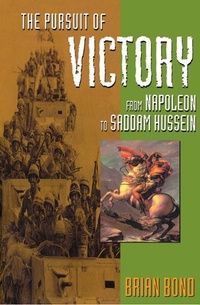
The Pursuit of Victory
From Napoleon to Saddam Hussein
Published on 12. March 1998
Book
Paperback/Softback
250 pages
978-0-19-820735-1 (ISBN)
Description
In Western Europe and North America the idea that war can deliberately be used as an 'instrument of policy' has become unfashionable, not least because of the carnage of two World Wars and the Americans' humiliating experience in Vietnam. But wars are still fought. Those who start wars clearly believe they are worthwhile. Why? In this original study, Brian Bond discusses the successes and failures of military and political leaders in their pursuit of victory over the last two centuries.
Professor Bond argues that in order to be counted victorious, a leader has to progress beyond military triumph to preserve the political control needed to secure an advantageous and enduring peace settlement. Napoleon was a brilliant general, but failed as a statesman. Bismarck, on the other hand, was a success in skilfully exploiting Moltlike's victories on the battlefield to create a unified Germany. In the First World War, Germany and her allies were defeated but at such great cost that confidence in the idea that war could be controlled, and the pursuit of victory made rational, received a terrible shock. Germany and Japan exploited their military opportunities between 1939 and 1942, but lack of political control and moderation brought them catastrophic defeat. After 1945, nuclear weapons and the increased complexity of international relations blurred the identity of 'victors' and 'losers' and seemed to make the idea of a 'decisive' victory almost unthinkable. But this study warns against the assumption that war as an instrument of policy has now been completely discarded. The Falklands and Gulf conflicts show that aggressors are still prepared to risk war for tangible goals, and that their opponents are quite capable of responding successfully to such challenges.
Professor Bond argues that in order to be counted victorious, a leader has to progress beyond military triumph to preserve the political control needed to secure an advantageous and enduring peace settlement. Napoleon was a brilliant general, but failed as a statesman. Bismarck, on the other hand, was a success in skilfully exploiting Moltlike's victories on the battlefield to create a unified Germany. In the First World War, Germany and her allies were defeated but at such great cost that confidence in the idea that war could be controlled, and the pursuit of victory made rational, received a terrible shock. Germany and Japan exploited their military opportunities between 1939 and 1942, but lack of political control and moderation brought them catastrophic defeat. After 1945, nuclear weapons and the increased complexity of international relations blurred the identity of 'victors' and 'losers' and seemed to make the idea of a 'decisive' victory almost unthinkable. But this study warns against the assumption that war as an instrument of policy has now been completely discarded. The Falklands and Gulf conflicts show that aggressors are still prepared to risk war for tangible goals, and that their opponents are quite capable of responding successfully to such challenges.
Reviews / Votes
I have always enjoyed Brian Bond's commonsensical approach to military history, and as a result have learnt a great deal from him. I hope other readers of this journal will benefit similarly. * James Lunt, Army Quarterly and Defence Journal, Volume 127, No. 2, 1997 * Professor Bond is a sure-footed guide to the mass of literature on this broad topic which has appeared in the recent past. He moves his story along at a fast clip as the focus shifts from battles to campaigns and from operations to grand strategy ... this book concisely conveys a good deal of the substance of much of the military history of the last decade, along with a commentary which is always well founded and thought-provoking. It is a book to put confidently into the hands of anyone, whether undergraduate or layperson, whom one wishes to persuade of the merits of modern military history. * John Gooch, University of Leeds, The Historical Association 1997 * This is a thought-provoking book. As the various chapters are read, a coherent and persuasive argument emerges ... First, it is an extremely valuable overview of warfare since the mid-eighteenth century, essential to the reader who wishes to gain insights into how conflict has changed during that time. Second, it presents a well researched and resourced theme on the changing nature of 'victory', introducing the reader to complex arguments in a straightforward way. It is those arguments that make us think, and that should always be the aim of a scholarly work. When, in addition, the book is well produced, with good illustrations and clear maps ... it is a work to be recommended to specialist and general readers alike. * John Pimlott, Dept of War Studies, RMA Sandhurst, Journal of Strategic Studies, Vol. 20, No. 2, June '97 *More details
Language
English
Place of publication
Oxford
United Kingdom
Target group
Professional and scholarly
Illustrations
16 pp plates, maps
Dimensions
Height: 234 mm
Width: 158 mm
Thickness: 16 mm
Weight
416 gr
ISBN-13
978-0-19-820735-1 (9780198207351)
Copyright in bibliographic data and cover images is held by Nielsen Book Services Limited or by the publishers or by their respective licensors: all rights reserved.
Schweitzer Classification
Person
Professor of Military History at King's College, London, Brian Bond is the editor of The First World War and British Military History, (1991, OUP) and a contributor to The Oxford Illustrated History of The British Army, (1994)
Content
1. Frederick the Great and the era of limited war ; 2. Napoleon and the decisive battle ; 3. The Napoleonic legacy: the influence of Jomini and Clausewitz ; 4. Moltke and the wars of German unification ; 5. The quest for victory in the Schlieffen era, 1890-1914 ; 6. The pursuit of victory in the First World War and the aftermath ; 7. The pursuit of victory in the Second World War ; 8. The pursuit of victory in the nuclear age ; Conclusion