

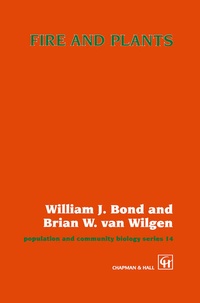
Fire and Plants
Published on 28. September 2011
Book
Paperback/Softback
VIII, 263 pages
978-94-010-7170-3 (ISBN)
Description
Large regions of the world are regularly burnt either deliberately or naturally. However, despite the widespread occurrence of such fire-prone ecosystems, and considerable body of research on plant population biology in relation to fire, until now there have only been limited attempts at a coherent conceptual synthesis of the field for use by students or researchers.
More details
Series
Edition
Softcover reprint of the original 1st ed. 1996
Language
English
Place of publication
Dordrecht
Netherlands
Target group
Professional and scholarly
Research
Illustrations
VIII, 263 p.
Dimensions
Height: 235 mm
Width: 155 mm
Thickness: 16 mm
Weight
429 gr
ISBN-13
978-94-010-7170-3 (9789401071703)
DOI
10.1007/978-94-009-1499-5
Schweitzer Classification
Other editions
Additional editions
William J. Bond | B.W. van Wilgen
Fire and Plants
E-Book
12/2012
Springer
€213.99
Available for download
William J. Bond | B.W. van Wilgen
Fire and Plants
Book
12/1995
Chapman and Hall
€213.99
Shipment within 10-20 days
Content
1 Introduction.- 1.1 The global importance of fire.- 1.2 Why we have written this book.- 1.3 What this book is about.- 1.4 Methods of fire ecology.- 1.5 Ecological concepts and fire ecology.- 1.6 Fire and the ecology of plants.- 2 Why and how do ecosystems burn?.- 2.1 The fire regime.- 2.2 Prerequisites for fire.- 2.3 Plants as 'fuel': what makes vegetation flammable?.- 2.4 Fire recurrence intervals and their measurement.- 2.5 Temperature of fires and survival of plant tissues.- 2.6 Conclusions.- 3 Surviving fires - vegetative and reproductive responses.- 3.1 Vegetative survival.- 3.2 The post-burn environment as reproductive stimulus.- 3.3 Reproduction and fire.- 3.4 Fire life-histories.- 3.5 Conclusions.- 4 Plant demography and fire I. Interval-dependent effects.- 4.1 Introduction.- 4.2 Types of population growth.- 4.3 Modelling populating growth.- 4.4 Demography and the fire-interval hypothesis.- 4.5 Density dependence and population regulation - the self-regulatory hypothesis.- 4.6 Event-dependent dynamics and population regulation.- 4.7 Conclusion.- 5 Plant demography and fire II. Event-dependent effects.- 5.1 Introduction.- 5.2 Effects of fire intensity and season on survival.- 5.3 Effects of fire intensity and season on recruitment.- 5.4 Effects of climate variation on recruitment.- 5.5 Effects of ground fires.- 5.6 Effects of fire area.- 5.7 The causes of event-dependent effects.- 5.8 Explaining survival patterns.- 5.9 Explaining recruitment patterns.- 5.10 Predicting event-dependent effects.- 5.11 Event-dependent effects in different biomes.- 5.12 Conclusions.- 6 Fire and the evolutionary ecology of plants.- 6.1 Fire and the evolution of plant traits.- 6.2 Sprouters versus non-sprouters.- 6.3 Life-history evolution.- 6.4 Timing of reproduction andrecruitment.- 6.5 Evolution of fire-survival traits.- 6.6 Evolution of flammability.- 6.7 Conclusions.- 7 Fire, competition and the organization of communities.- 7.1 Introduction.- 7.2 What determines changes in plant communities over time?.- 7.3 What determines spatial patterns in communities?.- 7.4 Which combinations of species occur together and why?.- 7.5 Determinants of species diversity.- 7.6 Which rules for which communities?.- 7.7 Conclusions.- 8 Fire and management.- 8.1 Introduction.- 8.2 Fire as a versatile management practice.- 8.3 Predicting the ecological effects of fire.- 8.4 Managing fires.- 8.5 Conclusions.- 9 Fire and the ecology of a changing world.- 9.1 Introduction.- 9.2 Climate, fire and biogeography.- 9.3 Changing patterns of fire in modern landscapes.- 9.4 Ecological consequences of changing fire regimes.- 9.5 Conclusions.- References.- Species Index.