

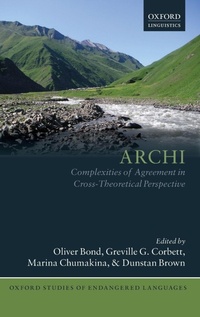
Archi
Complexities of Agreement in Cross-Theoretical Perspective
Published on 25. August 2016
Book
Hardback
304 pages
978-0-19-874729-1 (ISBN)
Description
This book presents a controlled evaluation of three widely practised syntactic theories on the basis of the extremely complex agreement system of Archi, an endangered Nakh-Daghestanian language. Even straightforward agreement examples are puzzling for syntacticians because agreement involves both redundancy and arbitrariness. Agreement is a significant source of syntactic complexity, exacerbated by the great diversity of its morphological expression. Imagine how the
discipline of linguistics would be if expert practitioners of different theories met in a collaborative setting to tackle such challenging agreement data - to test the limits of their models and examine how the predictions of their theories differ given the same linguistic facts. Following an
overview of the essentials of Archi grammar and an introduction to the remarkable agreement phenomena found in this language, three distinct accounts of the Archi data examine the tractability and predictive power of major syntactic theories: Head-driven Phrase Structure Grammar, Lexical Functional Grammar, and Minimalism. The final chapter compares the problems encountered and the solutions proposed in the different syntactic analyses and outlines the implications of the challenges that the
Archi agreement system poses for linguistic theory.
discipline of linguistics would be if expert practitioners of different theories met in a collaborative setting to tackle such challenging agreement data - to test the limits of their models and examine how the predictions of their theories differ given the same linguistic facts. Following an
overview of the essentials of Archi grammar and an introduction to the remarkable agreement phenomena found in this language, three distinct accounts of the Archi data examine the tractability and predictive power of major syntactic theories: Head-driven Phrase Structure Grammar, Lexical Functional Grammar, and Minimalism. The final chapter compares the problems encountered and the solutions proposed in the different syntactic analyses and outlines the implications of the challenges that the
Archi agreement system poses for linguistic theory.
More details
Other editions
Additional editions
Oliver Bond | Greville G. Corbett | Marina Chumakina
Archi
Complexities of Agreement in Cross-Theoretical Perspective
E-Book
08/2016
1st Edition
OUP eBook
€64.49
Available for download
Persons
Oliver Bond is Lecturer in Linguistics in the Surrey Morphology Group, University of Surrey. His research interests include theoretical morphosyntax, typology, and language documentation and description. His recent work concerns the interface between the morphological component of grammar and the lexicon in Lexical Functional Grammar (Bond 2015) and the grammaticalized functions of Cognate Head-Dependent Constructions in African languages (Bond and Anderson 2014).
Greville G. Corbett is Distinguished Professor of Linguistics, University of Surrey, and leads the Surrey Morphology Group. He works on the typology of features, as in Gender (1991), Number (2000), Agreement (2006), and Features (2012), all with Cambridge University Press. Recently he has been developing the canonical approach to typology. Within that approach he has papers in Language on suppletion (2007) and on lexical splits (2015). He is the co-editor of the OUP volumes Canonical
Morphology and Syntax (2013; with Dunstan Brown and Marina Chumakina) and Understanding and Measuring Morphological Complexity (2015; with Matthew Baerman and Dunstan Brown).
Marina Chumakina is a Research Fellow in the Surrey Morphology Group, University of Surrey. Her work focuses on Nakh-Daghestanian languages and typology. She has done extensive fieldwork on the Archi language resulting in an online Archi Dictionary (with Dunstan Brown, Greville G. Corbett, and Harley Quilliam, 2007) and works on Archi morphosyntax (Chumakina 2013). She is co-editor, with Dunstan Brown and Greville G. Corbett, of Canonical Morphology and Syntax (OUP 2013).
Dunstan Brown is an Anniversary Professor at the University of York, and a Visiting Professor in the Surrey Morphology Group, University of Surrey. His research interests include autonomous morphology, morphology-syntax interaction and typology. His recent publications include Network Morphology (with Andrew Hippisley, CUP 2012), and, as co-editor, Canonical Morphology and Syntax (with Marina Chumakina and Greville G. Corbett; OUP 2013) and Understanding and Measuring
Morphological Complexity (with Matthew Baerman and Greville G. Corbett; OUP 2015).
Greville G. Corbett is Distinguished Professor of Linguistics, University of Surrey, and leads the Surrey Morphology Group. He works on the typology of features, as in Gender (1991), Number (2000), Agreement (2006), and Features (2012), all with Cambridge University Press. Recently he has been developing the canonical approach to typology. Within that approach he has papers in Language on suppletion (2007) and on lexical splits (2015). He is the co-editor of the OUP volumes Canonical
Morphology and Syntax (2013; with Dunstan Brown and Marina Chumakina) and Understanding and Measuring Morphological Complexity (2015; with Matthew Baerman and Dunstan Brown).
Marina Chumakina is a Research Fellow in the Surrey Morphology Group, University of Surrey. Her work focuses on Nakh-Daghestanian languages and typology. She has done extensive fieldwork on the Archi language resulting in an online Archi Dictionary (with Dunstan Brown, Greville G. Corbett, and Harley Quilliam, 2007) and works on Archi morphosyntax (Chumakina 2013). She is co-editor, with Dunstan Brown and Greville G. Corbett, of Canonical Morphology and Syntax (OUP 2013).
Dunstan Brown is an Anniversary Professor at the University of York, and a Visiting Professor in the Surrey Morphology Group, University of Surrey. His research interests include autonomous morphology, morphology-syntax interaction and typology. His recent publications include Network Morphology (with Andrew Hippisley, CUP 2012), and, as co-editor, Canonical Morphology and Syntax (with Marina Chumakina and Greville G. Corbett; OUP 2013) and Understanding and Measuring
Morphological Complexity (with Matthew Baerman and Greville G. Corbett; OUP 2015).
Editor
Lecturer in LinguisticsLecturer in Linguistics, University of Surrey
Distinguished Professor of LinguisticsDistinguished Professor of Linguistics, University of Surrey
Research Fellow in the Surrey Morphology GroupResearch Fellow in the Surrey Morphology Group, University of Surrey
Professor of LinguisticsProfessor of Linguistics, University of York