

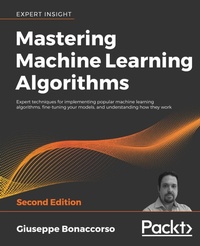
Mastering Machine Learning Algorithms
Expert techniques for implementing popular machine learning algorithms, fine-tuning your models, and understanding how they work
2nd Edition
Published on 31. January 2020
Book
Paperback/Softback
798 pages
978-1-83882-029-9 (ISBN)
Description
Updated and revised second edition of the bestselling guide to exploring and mastering the most important algorithms for solving complex machine learning problems
Key Features
Updated to include new algorithms and techniques
Code updated to Python 3.8 & TensorFlow 2.x
New coverage of regression analysis, time series analysis, deep learning models, and cutting-edge applications
Book DescriptionMastering Machine Learning Algorithms, Second Edition helps you harness the real power of machine learning algorithms in order to implement smarter ways of meeting today's overwhelming data needs. This newly updated and revised guide will help you master algorithms used widely in semi-supervised learning, reinforcement learning, supervised learning, and unsupervised learning domains.
You will use all the modern libraries from the Python ecosystem - including NumPy and Keras - to extract features from varied complexities of data. Ranging from Bayesian models to the Markov chain Monte Carlo algorithm to Hidden Markov models, this machine learning book teaches you how to extract features from your dataset, perform complex dimensionality reduction, and train supervised and semi-supervised models by making use of Python-based libraries such as scikit-learn. You will also discover practical applications for complex techniques such as maximum likelihood estimation, Hebbian learning, and ensemble learning, and how to use TensorFlow 2.x to train effective deep neural networks.
By the end of this book, you will be ready to implement and solve end-to-end machine learning problems and use case scenarios.What you will learn
Understand the characteristics of a machine learning algorithm
Implement algorithms from supervised, semi-supervised, unsupervised, and RL domains
Learn how regression works in time-series analysis and risk prediction
Create, model, and train complex probabilistic models
Cluster high-dimensional data and evaluate model accuracy
Discover how artificial neural networks work - train, optimize, and validate them
Work with autoencoders, Hebbian networks, and GANs
Who this book is forThis book is for data science professionals who want to delve into complex ML algorithms to understand how various machine learning models can be built. Knowledge of Python programming is required.
Key Features
Updated to include new algorithms and techniques
Code updated to Python 3.8 & TensorFlow 2.x
New coverage of regression analysis, time series analysis, deep learning models, and cutting-edge applications
Book DescriptionMastering Machine Learning Algorithms, Second Edition helps you harness the real power of machine learning algorithms in order to implement smarter ways of meeting today's overwhelming data needs. This newly updated and revised guide will help you master algorithms used widely in semi-supervised learning, reinforcement learning, supervised learning, and unsupervised learning domains.
You will use all the modern libraries from the Python ecosystem - including NumPy and Keras - to extract features from varied complexities of data. Ranging from Bayesian models to the Markov chain Monte Carlo algorithm to Hidden Markov models, this machine learning book teaches you how to extract features from your dataset, perform complex dimensionality reduction, and train supervised and semi-supervised models by making use of Python-based libraries such as scikit-learn. You will also discover practical applications for complex techniques such as maximum likelihood estimation, Hebbian learning, and ensemble learning, and how to use TensorFlow 2.x to train effective deep neural networks.
By the end of this book, you will be ready to implement and solve end-to-end machine learning problems and use case scenarios.What you will learn
Understand the characteristics of a machine learning algorithm
Implement algorithms from supervised, semi-supervised, unsupervised, and RL domains
Learn how regression works in time-series analysis and risk prediction
Create, model, and train complex probabilistic models
Cluster high-dimensional data and evaluate model accuracy
Discover how artificial neural networks work - train, optimize, and validate them
Work with autoencoders, Hebbian networks, and GANs
Who this book is forThis book is for data science professionals who want to delve into complex ML algorithms to understand how various machine learning models can be built. Knowledge of Python programming is required.
More details
Edition
2nd Revised edition
Language
English
Place of publication
Birmingham
United Kingdom
Target group
Professional and scholarly
US School Grade: College Graduate Student
Edition type
Revised edition
Dimensions
Height: 235 mm
Width: 191 mm
Thickness: 43 mm
Weight
1460 gr
ISBN-13
978-1-83882-029-9 (9781838820299)
Copyright in bibliographic data and cover images is held by Nielsen Book Services Limited or by the publishers or by their respective licensors: all rights reserved.
Schweitzer Classification
Other editions
Additional editions
Giuseppe Bonaccorso
Mastering Machine Learning Algorithms
Expert techniques for implementing popular machine learning algorithms, fine-tuning your models, and understanding how they work
E-Book
09/2024
2nd Edition
Packt Publishing
€33.99
Available for download
Person
Giuseppe Bonaccorso is an experienced manager in the fields of AI, data science, and machine learning. He has been involved in solution design, management, and delivery in different business contexts. He got his M.Sc.Eng in electronics in 2005 from the University of Catania, Italy, and continued his studies at the University of Rome Tor Vergata, Italy, and the University of Essex, UK. His main interests include machine/deep learning, reinforcement learning, big data, bio-inspired adaptive systems, neuroscience, and natural language processing.
Content
Table of Contents
Machine Learning Model Fundamentals
Loss functions and Regularization
Introduction to Semi-Supervised Learning
Advanced Semi-Supervised Classifiation
Graph-based Semi-Supervised Learning
Clustering and Unsupervised Models
Advanced Clustering and Unsupervised Models
Clustering and Unsupervised Models for Marketing
Generalized Linear Models and Regression
Introduction to Time-Series Analysis
Bayesian Networks and Hidden Markov Models
The EM Algorithm
Component Analysis and Dimensionality Reduction
Hebbian Learning
Fundamentals of Ensemble Learning
Advanced Boosting Algorithms
Modeling Neural Networks
Optimizing Neural Networks
Deep Convolutional Networks
Recurrent Neural Networks
Auto-Encoders
Introduction to Generative Adversarial Networks
Deep Belief Networks
Introduction to Reinforcement Learning
Advanced Policy Estimation Algorithms
Machine Learning Model Fundamentals
Loss functions and Regularization
Introduction to Semi-Supervised Learning
Advanced Semi-Supervised Classifiation
Graph-based Semi-Supervised Learning
Clustering and Unsupervised Models
Advanced Clustering and Unsupervised Models
Clustering and Unsupervised Models for Marketing
Generalized Linear Models and Regression
Introduction to Time-Series Analysis
Bayesian Networks and Hidden Markov Models
The EM Algorithm
Component Analysis and Dimensionality Reduction
Hebbian Learning
Fundamentals of Ensemble Learning
Advanced Boosting Algorithms
Modeling Neural Networks
Optimizing Neural Networks
Deep Convolutional Networks
Recurrent Neural Networks
Auto-Encoders
Introduction to Generative Adversarial Networks
Deep Belief Networks
Introduction to Reinforcement Learning
Advanced Policy Estimation Algorithms