

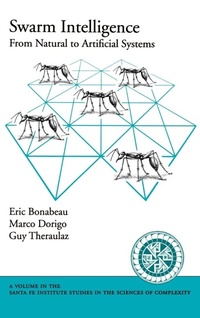
Swarm Intelligence
From Natural to Artificial Systems
Published on 21. October 1999
Book
Hardback
322 pages
978-0-19-513158-1 (ISBN)
Description
Social insects--ants, bees, termites, and wasps--can be viewed as powerful problem-solving systems with sophisticated collective intelligence. Composed of simple interacting agents, this intelligence lies in the networks of interactions among individuals and between individuals and the environment. A fascinating subject, social insects are also a powerful metaphor for artificial intelligence, and the problems they solve--finding food, dividing labor among nestmates, building nests, responding to external challenges--have important counterparts in engineering and computer science.
This book provides a detailed look at models of social insect behaviour and how to apply these models in the design of complex systems. The book shows how these models replace an emphasis on control, preprogramming, and centralization with designs featuring autonomy, emergence, and distributed functioning. These designs are proving immensely flexible and robust, able to adapt quickly to changing environments and to continue functioning even when individual elements fail. In particular, these designs are an exciting approach to the tremendous growth of complexity in software and information. Swarm Intelligence draws on up-to-date research from biology, neuroscience, artificial intelligence, robotics, operations research, and computer graphics, and each chapter is organized around a particular biological example, which is then used to develop an algorithm, a multiagent system, or a group of robots. The book will be an invaluable resource for a broad range of disciplines.
This book provides a detailed look at models of social insect behaviour and how to apply these models in the design of complex systems. The book shows how these models replace an emphasis on control, preprogramming, and centralization with designs featuring autonomy, emergence, and distributed functioning. These designs are proving immensely flexible and robust, able to adapt quickly to changing environments and to continue functioning even when individual elements fail. In particular, these designs are an exciting approach to the tremendous growth of complexity in software and information. Swarm Intelligence draws on up-to-date research from biology, neuroscience, artificial intelligence, robotics, operations research, and computer graphics, and each chapter is organized around a particular biological example, which is then used to develop an algorithm, a multiagent system, or a group of robots. The book will be an invaluable resource for a broad range of disciplines.
More details
Series
Language
English
Place of publication
New York
United States
Target group
Professional and scholarly
Illustrations
numerous halftone and line illustrations
Dimensions
Height: 235 mm
Width: 157 mm
Thickness: 24 mm
Weight
675 gr
ISBN-13
978-0-19-513158-1 (9780195131581)
Copyright in bibliographic data and cover images is held by Nielsen Book Services Limited or by the publishers or by their respective licensors: all rights reserved.
Schweitzer Classification
Other editions
Additional editions
Book
10/1999
Oxford University Press Inc
€100.80
Shipment within 15-20 days
E-Book
09/1999
1st Edition
OUP USA
€67.49
Available for download
E-Book
09/1999
1st Edition
OUP USA
€67.49
Available for download
Persons
Content
Preface
1: Introduction
2: Ant Foraging Behavior, Combinatorial Optimization, and Routing in Communications Network
3: Division of Labor and Task Allocation
4: Cemetery Organization, Brood Sorting, Data Analysis and Graph Partitioning
5: Self-Organization and Templates: Application to Data Analysis and Graph Partitioning
6: Nest Building and Self-Assembling
7: Cooperative Transport by Insects and Robots
8: Epilogue
Bibliography
Index
1: Introduction
2: Ant Foraging Behavior, Combinatorial Optimization, and Routing in Communications Network
3: Division of Labor and Task Allocation
4: Cemetery Organization, Brood Sorting, Data Analysis and Graph Partitioning
5: Self-Organization and Templates: Application to Data Analysis and Graph Partitioning
6: Nest Building and Self-Assembling
7: Cooperative Transport by Insects and Robots
8: Epilogue
Bibliography
Index