

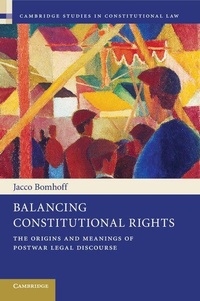
Balancing Constitutional Rights
The Origins and Meanings of Postwar Legal Discourse
Published on 8. October 2015
Book
Paperback/Softback
290 pages
978-1-107-62248-7 (ISBN)
Description
The language of balancing is pervasive in constitutional rights jurisprudence around the world. In this book, Jacco Bomhoff offers a comparative and historical account of the origins and meanings of this talismanic form of language, and of the legal discourse to which it is central. Contemporary discussion has tended to see the increasing use of balancing as the manifestation of a globalization of constitutional law. This book is the first to argue that 'balancing' has always meant radically different things in different settings. Bomhoff uses detailed case studies of early post-war US and German constitutional jurisprudence to show that the same unique language expresses both biting scepticism and profound faith in law and adjudication, and both deep pessimism and high aspirations for constitutional rights. An understanding of these radically different meanings is essential for any evaluation of the work of constitutional courts today.
More details
Series
Language
English
Place of publication
Cambridge
United Kingdom
Target group
Professional and scholarly
Product notice
Paperback (trade)
Illustrations
1 Tables, black and white
Dimensions
Height: 229 mm
Width: 152 mm
Thickness: 16 mm
Weight
424 gr
ISBN-13
978-1-107-62248-7 (9781107622487)
Copyright in bibliographic data and cover images is held by Nielsen Book Services Limited or by the publishers or by their respective licensors: all rights reserved.
Schweitzer Classification
Other editions
Additional editions
Book
12/2013
Cambridge University Press
€140.90
Shipment within 15-20 days
Person
Jacco Bomhoff is Associate Professor of Law at the London School of Economics and Political Science.
Content
Introduction; 1. Questioning a 'global age of balancing'; 2. Balancing's beginnings: concepts and interests; 3. 'A perfect constitutional order'; 4. 'A dangerous doctrine'; 5. Two paradigms of balancing; Conclusion.