

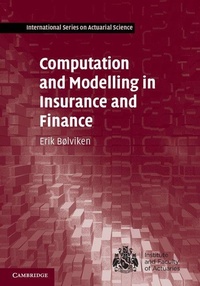
Computation and Modelling in Insurance and Finance
Published on 10. April 2014
Book
Hardback
712 pages
978-0-521-83048-5 (ISBN)
Description
Focusing on what actuaries need in practice, this introductory account provides readers with essential tools for handling complex problems and explains how simulation models can be created, used and re-used (with modifications) in related situations. The book begins by outlining the basic tools of modelling and simulation, including a discussion of the Monte Carlo method and its use. Part II deals with general insurance and Part III with life insurance and financial risk. Algorithms that can be implemented on any programming platform are spread throughout and a program library written in R is included. Numerous figures and experiments with R-code illustrate the text. The author's non-technical approach is ideal for graduate students, the only prerequisites being introductory courses in calculus and linear algebra, probability and statistics. The book will also be of value to actuaries and other analysts in the industry looking to update their skills.
More details
Series
Language
English
Place of publication
Cambridge
United Kingdom
Target group
Professional and scholarly
Illustrations
Worked examples or Exercises; 45 Tables, black and white; 80 Line drawings, unspecified
Dimensions
Height: 250 mm
Width: 175 mm
Thickness: 42 mm
Weight
1387 gr
ISBN-13
978-0-521-83048-5 (9780521830485)
Copyright in bibliographic data and cover images is held by Nielsen Book Services Limited or by the publishers or by their respective licensors: all rights reserved.
Schweitzer Classification
Other editions
Additional editions
Erik Bolviken
Computation and Modelling in Insurance and Finance
E-Book
04/2014
Cambridge University Press
€96.49
Available for download
Erik Bolviken
Computation and Modelling in Insurance and Finance
E-Book
03/2014
1st Edition
Cambridge University Press
€115.99
Available for download
Person
Erik Bolviken, with broad experience as an applied statistician, holds the Chair of Actuarial Science at the University of Oslo and was for many years a partner in Gabler and Partners, Oslo.
Content
1. Introduction; Part I. Tools for Risk Analysis: 2. Getting started the Monte Carlo way; 3. Evaluating risk: a primer; 4. Monte Carlo II: improving technique; 5. Modelling I: linear dependence; 6. Modelling II: conditional and non-linear; 7. Historical estimation and error; Part II. General Insurance: 8. Modelling claim frequency; 9. Modelling claim size; 10. Solvency and pricing; 11. Liabilities over long terms; Part III. Life Insurance and Financial Risk: 12. Life and state-dependent insurance; 13. Stochastic asset models; 14. Financial derivatives; 15. Integrating risk of different origin; Appendix A. Random variables: principal tools; Appendix B. Linear algebra and stochastic vectors; Appendix C. Numerical algorithms: a third tool; References; Index.