

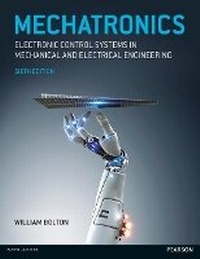
Mechatronics: Electronic Control Systems in Mechanical and Electrical Engineering
6th Edition
Published on 27. February 2015
Book
Paperback/Softback
664 pages
978-1-292-07668-3 (ISBN)
Description
Mechatronics is essential reading for students requiring an introduction to this exciting area at undergraduate and higher diploma level.
More details
Other editions
New editions
Book
12/2018
7th Edition
Pearson Education Limited
€106.99
Shipment within 10-20 days
Previous edition
Book
11/2011
5th Edition
Prentice Hall
€175.89
Article exhausted; check for reprint
Person
Bill Bolton was formerly Consultant to the Further Education Unit and Head of Research and Development and Monitoring at BTEC. He has also been a UNESCO consultant and is the author of many successful engineering textbooks.
Content
Preface
Introduction
1 Introducing mechatronics
Chapter objectives
1.1 What is mechatronics?
1.2 The design process
1.3 Systems
1.4 Measurement systems
1.5 Control systems
1.6 Programmable logic controller
1.7 Examples of mechatronic systems
Summary
Problems
Sensors and signal conditioning
2 Sensors and transducers
Chapter objectives
2.1 Sensors and transducers
2.2 Performance terminology
2.3 Displacement, position and proximity
2.4 Velocity and motion
2.5 Force
2.6 Fluid pressure
2.7 Liquid flow
2.8 Liquid level
2.9 Temperature
2.10 Light sensors
2.11 Selection of sensors
2.12 Inputting data by switches
Summary
Problems
3 Signal conditioning
Chapter objectives
3.1 Signal conditioning
3.2 The operational amplifier
3.3 Protection
3.4 Filtering
3.5 Wheatstone bridge
3.6 Pulse modulation
3.7 Problems with signals
3.8 Power transfer
Summary
Problems
4 Digital signals
Chapter objectives
4.1 Digital signals
4.2 Analogue and digital signals
4.3 Digital-to-analogue and analogue-to-digital converters
4.4 Multiplexers
4.5 Data acquisition
4.6 Digital signal processing
Summary
Problems
5 Digital logic
Chapter objectives
5.1 Digital logic
5.2 Logic gates
5.3 Applications of logic gates
5.4 Sequential logic
Summary
Problems
6 Data presentation systems
Chapter objectives
6.1 Displays
6.2 Data presentation elements
6.3 Magnetic recording
6.4 Optical recording
6.5 Displays
6.6 Data acquisition systems
6.7 Measurement systems
6.8 Testing and calibration
Summary
Problems
Actuation
7 Pneumatic and hydraulic actuation systems
Chapter objectives
7.1 Actuation systems
7.2 Pneumatic and hydraulic systems
7.3 Directional control valves
7.4 Pressure control valves
7.5 Cylinders
7.6 Servo and proportional control valves
7.7 Process control valves
7.8 Rotary actuators
Summary
Problems
8 Mechanical actuation systems
Chapter objectives
8.1 Mechanical systems
8.2 Types of motion
8.3 Kinematic chains
8.4 Cams
8.5 Gear trains
8.6 Ratchet and pawl
8.7 Belt and chain drives
8.8 Bearings
8.9 Mechanical aspects of motor selection
Summary
Problems
9 Electrical actuation systems
Chapter objectives
9.1 Electrical systems
9.2 Mechanical switches
9.3 Solid-state switches
9.4 Solenoids
9.5 D.C. motors
9.6 A.C. motors
9.7 Stepper motors
Summary
Problems
Microprocessor systems
10 Microprocessors and microcontrollers
Chapter objectives
10.1 Control
10.2 Microprocessor systems
10.3 Microcontrollers
10.4 Applications
10.5 Programming
Summary
Problems
11 Assembly language
Chapter objectives
11.1 Languages
11.2 Instruction sets
11.3 Assembly language programs
11.4 Subroutines
11.5 Look-up tables
11.6 Embedded systems
Summary
Problems
12 C language
12.1 Why C?
12.2 Program structure
12.3 Branches and loops
12.4 Arrays
12.5 Pointers
12.6 Program development
12.7 Examples of programs
12.8 Arduino programs
Summary
Problems
13 Input/output systems
Chapter Ob
Introduction
1 Introducing mechatronics
Chapter objectives
1.1 What is mechatronics?
1.2 The design process
1.3 Systems
1.4 Measurement systems
1.5 Control systems
1.6 Programmable logic controller
1.7 Examples of mechatronic systems
Summary
Problems
Sensors and signal conditioning
2 Sensors and transducers
Chapter objectives
2.1 Sensors and transducers
2.2 Performance terminology
2.3 Displacement, position and proximity
2.4 Velocity and motion
2.5 Force
2.6 Fluid pressure
2.7 Liquid flow
2.8 Liquid level
2.9 Temperature
2.10 Light sensors
2.11 Selection of sensors
2.12 Inputting data by switches
Summary
Problems
3 Signal conditioning
Chapter objectives
3.1 Signal conditioning
3.2 The operational amplifier
3.3 Protection
3.4 Filtering
3.5 Wheatstone bridge
3.6 Pulse modulation
3.7 Problems with signals
3.8 Power transfer
Summary
Problems
4 Digital signals
Chapter objectives
4.1 Digital signals
4.2 Analogue and digital signals
4.3 Digital-to-analogue and analogue-to-digital converters
4.4 Multiplexers
4.5 Data acquisition
4.6 Digital signal processing
Summary
Problems
5 Digital logic
Chapter objectives
5.1 Digital logic
5.2 Logic gates
5.3 Applications of logic gates
5.4 Sequential logic
Summary
Problems
6 Data presentation systems
Chapter objectives
6.1 Displays
6.2 Data presentation elements
6.3 Magnetic recording
6.4 Optical recording
6.5 Displays
6.6 Data acquisition systems
6.7 Measurement systems
6.8 Testing and calibration
Summary
Problems
Actuation
7 Pneumatic and hydraulic actuation systems
Chapter objectives
7.1 Actuation systems
7.2 Pneumatic and hydraulic systems
7.3 Directional control valves
7.4 Pressure control valves
7.5 Cylinders
7.6 Servo and proportional control valves
7.7 Process control valves
7.8 Rotary actuators
Summary
Problems
8 Mechanical actuation systems
Chapter objectives
8.1 Mechanical systems
8.2 Types of motion
8.3 Kinematic chains
8.4 Cams
8.5 Gear trains
8.6 Ratchet and pawl
8.7 Belt and chain drives
8.8 Bearings
8.9 Mechanical aspects of motor selection
Summary
Problems
9 Electrical actuation systems
Chapter objectives
9.1 Electrical systems
9.2 Mechanical switches
9.3 Solid-state switches
9.4 Solenoids
9.5 D.C. motors
9.6 A.C. motors
9.7 Stepper motors
Summary
Problems
Microprocessor systems
10 Microprocessors and microcontrollers
Chapter objectives
10.1 Control
10.2 Microprocessor systems
10.3 Microcontrollers
10.4 Applications
10.5 Programming
Summary
Problems
11 Assembly language
Chapter objectives
11.1 Languages
11.2 Instruction sets
11.3 Assembly language programs
11.4 Subroutines
11.5 Look-up tables
11.6 Embedded systems
Summary
Problems
12 C language
12.1 Why C?
12.2 Program structure
12.3 Branches and loops
12.4 Arrays
12.5 Pointers
12.6 Program development
12.7 Examples of programs
12.8 Arduino programs
Summary
Problems
13 Input/output systems
Chapter Ob