

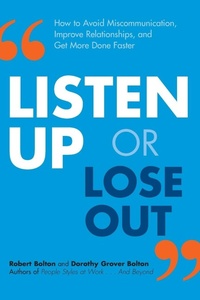
Listen Up or Lose Out
How to Avoid Miscommunication, Improve Relationships, and Get More Done Faster
Published on 23. March 2018
Book
Paperback/Softback
272 pages
978-0-8144-3201-3 (ISBN)
Description
Learning how to actively listen and absorb what a person is saying, thinking, and feeling can set the stage for dramatically improved relationships and increased personal success.
Most people retain only a fraction of what they hear, resulting in miscommunications and lost opportunities. In Listen Up or Lose Out, communications expert Robert Bolton highlights the underestimated and under-utilized tool of active listening and explains how it can be used to gather perspectives, bridge differences, and resolve problems.
Bolton teaches you key communication skills by:
breaking down listening into a set of learnable skills such as avoiding the urge to criticize, question, or advise;
focusing on the speaker's point of view;
asking the right questions, in the right order;
and learning how to read people's feelings and reflect them back
Listen Up or Lose Out explains how one can become a skilled listener who experiences fewer conflicts, makes better decisions, and discovers opportunities that others might miss. Whether personally or in business, could you benefit from better communication? Give listening a try!
Most people retain only a fraction of what they hear, resulting in miscommunications and lost opportunities. In Listen Up or Lose Out, communications expert Robert Bolton highlights the underestimated and under-utilized tool of active listening and explains how it can be used to gather perspectives, bridge differences, and resolve problems.
Bolton teaches you key communication skills by:
breaking down listening into a set of learnable skills such as avoiding the urge to criticize, question, or advise;
focusing on the speaker's point of view;
asking the right questions, in the right order;
and learning how to read people's feelings and reflect them back
Listen Up or Lose Out explains how one can become a skilled listener who experiences fewer conflicts, makes better decisions, and discovers opportunities that others might miss. Whether personally or in business, could you benefit from better communication? Give listening a try!
More details
Language
English
Place of publication
United States
Publishing group
HarperCollins Focus
Dimensions
Height: 229 mm
Width: 152 mm
Thickness: 17 mm
Weight
474 gr
ISBN-13
978-0-8144-3201-3 (9780814432013)
Copyright in bibliographic data and cover images is held by Nielsen Book Services Limited or by the publishers or by their respective licensors: all rights reserved.
Schweitzer Classification
Persons
ROBERT BOLTON, PH.D., is known for his expertise in training trainers. He is a cofounder of Ridge Associates, a training and consulting firm that serves many Fortune 500 companies, and the author of several books.
DOROTHY GROVER BOLTON, ED.M., are known for their expertise in training trainers. They are cofounders of Ridge Associates, a training and consulting firm that serves many Fortune 500 companies, and the authors of several books including the perennially popular People Styles at Work . . . And Beyond.
DOROTHY GROVER BOLTON, ED.M., are known for their expertise in training trainers. They are cofounders of Ridge Associates, a training and consulting firm that serves many Fortune 500 companies, and the authors of several books including the perennially popular People Styles at Work . . . And Beyond.
Content
Introduction: What This Book Will Do for You xi
PART I: WHY IMPROVE YOUR LISTENING?
1. Quality Listening Enhances Work Relationships 3
2. Listening Well Is Good Business 15
3. A Good Listener Is a Rare Find 23
4. Quality Listening Strengthens Personal Relationships 31
PART II: DO'S AND DON'TS OF GREAT LISTENING
5. Trouble Spots in the Talking--Listening Process 43
6. Identifying Your Listening Missteps 53
7. Reducing Major Missteps 67
8. Skill-Based Listening 71
9. Whose Turn Is it? 77
10. Focus Your Attention 83
11. Be a Great Asker 95
12. Creating and Sequencing Productive Questions 101
PART III: REFLECTING CONTENT
13. Reflective Listening: Antidote to Miscommunication 115
14. Paraphrase What's Important 129
15. Listen Through the Pauses 141
PART IV: READING AND REFLECTING OTHER PEOPLE'S FEELINGS
16. Why Listen to People's Feelings? 151
17. "Read" People's Feelings 161
18. Reflect Feelings and Meanings 171
PART V: THINGS TO KEEP IN MIND
19. Wrap It Up with a Summary Reflection 185
20. Results-Focused Listening 193
21. The Listening Spirit 209
22. Make Great Listening Part of Your Everyday Life 219
Appendix 231
Endnotes 243
Index 261
PART I: WHY IMPROVE YOUR LISTENING?
1. Quality Listening Enhances Work Relationships 3
2. Listening Well Is Good Business 15
3. A Good Listener Is a Rare Find 23
4. Quality Listening Strengthens Personal Relationships 31
PART II: DO'S AND DON'TS OF GREAT LISTENING
5. Trouble Spots in the Talking--Listening Process 43
6. Identifying Your Listening Missteps 53
7. Reducing Major Missteps 67
8. Skill-Based Listening 71
9. Whose Turn Is it? 77
10. Focus Your Attention 83
11. Be a Great Asker 95
12. Creating and Sequencing Productive Questions 101
PART III: REFLECTING CONTENT
13. Reflective Listening: Antidote to Miscommunication 115
14. Paraphrase What's Important 129
15. Listen Through the Pauses 141
PART IV: READING AND REFLECTING OTHER PEOPLE'S FEELINGS
16. Why Listen to People's Feelings? 151
17. "Read" People's Feelings 161
18. Reflect Feelings and Meanings 171
PART V: THINGS TO KEEP IN MIND
19. Wrap It Up with a Summary Reflection 185
20. Results-Focused Listening 193
21. The Listening Spirit 209
22. Make Great Listening Part of Your Everyday Life 219
Appendix 231
Endnotes 243
Index 261