

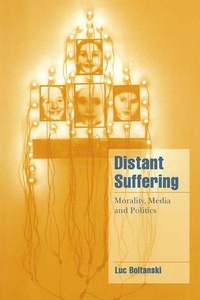
Distant Suffering
Morality, Media and Politics
Published on 13. October 1999
Book
Paperback/Softback
268 pages
978-0-521-65953-6 (ISBN)
Description
Distant Suffering, first published in 1999, examines the moral and political implications for a spectator of the distant suffering of others as presented through the media. What are the morally acceptable responses to the sight of suffering on television, for example, when the viewer cannot act directly to affect the circumstances in which the suffering takes place? Luc Boltanski argues that spectators can actively involve themselves and others by speaking about what they have seen and how they were affected by it. Developing ideas in Adam Smith's moral theory, he examines three rhetorical 'topics' available for the expression of the spectator's response to suffering: the topics of denunciation and of sentiment and the aesthetic topic. The book concludes with a discussion of a 'crisis of pity' in relation to modern forms of humanitarianism. A possible way out of this crisis is suggested which involves an emphasis and focus on present suffering.
More details
Series
Language
English
French
Place of publication
Cambridge
United Kingdom
Target group
Professional and scholarly
College/higher education
Product notice
Paperback (trade)
Illustrations
Worked examples or Exercises
Dimensions
Height: 229 mm
Width: 152 mm
Thickness: 17 mm
Weight
440 gr
ISBN-13
978-0-521-65953-6 (9780521659536)
Copyright in bibliographic data and cover images is held by Nielsen Book Services Limited or by the publishers or by their respective licensors: all rights reserved.
Schweitzer Classification
Persons
Content
Part I. The Question of the Spectator: 1. The politics of pity; 2. Taking sides; 3. The moral spectator; Part II. The Topics of Suffering: 4. The topic of denunciation; 5. The topic of sentiment; 6. The critique of sentimentalism; 7. The aesthetic topic; 8. Heroes and the accursed; Part III. The Crisis of Pity: 9. What reality has misfortune?; 10. How realistic is action?