

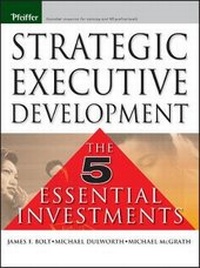
Strategic Executive Development
The Five Essential Investments
Published on 15. July 2005
Book
Hardback
196 pages
978-0-7879-7463-3 (ISBN)
Description
Strategic Executive Development--written by three leaders in the field of executive development, James F. Bolt, Michael McGrath and Michael Dulworth--shows how world-class companies use executive development to drive business strategy and affect growth. This important resource presents five strategic uses of executive development that produce demonstrable business impact. Based on empirical data gathered from their extensive research and consulting, and a comprehensive survey of executive development in leading organizations, this book answers the key question: What are the investments in executive development that have the biggest impact? Using illustrative case studies, the authors clearly demonstrate how executive development is being successfully implemented at some of the world's most recognizable and enduring companies, including Texas Instruments. These cases describe what is working and why, offer insights into the key process steps, and show how companies have measured and validated the effects of executive development. Strategic Executive Development offers the framework needed to create an executive development strategy and program that will help your organization achieve measurable business results and develop the executive capabilities needed to win in the marketplace.
More details
Language
English
Place of publication
United States
Publishing group
John Wiley & Sons Inc
Target group
Professional and scholarly
Illustrations
Drawings: 30 B&W, 0 Color; Tables: 30 B&W, 0 Color
Dimensions
Height: 244 mm
Width: 185 mm
Thickness: 23 mm
Weight
572 gr
ISBN-13
978-0-7879-7463-3 (9780787974633)
Copyright in bibliographic data and cover images is held by Nielsen Book Services Limited or by the publishers or by their respective licensors: all rights reserved.
Schweitzer Classification
Persons
The Authors
James F. Bolt is chairman and founder of Executive Development Associates, Inc., a leading consulting firm specializing in the strategic use of executive development. He was selected by the Financial Times as one of the top experts in executive and leadership development; Linkage, Inc., named him one of the top fifty executive coaches in the world. Bolt is an online columnist for Fast Company. His previous books include Executive Development: A Strategy for Corporate Competitiveness and The Future of Executive Development.
Michael Dulworth is the managing director of Executive Development Associates, Inc.
Michael McGrath, PhD., is vice president of Executive Development Associates, Inc.
James F. Bolt is chairman and founder of Executive Development Associates, Inc., a leading consulting firm specializing in the strategic use of executive development. He was selected by the Financial Times as one of the top experts in executive and leadership development; Linkage, Inc., named him one of the top fifty executive coaches in the world. Bolt is an online columnist for Fast Company. His previous books include Executive Development: A Strategy for Corporate Competitiveness and The Future of Executive Development.
Michael Dulworth is the managing director of Executive Development Associates, Inc.
Michael McGrath, PhD., is vice president of Executive Development Associates, Inc.
Content
Introduction xi
1 Critical Trends in Executive Development: What Lies Ahead? 1
2 Creating Executive Development Strategies and Programs That Support Your Business Objectives 17
3 The Five High-Impact Uses of Executive Development 26
4 Creating Strategic Unity and Alignment 36
5 Ensuring the Successful Transition of New Executives 58
6 Accelerating the Development of Emerging Leaders 70
7 Transforming Organizations 91
8 Identifying and Addressing Critical Business Challenges 105
9 The Business Impact of Corporate Executive Development 117
Appendix A EDA 2004 Trends Survey Advisory Board 135
Appendix B EDA 2004 Trends Survey Respondent Demographics 139
Appendix C Definitions of Twelve Best Practices from the EDA 2004 Trends Survey 141
Appendix D Comparing 2000 and 2004 Trends Survey Results 143
Appendix E Research and Analysis: Examples of Documents to Gather and Review 147
Appendix F Design: Typical Action-Oriented Learning Activities 149
Appendix G Pilot Program: Typical Facilitator Activities 151
Appendix H EDA's Rapid-Cycle Design (R) Process 153
Appendix I Web-Based Survey: Typical Question Themes 161
Appendix J Different Ways of Measuring Executive Development 163
Index 167
About the Authors 171
About Pfeiffer 175
1 Critical Trends in Executive Development: What Lies Ahead? 1
2 Creating Executive Development Strategies and Programs That Support Your Business Objectives 17
3 The Five High-Impact Uses of Executive Development 26
4 Creating Strategic Unity and Alignment 36
5 Ensuring the Successful Transition of New Executives 58
6 Accelerating the Development of Emerging Leaders 70
7 Transforming Organizations 91
8 Identifying and Addressing Critical Business Challenges 105
9 The Business Impact of Corporate Executive Development 117
Appendix A EDA 2004 Trends Survey Advisory Board 135
Appendix B EDA 2004 Trends Survey Respondent Demographics 139
Appendix C Definitions of Twelve Best Practices from the EDA 2004 Trends Survey 141
Appendix D Comparing 2000 and 2004 Trends Survey Results 143
Appendix E Research and Analysis: Examples of Documents to Gather and Review 147
Appendix F Design: Typical Action-Oriented Learning Activities 149
Appendix G Pilot Program: Typical Facilitator Activities 151
Appendix H EDA's Rapid-Cycle Design (R) Process 153
Appendix I Web-Based Survey: Typical Question Themes 161
Appendix J Different Ways of Measuring Executive Development 163
Index 167
About the Authors 171
About Pfeiffer 175