

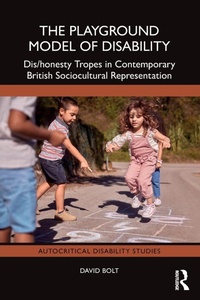
The Playground Model of Disability
Dis/honesty Tropes in Contemporary British Sociocultural Representation
1st Edition
Published on 14. October 2025
Book
Paperback/Softback
110 pages
978-1-041-06492-3 (ISBN)
Description
More than being counter to what we must surely endeavour to consider the status quo of honesty, not to mention the pursuit of truth that should still be fundamental in academia and education more broadly, dishonesty involves deceit and thus victimisation, which is to say it tends to be used either against someone or to give someone an unfair advantage. Such personal interactions are sometimes and, in the context of this book, revealingly referred to as the games people play.
When an unfair advantage is so given, someone else tends to be disadvantaged, an aspect of dishonesty that resonates with disablement. This book coins the term dis/honesty to define the many moments in which dishonesty is invoked by disability, and vice versa. The concept is explored via a selection of contemporary British sociocultural representations - namely, short jokes, disability sitcom, soap opera, activist radio interviews, fictionalised observations, and the robotic positionality of Artificial Intelligence.
In investigating these representations of dis/honesty, on the basis that the blueprint of adult behaviour is found in the schoolyard, playground figurations are posited as part of the autocritical framework. Remarkably, there are many such relationships with disablement, for intrinsic to Piggy in the Middle, Leapfrog, Pile On, Hide and Seek, Blind Man's Bluff, and Robot Tick, among other playground games, is interpersonal inequity, whereby a normative position is juxtaposed with one defined by being outnumbered, inhibited, and/or singled out.
The playground model of disability reveals normative traditions that, according to a range of recent representations, people are often more than tempted to follow. Like a hegemonic game of Hopscotch, the way of the normative social order is sketched before us, complete with behavioural guidelines legitimised by repetition and competition. This book shows how dis/honesty tropes serve the normative social order and how the playground model can be used to critique instances in which disablement emanates from interactions more than institutions, people more than places.
The Playground Model of Disability: Dis/honesty Tropes in Contemporary British Sociocultural Representation will be of particular interest to readers in disability studies, as well as those in humour studies, radio studies, media studies, television studies, literary studies, cultural studies, inclusion studies, drama, sociology, and critical theory.
When an unfair advantage is so given, someone else tends to be disadvantaged, an aspect of dishonesty that resonates with disablement. This book coins the term dis/honesty to define the many moments in which dishonesty is invoked by disability, and vice versa. The concept is explored via a selection of contemporary British sociocultural representations - namely, short jokes, disability sitcom, soap opera, activist radio interviews, fictionalised observations, and the robotic positionality of Artificial Intelligence.
In investigating these representations of dis/honesty, on the basis that the blueprint of adult behaviour is found in the schoolyard, playground figurations are posited as part of the autocritical framework. Remarkably, there are many such relationships with disablement, for intrinsic to Piggy in the Middle, Leapfrog, Pile On, Hide and Seek, Blind Man's Bluff, and Robot Tick, among other playground games, is interpersonal inequity, whereby a normative position is juxtaposed with one defined by being outnumbered, inhibited, and/or singled out.
The playground model of disability reveals normative traditions that, according to a range of recent representations, people are often more than tempted to follow. Like a hegemonic game of Hopscotch, the way of the normative social order is sketched before us, complete with behavioural guidelines legitimised by repetition and competition. This book shows how dis/honesty tropes serve the normative social order and how the playground model can be used to critique instances in which disablement emanates from interactions more than institutions, people more than places.
The Playground Model of Disability: Dis/honesty Tropes in Contemporary British Sociocultural Representation will be of particular interest to readers in disability studies, as well as those in humour studies, radio studies, media studies, television studies, literary studies, cultural studies, inclusion studies, drama, sociology, and critical theory.
More details
Series
Language
English
Place of publication
London
United Kingdom
Publishing group
Taylor & Francis Ltd
Target group
College/higher education
Postgraduate
Dimensions
Height: 234 mm
Width: 156 mm
Thickness: 8 mm
Weight
219 gr
ISBN-13
978-1-041-06492-3 (9781041064923)
Copyright in bibliographic data and cover images is held by Nielsen Book Services Limited or by the publishers or by their respective licensors: all rights reserved.
Schweitzer Classification
Other editions
Additional editions
David Bolt
The Playground Model of Disability
Dis/honesty Tropes in Contemporary British Sociocultural Representation
E-Book
10/2025
1st Edition
Routledge
€55.49
Available for download
David Bolt
The Playground Model of Disability
Dis/honesty Tropes in Contemporary British Sociocultural Representation
E-Book
10/2025
1st Edition
Routledge
€55.49
Available for download
David Bolt
The Playground Model of Disability
Dis/honesty Tropes in Contemporary British Sociocultural Representation
Book
10/2025
1st Edition
Routledge
€206.90
Shipment within 15-20 days
Person
David Bolt is Professor of Disability Studies and Interdisciplinarity, Programme Leader on the Disability Studies MA, and Director of the Centre for Culture and Disability Studies at Liverpool Hope University.
Content
0.Prologue - The Games People Play: Disability, Dishonesty, and the Hopscotch of Hegemony. 1.Piggy in the Middle: The Gagging Order of Jokebooks. 2.Leapfrog: Ability, Disability, and Radio Sitcom. 3.Pile On: Street Life, Society, and Television Soap Opera. 4.Hide and Seek: Just Desertions from the Classic Radio Interview. 5.Blind Man's Bluff: Fictionalised Facts and Figures. 6.Robot Tick: Superficial-Artificial Intelligence. x.Epilogue - The Smashed Window Phase: Beyond the Hopscotch. of Hegemony