

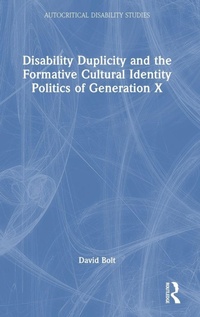
Disability Duplicity and the Formative Cultural Identity Politics of Generation X
1st Edition
Published on 21. September 2023
Book
Hardback
100 pages
978-1-032-55398-6 (ISBN)
Description
Disability is history and futurity, culture and society, practice and theory, work and play, an immense desire for life by which body and mind are dragged kicking and screaming into each and every new day.
Using autocritical discourse analysis, a new hybrid research method that combines aspects of the established methods of critical discourse analysis (CDA) and autoethnography, this book explores the formative cultural identity politics of disability via cultural stations of UK popular culture. These cultural stations include action figures, children's books, television miniseries, comics, comedy films, teenage drama and sitcoms, the punk rock movement, and alternative comedy. Although the cultural stations range from toys and comics to aggressive music and chaotic sitcoms, all are considered with a focus on the language and tropes of disability. Indeed, most of the works are not remembered as portrayals of disability but the book's analysis reveals flash if not fleeting representations that, when centralised, clarify patterns of duplicity. Via the language of power, and the power of language, all these texts are found to have contributed to the formative cultural identity politics of disability.
It will be of interest to all scholars and students of disability studies, sociology, toy studies, comic studies, humour studies, television studies, popular music studies, gender studies, literary studies, and cultural studies.
Using autocritical discourse analysis, a new hybrid research method that combines aspects of the established methods of critical discourse analysis (CDA) and autoethnography, this book explores the formative cultural identity politics of disability via cultural stations of UK popular culture. These cultural stations include action figures, children's books, television miniseries, comics, comedy films, teenage drama and sitcoms, the punk rock movement, and alternative comedy. Although the cultural stations range from toys and comics to aggressive music and chaotic sitcoms, all are considered with a focus on the language and tropes of disability. Indeed, most of the works are not remembered as portrayals of disability but the book's analysis reveals flash if not fleeting representations that, when centralised, clarify patterns of duplicity. Via the language of power, and the power of language, all these texts are found to have contributed to the formative cultural identity politics of disability.
It will be of interest to all scholars and students of disability studies, sociology, toy studies, comic studies, humour studies, television studies, popular music studies, gender studies, literary studies, and cultural studies.
Reviews / Votes
David Bolt's Disability Duplicity and the Formative Cultural Identity Politics of Generation X is the latest of four monographs in Routledge's Autocritical Disability Studies series. Internationally recognized as a foundational scholar within the field of critical disability studies, Bolt has done much to welcome newcomers into what he has helped become a truly interdisciplinary domain. He is both the author of this beautifully crafted monograph and the editor of this pioneering series that "represents both a contribution to, and a departure from, the academic field of critical disability studies" (ii) by addressing unease that the latter has inadequately considered the lived experiences and political concerns of disabled people. The titles within this collection blend critical disability theory, which commonly emphasizes textual analysis, with autoethnography-a coupling of autobiography and ethnography-where researchers investigate culture and society through their personal experiences and reflections. This enlightening text demonstrates that there are still so many ways to grow cultural and literary disability studies. David Bolt continues to take us in promising directions.Chloe Hughes
Western Oregon University
More details
Series
Language
English
Place of publication
London
United Kingdom
Publishing group
Taylor & Francis Ltd
Target group
College/higher education
Postgraduate
Illustrations
1 s/w Abbildung, 1 s/w Photographie bzw. Rasterbild
1 Halftones, black and white; 1 Illustrations, black and white
Dimensions
Height: 240 mm
Width: 161 mm
Thickness: 11 mm
Weight
352 gr
ISBN-13
978-1-032-55398-6 (9781032553986)
Copyright in bibliographic data and cover images is held by Nielsen Book Services Limited or by the publishers or by their respective licensors: all rights reserved.
Schweitzer Classification
Other editions
Additional editions
Book
09/2023
1st Edition
Routledge
€57.40
Shipment within 10-20 days
E-Book
09/2023
1st Edition
Routledge
€51.49
Available for download
E-Book
09/2023
1st Edition
Routledge
€51.49
Available for download
Person
David Bolt is Professor of Disability Studies and Interdisciplinarity at Liverpool Hope University, where he is Director of the Centre for Culture and Disability Studies and the Disability Studies MA. He is Editor-in-Chief of the Journal of Literary and Cultural Disability Studies and his work has been internationally recognised in education, the humanities, and the social sciences.
Content
0.Prologue. 1.Toy Man: Figuring Out the Play Figure. 2.Mr Moral: Animating the Ordinary via the Extraordinary. 3. Made in Misterland: Rain and Shine on the Identity Parade. 4.Comic Priming: To Read and Subscribe. 5.Power and Palaver: Medicalisation of the Funny Film Franchise. 6.Happy Hill: Teenage Television and the Half-Hour Antihero. 7.No Futurity: Non-normative Affinities with the Punk Rock Movement. 8.Anarchy in the Comedy: A Complete and Utter Alternative. 9.Epilogue.